
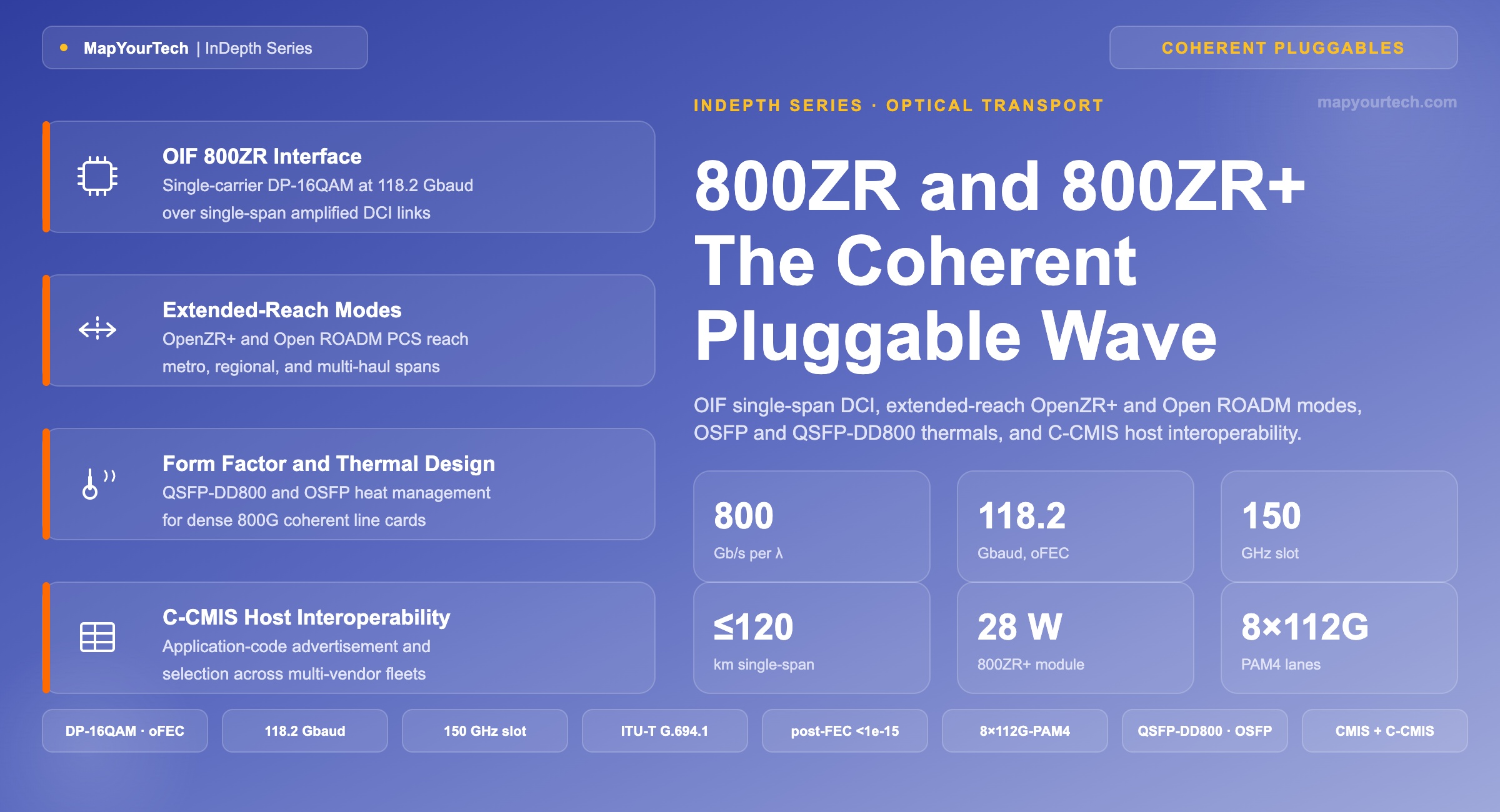
800ZR and 800ZR+: The Coherent Pluggable Wave
The move from 400ZR to 800G coherent pluggables is now a volume deployment. This deep dive works through the OIF 800ZR Implementation Agreement, the extended-reach modes marketed as 800ZR+, QSFP-DD800 and OSFP thermal design, host interoperability through Coherent CMIS application codes, and the change in optical transport economics that follows when an 800G wavelength originates from a router faceplate.
1. Introduction
An 800 Gb/s coherent wavelength that once required a dedicated transponder line card now originates from a pluggable module in a router or switch port. That single change — the same coherent optics and digital signal processing (DSP) that powered dense wavelength division multiplexing (DWDM) transponders, compressed into a faceplate module — defines the 800ZR generation. The Optical Internetworking Forum (OIF) released the 800ZR Implementation Agreement, OIF-800ZR-01.0, on 30 October 2024, specifying an interoperable 800G coherent line interface for single-span, amplified 80–120 km DWDM links aimed at data center interconnect (DCI). Cignal AI forecasts that 800ZR-class pluggables will ship more than 200,000 ports in 2026, and Dell'Oro projects that 800 ZR/ZR+ may account for over one-third of IP-over-DWDM coherent-pluggable revenue in the same year — both analyst figures, and both a direct consequence of AI training clusters spreading across multiple sites.
The demand driver is geographic. AI model training and inference now span buildings and campuses because power and floor space at a single site run out before the compute requirement does. That distribution turns what used to be intra-facility traffic into data center interconnect traffic, and it overruns the capacity a 400ZR fabric was sized for. Hyperscalers, led by Meta, are adopting the extended-reach 800G modes to interconnect distributed sites over IP-over-DWDM, a shift covered in the MapYourTech primer on IP over DWDM architecture. The result is that after 2026, telecom bandwidth growth outside the data center is expected to be dominated by pluggable coherent optics rather than embedded transponders.
This article is written for the engineer who has to specify, deploy, or operate these modules. It resolves the standards picture — what OIF 800ZR fixes, and what the term "800ZR+" actually refers to across the OpenZR+ Multi-Source Agreement (MSA) and the Open ROADM MSA. It derives the line-rate and spectral relationships that set the 118.2 Gbaud symbol rate and the 150 GHz channel width. It addresses the two engineering problems that decide a deployment: thermal management in the QSFP-DD800 and OSFP form factors, and host interoperability through Coherent CMIS (C-CMIS) application codes. It closes on the economic question in the title — how 800G pluggables redistribute revenue in optical transport, and which parts of the supply base gain and which adjust.
Every figure below carries its class in the same sentence: standard-specified (from an OIF, ITU-T, or IEEE document), measured (from a plugfest or field report), vendor claim (from a supplier data sheet), or theoretical limit. A coherent line rate reported without that class reads as marketing, and this generation attracts a great deal of it.
2. Coherent Line-Rate Fundamentals and the ZR Design Philosophy
A coherent interface recovers both the amplitude and the phase of the optical field on two orthogonal polarizations, then applies DSP to undo chromatic dispersion, polarization rotation, and phase noise in the electronic domain. That receiver architecture is what lets a single wavelength carry hundreds of gigabits over amplified fiber without inline dispersion compensation. The generation that matters here is digital coherent optics (DCO): the coherent DSP application-specific integrated circuit (ASIC) sits inside the pluggable module, not on the host line card. The earlier analog coherent optics (ACO) approach kept the DSP on the host and passed a high-speed analog interface across the module boundary, which proved harder to standardize and to route on a host board. DCO won because it presents a clean digital electrical interface to the host and hides the analog complexity inside the module.
The Three Levers of Line Rate
A coherent line rate is set by three quantities: the symbol rate (baud), the modulation order (bits carried per symbol), and the code rate left after forward error correction (FEC) overhead. The 400ZR and 800ZR generations held the modulation order fixed at dual-polarization 16-state quadrature amplitude modulation (DP-16QAM) and let the symbol rate carry almost the entire rate increase. 400ZR runs at 59.8–60.1 Gbaud depending on the FEC variant, a value fixed by the OIF 400ZR Implementation Agreement. 800ZR doubles that to a nominal 118.2 Gbaud, still DP-16QAM, so the per-wavelength rate doubles from 400 to 800 Gb/s. The choice to scale baud rather than modulation order is deliberate: a higher-order constellation such as 64QAM packs more bits per symbol but needs several decibels more optical signal-to-noise ratio (OSNR) to hold the same error rate, which shortens reach. Holding DP-16QAM and raising baud keeps the OSNR requirement close to the 400ZR value while doubling capacity, at the cost of doubling the analog bandwidth the DSP, digital-to-analog converters, and optics must support. The interplay of these levers is developed further in the MapYourTech treatment of spectral efficiency and its four levers.
Read the Full Analysis with Premium
The remaining 88% of this article — the design numbers, trade-offs and field guidance — is part of MapYourTech Premium, along with the full premium library, courses and professional tools.
You May Also Like
-
Premium
-
September 2, 2026
-
Premium
-
September 1, 2026
-
Premium
-
September 1, 2026