- What is a Raman amplifier?
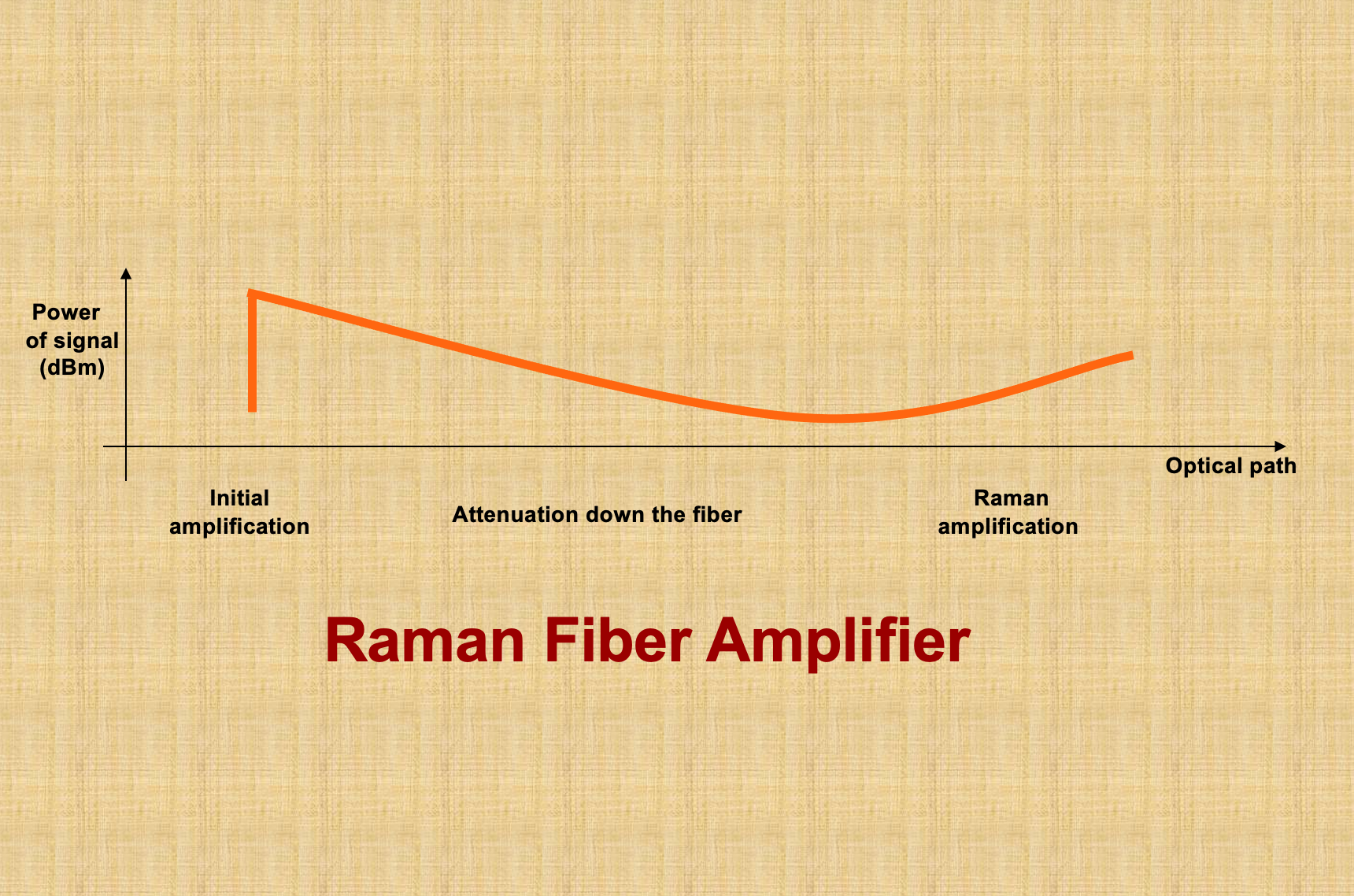
A: A Raman amplifier is a type of optical amplifier that utilizes stimulated Raman scattering (SRS) to amplify optical signals in fiber-optic communication systems.
- How does a Raman amplifier work?
A: Raman amplification occurs when a high-power pump laser interacts with the optical signal in the transmission fiber, causing energy transfer from the pump wavelength to the signal wavelength through stimulated Raman scattering, thus amplifying the signal.
- What is the difference between a Raman amplifier and an erbium-doped fiber amplifier (EDFA)?
A: A Raman amplifier uses stimulated Raman scattering in the transmission fiber for amplification, while an EDFA uses erbium-doped fiber as the gain medium. Raman amplifiers can provide gain over a broader wavelength range and have lower noise compared to EDFAs.
- What are the advantages of Raman amplifiers?
A: Advantages of Raman amplifiers include broader gain bandwidth, lower noise, and better performance in combating nonlinear effects compared to other optical amplifiers, such as EDFAs.
- What is the typical gain bandwidth of a Raman amplifier?
A: The typical gain bandwidth of a Raman amplifier can be up to 100 nm or more, depending on the pump laser configuration and fiber properties.
- What are the key components of a Raman amplifier?
A: Key components of a Raman amplifier include high-power pump lasers, wavelength division multiplexers (WDMs) or couplers, and the transmission fiber itself, which serves as the gain medium.
- How do Raman amplifiers reduce nonlinear effects in optical networks?
A: Raman amplifiers can be configured to provide distributed gain along the transmission fiber, reducing the peak power of the optical signals and thus mitigating nonlinear effects such as self-phase modulation and cross-phase modulation.
- What are the different types of Raman amplifiers?
A: Raman amplifiers can be classified as discrete Raman amplifiers (DRAs) and distributed Raman amplifiers (DRAs). DRAs use a separate section of fiber as the gain medium, while DRAs provide gain directly within the transmission fiber.
- How is a Raman amplifier pump laser configured?
A: Raman amplifier pump lasers can be configured in various ways, such as co-propagating (pump and signal travel in the same direction) or counter-propagating (pump and signal travel in opposite directions) to optimize performance.
- What are the safety concerns related to Raman amplifiers?
A: The high-power pump lasers used in Raman amplifiers can pose safety risks, including damage to optical components and potential harm to technicians if proper safety precautions are not followed.
- Can Raman amplifiers be used in combination with other optical amplifiers?
A: Yes, Raman amplifiers can be used in combination with other optical amplifiers, such as EDFAs, to optimize system performance by leveraging the advantages of each amplifier type.
- How does the choice of fiber type impact Raman amplification?
A: The choice of fiber type can impact Raman amplification efficiency, as different fiber types exhibit varying Raman gain coefficients and effective area, which affect the gain and noise performance.
- What is the Raman gain coefficient?
A: The Raman gain coefficient is a measure of the efficiency of the Raman scattering process in a specific fiber. A higher Raman gain coefficient indicates more efficient energy transfer from the pump laser to the optical signal.
- What factors impact the performance of a Raman amplifier?
A: Factors impacting Raman amplifier performance include pump laser power and wavelength, fiber type and length, signal wavelength, and the presence of other nonlinear effects.
- How does temperature affect Raman amplifier performance?
A: Temperature can affect Raman amplifier performance by influencing the Raman gain coefficient and the efficiency of the stimulated Raman scattering process. Proper temperature management is essential for optimal Raman amplifier performance.
- What is the role of a Raman pump combiner?
A: A Raman pump combiner is a device used to combine the output of multiple high-power pump lasers, providing a single high-power pump source to optimize Raman amplifier performance.
- How does polarization mode dispersion (PMD) impact Raman amplifiers?
A: PMD can affect the performance of Raman amplifiers by causing variations in the gain and noise characteristics for different polarization states, potentially leading to signal degradation.
- How do Raman amplifiers impact optical signal-to-noise ratio (OSNR)?
A: Raman amplifiers can improve the OSNR by providing distributed gain along the transmission fiber and reducing the peak power of the optical signals, which helps to mitigate nonlinear effects and improve signal quality.
- What are the challenges in implementing Raman amplifiers?
A: Challenges in implementing Raman amplifiers include the need for high-power pump lasers, proper safety precautions, temperature management, and potential interactions with other nonlinear effects in the fiber-optic system.
- What is the future of Raman amplifiers in optical networks?
A: The future of Raman amplifiers in optical networks includes further research and development to optimize performance, reduce costs, and integrate Raman amplifiers with other emerging technologies, such as software-defined networking (SDN), to enable more intelligent and adaptive optical networks.

Optical Communications & Network Automation Expert | Author of 3 Books for Optical Engineers | Founder, MapYourTech
Optical networking engineer with nearly two decades of experience across DWDM, OTN, coherent optics, submarine systems, and cloud infrastructure. Founder of MapYourTech. Read full bio →
Follow on LinkedIn