IP over DWDM (IPoDWDM)
Architecture, Implementation, and the Convergence of IP Routing with Optical Transport
Introduction
IP over DWDM, commonly abbreviated as IPoDWDM, represents one of the most significant architectural shifts in telecommunications network design over the past decade. This networking strategy directly integrates IP routing functionality onto Dense Wavelength Division Multiplexing transport networks, eliminating the traditional layered approach that has defined carrier infrastructure for decades. The convergence of these historically separate domains results in a streamlined network architecture that significantly reduces complexity and operating costs while simultaneously enhancing performance and scalability.
The emergence of IPoDWDM has been driven primarily by the explosion of IP traffic and the economic pressure on network operators to reduce both capital expenditure (CAPEX) and operational expenditure (OPEX). Traditional network architectures employed distinct transport layers including SONET/SDH and Optical Transport Network (OTN) equipment between IP routers and the underlying DWDM infrastructure. Each layer required dedicated hardware, management systems, and specialized operational teams. IPoDWDM fundamentally challenges this paradigm by enabling IP routers to interface directly with DWDM wavelengths through coherent pluggable optics, bypassing intermediate transport equipment entirely.
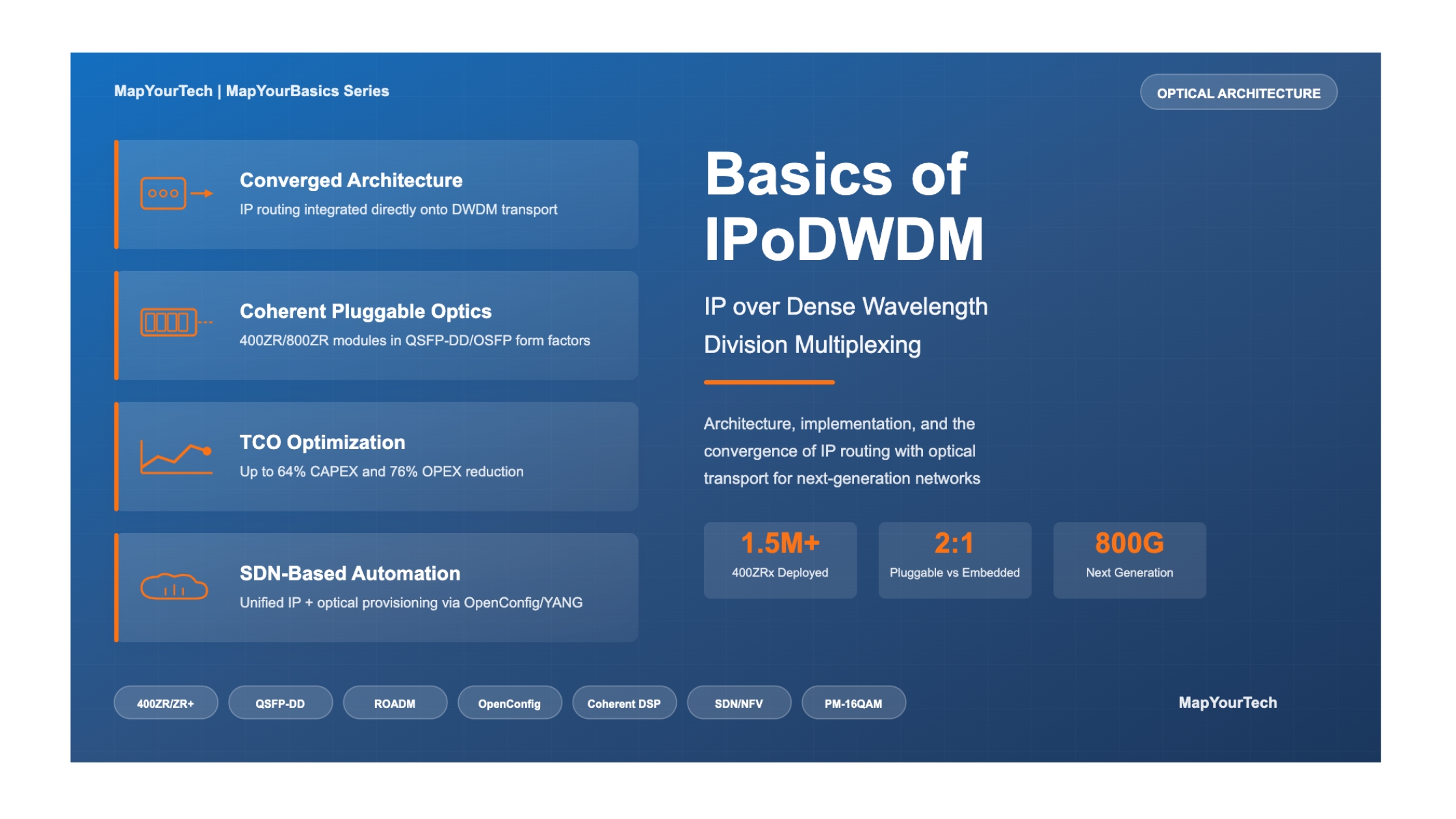
Strategic Importance: IPoDWDM is not merely a technical evolution but a strategic imperative for the telecommunications industry. Early adopters have reported up to 64% reduction in CAPEX and 76% decrease in OPEX, making it one of the most impactful architectural transformations available to network operators.
Background and Historical Context
The Traditional Multi-Layer Architecture
Legacy telecommunications networks evolved as a hierarchical stack of distinct technology layers, each optimized for specific functions. At the bottom, the DWDM layer provided raw optical transport capacity by multiplexing multiple wavelengths onto a single fiber pair. Above this, OTN equipment delivered digital wrapper functionality including forward error correction (FEC), performance monitoring, and protection switching. SONET/SDH cross-connects provided time-division multiplexing and grooming capabilities. Finally, IP/MPLS routers handled packet forwarding and traffic engineering at the top of the stack.
This layered approach offered clear demarcation points between technology domains, simplified fault isolation, and allowed independent optimization of each layer. However, it also introduced significant inefficiencies. Each layer required optical-electrical-optical (OEO) conversions at every node, consuming power and introducing latency. Equipment from different layers typically came from different vendors with incompatible management systems, creating operational silos. The cost of maintaining separate inventory, training specialized staff, and coordinating across domains represented a substantial portion of total network operating expenses.
Evolution of Coherent Optics
The technological foundation for IPoDWDM was established through the maturation of coherent optical transmission technology. Unlike earlier intensity-modulated direct-detection (IM-DD) systems, coherent receivers can extract both amplitude and phase information from the optical signal by mixing it with a local oscillator laser. This capability enables advanced modulation formats such as PM-QPSK and PM-16QAM, dramatically increasing spectral efficiency. More importantly, coherent receivers paired with sophisticated digital signal processing (DSP) can compensate for transmission impairments including chromatic dispersion and polarization mode dispersion in the electrical domain, eliminating the need for optical dispersion compensation modules.
The integration of all these functions into a single application-specific integrated circuit (ASIC) created coherent DSP chips that could be packaged into compact form factors. By approximately 2015, hyperscale cloud providers recognized that coherent technology had matured sufficiently to enable a new operational model. They drove the development and standardization of the 400ZR specification through the Optical Internetworking Forum (OIF), aiming to create an interoperable coherent pluggable module suitable for data center interconnect applications.
System Architecture
Core Architectural Principles
IPoDWDM architecture eliminates intermediate transport layers by hosting DWDM coherent optics directly within IP router line cards. In this model, a router's line card contains QSFP-DD or OSFP pluggable modules that generate coherent optical signals at ITU-T grid wavelengths. These signals interface directly with DWDM line systems consisting of optical amplifiers, wavelength-selective switches, and reconfigurable optical add-drop multiplexers (ROADMs). The router's control plane extends to encompass optical parameters, enabling integrated provisioning and monitoring across both domains.
Figure 1: Comparison of traditional multi-layer architecture versus converged IPoDWDM architecture
Pluggable Coherent Optics
The enabling technology for IPoDWDM is the coherent pluggable transceiver, available in form factors including QSFP-DD and OSFP. The 400ZR standard, ratified by the OIF in 2020, defines a 400 Gbps coherent interface using DP-16QAM modulation at approximately 60 GBaud. The specification targets data center interconnect applications with reaches up to 120 km over amplified links. Subsequent developments including 400ZR+ variants extend reach through enhanced FEC and proprietary DSP modes, enabling deployment in ROADM-based networks.
Since volume shipments began in 2021, more than 1.5 million 400ZRx optics have been deployed globally. This represents the fastest ramp of any coherent generation in optical transport history. The volumes are astronomical by historical standards of the optical transport hardware industry, and excluding the unique Chinese market which uses large form-factor DWDM modules, pluggable DWDM optics now out-ship embedded optics by more than 2-to-1.
| Parameter | 400ZR | 400ZR+ | 800ZR | 800ZR+ |
|---|---|---|---|---|
| Line Rate | 400 Gbps | 400 Gbps | 800 Gbps | 800 Gbps |
| Modulation | DP-16QAM | DP-16QAM/8QAM | DP-16QAM | DP-16QAM/8QAM/QPSK |
| Baud Rate | ~60 GBaud | ~60 GBaud | ~90-100 GBaud | ~90-100 GBaud |
| Output Power | -10 dBm | 0 dBm to +4 dBm | -10 dBm | 0 dBm to +3 dBm |
| Typical Reach | Up to 120 km | Up to 1,000 km | Up to 80 km | Up to 1,000 km |
| Form Factor | QSFP-DD, OSFP | QSFP-DD, OSFP | QSFP-DD800, OSFP | QSFP-DD800, OSFP |
| Power Consumption | 15-18W | 18-22W | 20-25W | 25-30W |
Integration with ROADM Networks
Modern IPoDWDM deployments leverage colorless, directionless, and contentionless (CDC) ROADM architectures that provide maximum flexibility in wavelength assignment and routing. CDC ROADMs enable any wavelength to be added or dropped at any port, routed in any direction, and multiple instances of the same wavelength can coexist at a node without contention. This flexibility is essential for IPoDWDM because router-hosted coherent optics must be able to integrate seamlessly into the existing optical infrastructure without wavelength planning constraints.
The integration of IPoDWDM with ROADM networks requires careful consideration of optical power levels and OSNR management. High output power variants of 400ZR (0 dBm and above) are necessary for traversing multiple ROADM nodes, as each wavelength-selective switch (WSS) introduces 5-7 dB of insertion loss. Network operators must ensure adequate OSNR margin across the end-to-end path, accounting for amplifier noise accumulation and filtering effects from cascaded WSS elements.
Operational Workflow
Provisioning and Activation
IPoDWDM fundamentally changes the provisioning workflow compared to traditional architectures. In legacy networks, activating a new wavelength service required coordinating between separate IP and optical operations teams, often using different management systems and ticketing processes. Provisioning times could extend to weeks as optical engineers configured transponders, verified link budgets, and performed acceptance testing before handing off to the IP team for router configuration.
With IPoDWDM, the entire provisioning process can be consolidated under unified SDN control. Modern implementations leverage protocols such as NETCONF with YANG data models and OpenConfig to provide programmatic access to both router and optical layer parameters. An orchestration system can configure the coherent pluggable module's wavelength, modulation format, and power level while simultaneously programming the ROADM path and configuring IP-layer parameters such as IGP metrics and MPLS label switched paths. This integrated approach dramatically improves operational efficiency and accelerates service delivery, potentially reducing provisioning times from weeks to mere minutes.
Figure 2: SDN-based provisioning workflow for IPoDWDM service activation
Monitoring and Performance Management
IPoDWDM enables integrated performance monitoring that spans both IP and optical layers. Coherent DSP chips continuously measure physical layer parameters including pre-FEC bit error rate, OSNR, chromatic dispersion, polarization mode dispersion, and nonlinear phase noise. These metrics stream via standard telemetry interfaces to centralized analytics platforms alongside traditional IP performance data such as packet loss, latency, and jitter. Correlation of optical and IP layer metrics provides unprecedented visibility into network behavior and enables proactive identification of degrading conditions before they impact services.
OSNR (dB) = 10 × log₁₀(Psignal / Pnoise)
G-OSNR = OSNR accounting for all noise sources (amplifiers, ROADMs, nonlinearities)
Pre-FEC BER threshold: typically < 4×10⁻² for modern SD-FEC
Post-FEC BER target: < 10⁻¹⁵ (error-free operation)
Protection and Restoration
Network protection in IPoDWDM environments typically leverages IP-layer mechanisms rather than optical layer protection switching. Fast reroute using MPLS traffic engineering or segment routing provides sub-50 ms restoration by pre-computing backup paths and maintaining forwarding state in advance. This approach offers several advantages: protection resources are shared more efficiently across multiple potential failures, restoration paths can be optimized based on current network state, and there is no need for dedicated protection wavelengths consuming optical spectrum.
For scenarios requiring optical-layer protection, IPoDWDM can integrate with ROADM-based protection switching. However, coordination between layers is essential to prevent both IP and optical protection mechanisms from activating simultaneously, which could lead to traffic oscillation. Properly designed hierarchical protection schemes use optical-layer restoration for fiber cuts and major failures while IP-layer mechanisms handle router or link failures within the protected optical span.
Challenges and Limitations
Operational Complexity
While IPoDWDM simplifies network architecture from a hardware perspective, it introduces new operational complexities. Traditional organizational structures separate IP network operations from optical transport operations, with each team possessing specialized skills and using distinct management systems. Converging these domains requires significant organizational change, cross-training of personnel, and integration of historically separate operational support systems. The challenge of "alien wavelengths," where independent IP and optical management systems hinder comprehensive end-to-end network control, vividly illustrates that without a unified understanding and management approach across both layers, the full benefits of physical convergence cannot be realized.
Reach and Performance Trade-offs
Router-hosted coherent pluggables face inherent constraints compared to purpose-built optical transport equipment. Power dissipation limits within router line cards constrain the sophistication of DSP algorithms and the output power of optical amplifiers. While 400ZR+ modules with 0 dBm output power can traverse multiple ROADM nodes, ultra-long-haul applications requiring transmission distances beyond approximately 1,500 km may still require dedicated optical transport equipment with higher performance DSPs, distributed Raman amplification, or coherent transponders optimized for maximum reach.
Form Factor and Thermal Constraints
The thermal management requirements of high-performance coherent optics present practical challenges in router environments. An 800ZR module may consume 25-30W, and a fully populated line card could dissipate several hundred watts. Router chassis must be designed with adequate airflow and cooling capacity to support these modules reliably. Hyperscalers have universally chosen the OSFP form factor for 800G deployments due to its superior thermal management capabilities compared to QSFP-DD. Service provider routers, however, have largely standardized on QSFP-DD, creating potential interoperability considerations.
Lack of OTN Functionality
IPoDWDM implementations using standard ZR/ZR+ modules do not provide OTN overhead capabilities. This means loss of certain features that service providers have relied upon, including tandem connection monitoring for multi-carrier links, generic communication channels for management traffic, and client signal adaptation with timing transparency. For applications requiring these capabilities, operators may deploy pluggable transponders that add OTN wrapper functionality while still leveraging the cost benefits of standardized coherent pluggables.
| Challenge | Impact | Mitigation Strategy |
|---|---|---|
| Organizational silos | Slow adoption, coordination issues | Cross-functional teams, unified training |
| Management system integration | Incomplete visibility, manual processes | SDN controllers, OpenConfig adoption |
| Reach limitations | Cannot address ULH applications | Hybrid architecture with optical transport for ULH |
| Thermal constraints | Density limitations, reliability concerns | OSFP form factor, enhanced cooling |
| Missing OTN features | Reduced monitoring, no TCM | Pluggable transponders with OTN wrapper |
Practical Considerations
Deployment Scenarios
IPoDWDM adoption varies significantly across market segments. Hyperscale cloud providers have been the primary drivers, deploying massive quantities of 400ZR optics in data center interconnect applications. For these operators, the operational simplicity and cost savings of IPoDWDM align perfectly with their cloud-native operational models. In 2024 alone, IP-over-DWDM represented a shift of $2.5 billion out of traditional optical transport and created a new market of $1.4 billion for router-hosted DWDM optics.
Service providers have adopted IPoDWDM more cautiously, primarily due to operational challenges and the need for additional functionality such as Layer 1 aggregation, demarcation, and protection that transponders traditionally provide. However, adoption is accelerating as carriers upgrade their routing infrastructure from 100G to 400G interfaces and recognize total cost of ownership benefits. Pluggable transponders provide a middle ground, enabling carriers to reap the benefits of standardized pluggables including significant space and power savings compared to embedded transponders while maintaining familiar operational practices.
Host Interoperability
The standardization of coherent pluggable interfaces through the OIF creates the potential for multi-vendor interoperability at the optics level. The Coherent Common Management Interface Specification (C-CMIS) standardizes how hosts and coherent pluggable modules communicate for management and control. The latest version introduces AppSel codes that enable "any plug in any host" operation by letting coherent pluggables advertise a table of supported modes including proprietary ones. This capability could significantly shift revenue streams in the optical transport market, as coherent interfaces account for two-thirds or more of total optical revenue.
Figure 3: IPoDWDM deployment options showing direct router-hosted optics and pluggable transponder alternatives
Cost Analysis
The economic benefits of IPoDWDM derive from multiple sources. Elimination of OTN transponder equipment removes significant hardware cost, as traditional muxponders represent a substantial portion of optical network CAPEX. Reduction in rack space and power consumption provides ongoing OPEX savings, particularly in facilities where power and cooling capacity are constrained. Simplified operations through unified management reduces labor costs and accelerates time to revenue for new services.
However, IPoDWDM is not without additional costs. The most commonly used client optic, 400GBASE-DR4, costs approximately $250-300 in volume, representing an additional 20% on top of a 400ZR+ optic when two client optics are needed. The cost of the host line card or sled is amortized across many interfaces but adds several thousand dollars. All-in, a pluggable transponder solution adds roughly 25-50% additional cost compared to a pure IP-over-DWDM solution, plus modest additional power and space consumption.
Future Evolution: 800G and Beyond
The transition to 800G coherent pluggables is well underway, with hyperscalers ready to deploy massive quantities of 800ZR/ZR+ optics. Service providers will continue their steady adoption using 400G optics as they upgrade routing infrastructure from 100G to 400G, but 800G-capable routers will take years to proliferate. In the interim, carriers can take advantage of 800ZR+ optics within pluggable transponders, achieving 800G regional to 400G ultra-long-haul distances at reduced power and cost per bit compared to embedded solutions.
Looking further ahead, 1600ZR development is targeting the OSFP form factor, which will precede development of high-performance modules at similar baud rates. There is significant overlap between Gen120P embedded interfaces and the latest Gen120C pluggables, which may lead vendors to scrutinize the return on investment of developing separate DSP implementations. A likely outcome is that a single DSP architecture finds use across multiple form factors, further accelerating the convergence of pluggable and embedded coherent technologies.
Key Principles of IPoDWDM Implementation
- Architecture Simplification: Eliminate intermediate transport layers to reduce equipment count, power consumption, and operational complexity while maintaining service quality
- Unified Operations: Converge IP and optical management under SDN control using standard protocols (NETCONF/YANG, OpenConfig) to enable automated provisioning and integrated monitoring
- Performance Optimization: Select appropriate pluggable variants (ZR vs ZR+) based on reach requirements and ROADM compatibility; use high output power modules for multi-node paths
- Hybrid Deployment: Maintain purpose-built optical transport for ultra-long-haul applications while deploying IPoDWDM for metro and regional connectivity
- Organizational Alignment: Address operational silos through cross-training and integrated teams to fully realize convergence benefits
- Economic Analysis: Evaluate total cost of ownership including hardware, power, space, and operational factors rather than component cost alone
Conclusion
IP over DWDM represents a fundamental transformation in telecommunications network architecture, driven by the maturation of coherent pluggable technology and the economic imperative to reduce network costs. By eliminating intermediate transport layers and integrating optical connectivity directly into IP routers, IPoDWDM delivers substantial reductions in both capital and operational expenditure while simplifying network operations and accelerating service delivery.
The technology has achieved remarkable market success, with more than 1.5 million 400ZRx optics deployed and pluggable coherent modules now outselling embedded optics in most market segments. Hyperscale cloud providers have led adoption, but service providers are increasingly deploying IPoDWDM as they upgrade network infrastructure and recognize total cost of ownership benefits. Pluggable transponders provide a transition path for operators requiring OTN functionality or preferring traditional operational models while still benefiting from standardized coherent pluggables.
As the industry transitions to 800G and beyond, IPoDWDM will continue to evolve. The convergence of IP and optical layers is not just a technical evolution but a strategic imperative, requiring network operators to develop integrated expertise spanning both domains. Engineers who possess this multi-layer knowledge will be uniquely positioned to design, implement, and optimize these converged networks, becoming critical enablers for the next generation of telecommunications infrastructure.
References
- ITU-T Recommendation G.709/Y.1331 – Interfaces for the optical transport network, 2020.
- OIF-400ZR-01.0 – 400ZR Implementation Agreement, Optical Internetworking Forum, 2020.
- OIF C-CMIS – Coherent Common Management Interface Specification, Optical Internetworking Forum, 2023.
- IEEE 802.3bs – 200 Gb/s and 400 Gb/s Ethernet Standard, 2017.
- OpenConfig Optical Transport Models – openconfig.net/projects/optical/
- Sanjay Yadav, "Optical Network Communications: An Engineer's Perspective" – Bridge the Gap Between Theory and Practice in Optical Networking.
- J. Zyskind and A. Srivastava, "Optically Amplified WDM Networks," Elsevier, 2011.

Optical Communications & Network Automation Expert | Author of 3 Books for Optical Engineers | Founder, MapYourTech
Optical networking engineer with nearly two decades of experience across DWDM, OTN, coherent optics, submarine systems, and cloud infrastructure. Founder of MapYourTech. Read full bio →
Follow on LinkedInRelated Articles on MapYourTech




Continue Reading This Article
Sign in with a free account to unlock the full article and access the complete MapYourTech knowledge base.