
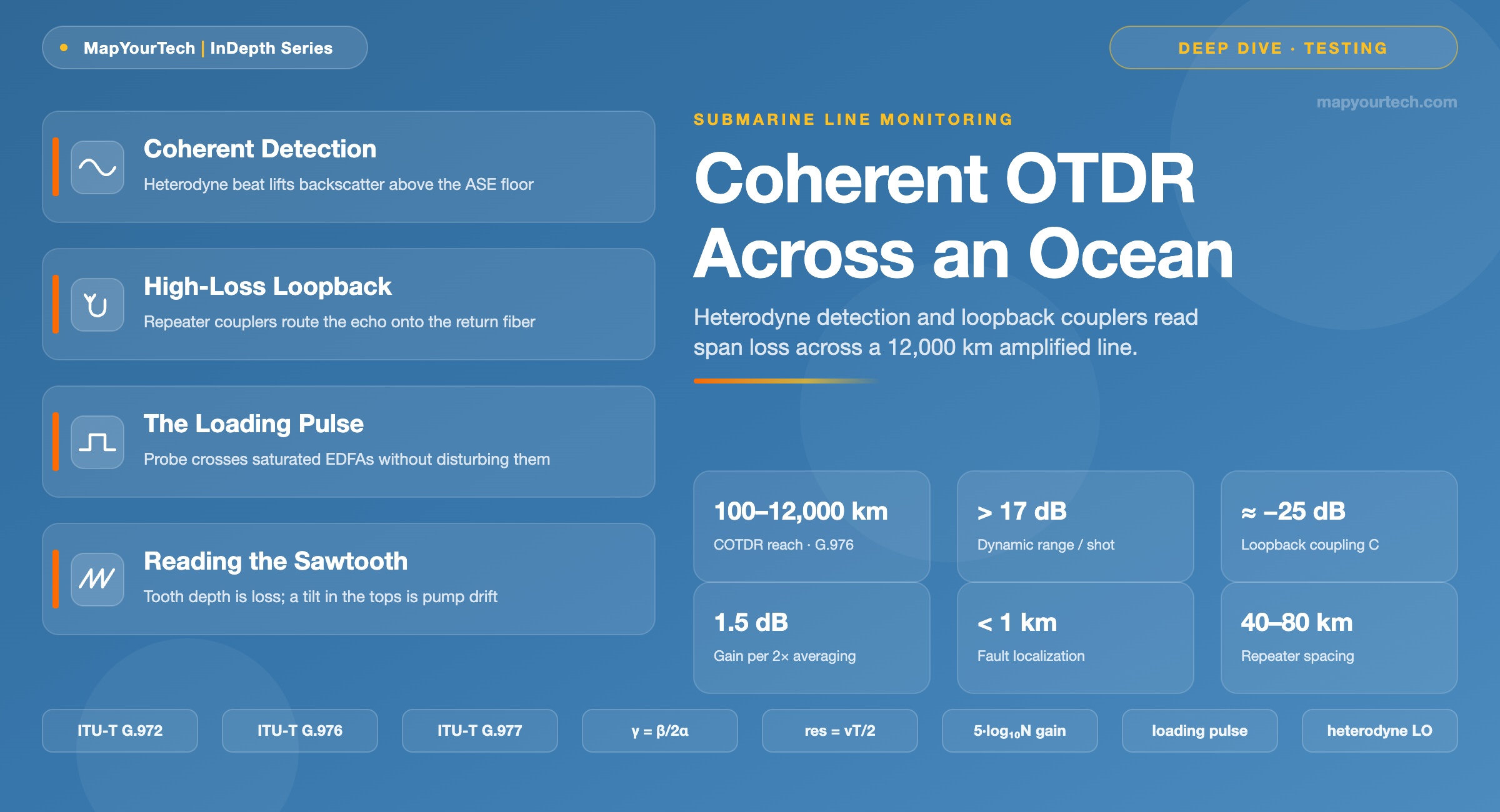
Coherent OTDR (COTDR): Seeing Backscatter Across an Ocean
A standard OTDR dies at the first repeater. Coherent detection, a high-loss loopback in every repeater, and a few million coherent averages turn that dead end into a span-by-span attenuation map of a 12,000 km amplified line — live, without touching traffic. Here is the physics, the architecture, and how to read the trace.
1. Introduction: the reach wall
A field OTDR fired into a transoceanic cable produces a bright reflection at the first connector, a short slope of fiber, and then nothing. The trace flatlines into the noise floor somewhere before 200 km, and every one of the eighty-plus repeaters between that point and the far shore is invisible. The instrument is not broken. It has run out of the one thing an OTDR lives on: enough returning Rayleigh backscatter to sit above its receiver noise, across a chain that deliberately blocks light from travelling backward.
Coherent Optical Time Domain Reflectometry — COTDR, sometimes written C-OTDR — is the answer submarine engineering settled on. ITU-T G.972 defines it plainly: COTDR has the same features as OTDR but uses coherent detection instead of direct detection, which gives it higher sensitivity and higher frequency selectivity (standard-specified, ITU-T G.972). That single substitution — mixing the faint return against a strong local oscillator before it hits the photodiode — buys tens of decibels of effective sensitivity. Paired with a high-loss loopback path built into every repeater and a few million coherent averages, it turns the flatline into a span-by-span attenuation map of a line that ITU-T G.976 rates for a distance range of 100 to 12,000 km (standard-specified, ITU-T G.976 Table III.1).
This article works from the physics outward. It starts with what an ordinary OTDR measures and why that measurement collapses on an amplified line, then builds the coherent receiver, the loopback return path, and the loading-pulse trick that lets a probe survive dozens of erbium-doped amplifiers. It shows how to read the sawtooth trace COTDR produces, how the averaging budget trades measurement time against reach, where the technique sits in the ITU-T monitoring framework, and how the same loopback hardware is now being pushed into distributed environmental sensing. For the fundamentals of the base instrument, the complete guide to optical time domain reflectometry is the companion piece; this one is about what changes when the fiber under test is an ocean long and amplified end to end.
COTDR is not a bigger OTDR. It replaces direct detection with coherent (heterodyne) detection and adds a repeater loopback so backscatter can return at all — two changes that together extend usable reach from a couple of hundred kilometres to transoceanic distances.
2. OTDR fundamentals refresher
An OTDR launches a rectangular optical pulse of duration T into the fiber and records returning power against time. Treat the fiber as a chain of short sections, each of length δ = vT/2, where v is the group velocity in glass (about 2 × 10⁸ m/s, measured). Each section acts as a weak distributed mirror. Launch a pulse at t = 0 and the power arriving back at t = 2x/v came from the section a distance x down the fiber, attenuated by the round trip. Because the correspondence between time and distance is fixed by the velocity, the time axis is a distance axis.
The fraction that returns is set by Rayleigh scattering — light scattered off refractive-index fluctuations frozen into the glass, a small part of which is recaptured within the fiber's numerical aperture and guided backward. The local Rayleigh backscatter coefficient β is roughly 10−7 m−1 for standard single-mode fiber (measured, corroborated across the sensing literature). The captured backscatter grows with pulse width because a longer pulse illuminates more fiber at once:
That last clause is the OTDR's defining compromise. Two-point spatial resolution equals the physical length of the pulse in the fiber:
Read the Full Analysis with Premium
The remaining 89% of this article — the design numbers, trade-offs and field guidance — is part of MapYourTech Premium, along with the full premium library, courses and professional tools.
You May Also Like
-
Free
-
August 22, 2026

-
Premium
-
August 22, 2026
-
Premium
-
August 22, 2026