
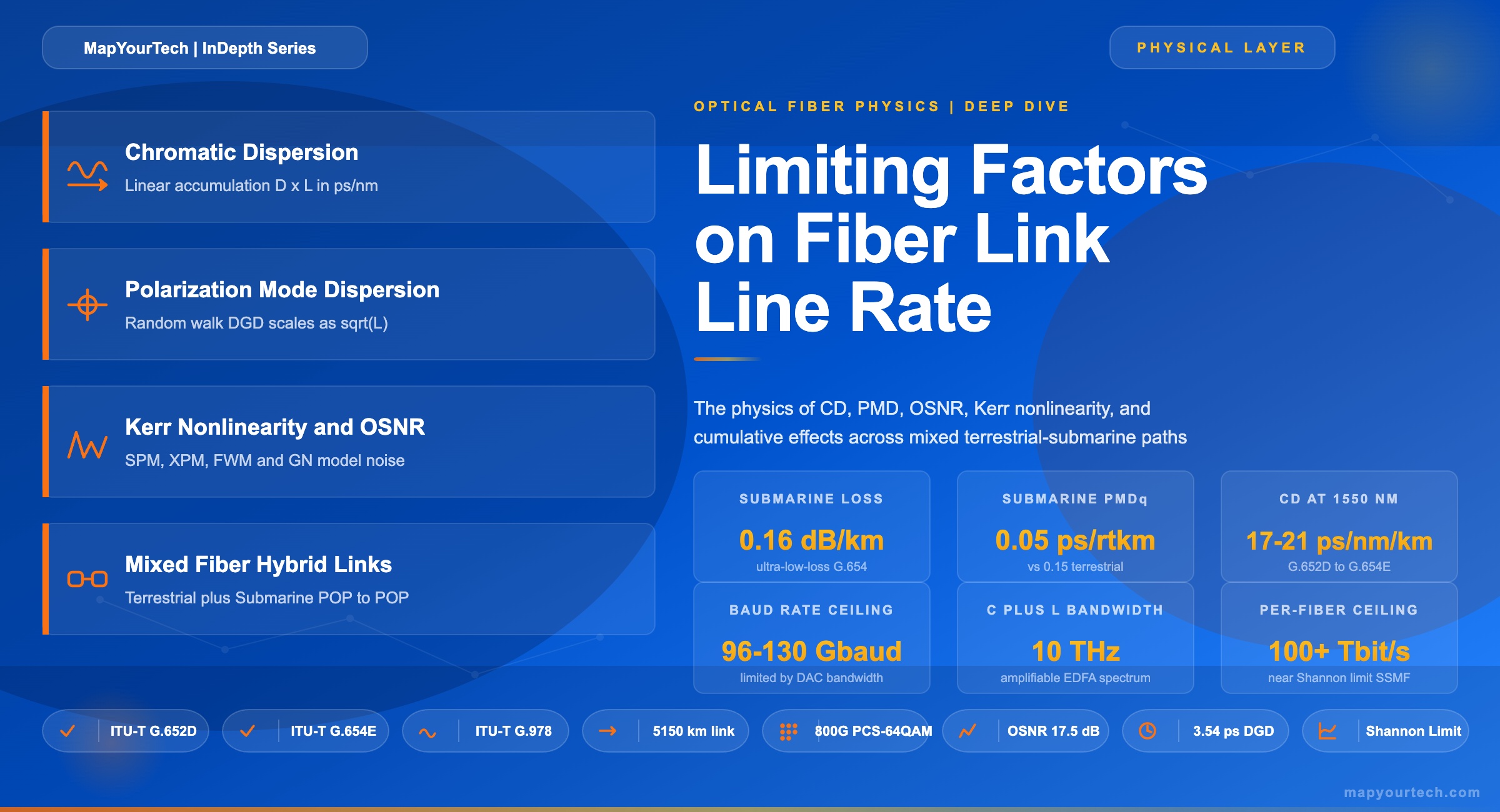
Limiting Factors on Fiber Link Line Rate: Physics Behind Channel Capacity Scaling
A research-grade analysis of the physical factors that cap how fast a single wavelength channel can run over optical fiber. This work examines attenuation and span loss, chromatic dispersion and its cumulative behavior, polarization mode dispersion and its square-root scaling, OSNR accumulation across amplifier chains, Kerr nonlinearities, scattering effects, baud rate and spectral width constraints, and the Shannon capacity limit that bounds everything.
1. Introduction
Scaling the line rate of a single wavelength channel on an optical fiber is a problem of competing physical limits. Every factor that lets a transmitter push more bits per second into the fiber also tightens some other constraint. Doubling the symbol rate halves the symbol period, which doubles the spectral width, which exposes the signal to more chromatic dispersion, which makes the receiver more sensitive to phase noise, which forces either more power (raising nonlinear penalties) or more sophisticated coding (raising complexity and latency). The modern optical engineer does not design against one limit. They design against a web of limits that pull in different directions.
This article examines the physical factors that bound channel line rate on optical fiber links, and it explains why each factor behaves the way it does. We cover linear impairments (attenuation, chromatic dispersion, polarization mode dispersion, polarization dependent loss), nonlinear impairments (Kerr effects, stimulated Raman scattering, stimulated Brillouin scattering, guided acoustic wave Brillouin scattering), receiver-side constraints (OSNR requirements, laser linewidth, equalization enhanced phase noise), and the theoretical ceiling set by the Shannon capacity formula and its nonlinear extension through the GN model.
Our target audience is the senior optical engineer designing or evaluating a transmission system: the person who needs to know not just that chromatic dispersion accumulates linearly with length but also why a coherent receiver can tolerate 50,000 ps/nm of accumulated CD while a direct detection receiver breaks at 1,000 ps/nm; the person who needs to know not just that PMD scales with the square root of length but also why the statistical Maxwellian distribution of differential group delay matters more than the mean value; the person who needs to know not just that higher baud rates give more capacity but also why a 130 Gbaud channel in 2026 cannot simply be scaled to 260 Gbaud without running into analog bandwidth limits in the digital-to-analog converter.
The line rate of a single channel in modern commercial systems has grown from 2.5 Gbit/s in the 1990s through 10 Gbit/s in the 2000s to 100 Gbit/s in the 2010s and now 800 Gbit/s to 1.2 Tbit/s on a single wavelength as of 2026. This growth did not come from one invention. It came from coherent detection enabling phase modulation, from polarization multiplexing doubling capacity, from higher-order QAM encoding more bits per symbol, from higher baud rates filling more spectrum per channel, from advanced forward error correction shaving the required OSNR, and from digital signal processing compensating for impairments in the electrical domain instead of the optical domain.
Each of these gains has a ceiling. The coherent detection ceiling is set by laser linewidth and OSNR. The polarization multiplexing ceiling is set by polarization dependent loss and PMD. The higher-order QAM ceiling is set by OSNR, which in turn is set by the amplifier noise figure and span loss. The baud rate ceiling is set by the analog bandwidth of the electronics, now pushing past 130 GHz at the component level in 2026. The FEC ceiling is set by Shannon, who told us in 1948 that for any channel with a given signal-to-noise ratio, there exists a maximum error-free data rate, and you cannot exceed it no matter how clever you are.
We will walk through each of these limits, show the physics that makes them what they are, provide the mathematical models that engineers use to predict them, and end with the design trade-offs that turn these abstract limits into concrete engineering choices. The goal is not to produce a textbook. The goal is to produce a reference that a working engineer can consult when they need to understand why a specific channel does not close over a specific link and what the lever arms are for making it close.
Key idea: Line rate scaling is a constrained optimization problem. The constraints are physical (dispersion, noise, nonlinearity, bandwidth), statistical (random birefringence, polarization state drift), and economic (cost per bit, power per gigabit). No single lever exists. The engineer who understands all the levers and how they couple is the one who closes the hardest links.
2. Historical Evolution of Line Rate Scaling
The history of optical transmission rate scaling is the history of moving impairments around. Early systems were limited by fiber attenuation, so engineers built longer reach by reducing loss from 20 dB/km in the 1970s to the 0.18 dB/km typical of modern G.654 submarine fibers. Once loss was manageable, systems became limited by dispersion, so engineers developed dispersion shifted fiber in the 1980s and in-line dispersion compensating fiber in the 1990s. Once dispersion was manageable, systems became limited by nonlinearities, so engineers developed large effective area fibers to reduce power density. Once nonlinearities were manageable at 10 Gbit/s per channel, the bit rate increase to 40 Gbit/s exposed PMD as a new dominant impairment, which drove the development of low-PMD fibers and eventually pushed the industry toward coherent detection.
The transition to coherent detection around 2010 changed everything. Before coherent, engineers fought chromatic dispersion by canceling it with dispersion compensating fiber in the optical domain. After coherent, they fought it by letting it accumulate freely along the line and compensating it in digital signal processing at the receiver. This freed the optical design to use high-dispersion fiber that suppresses nonlinearities through phase decorrelation between channels. It also freed the per-channel capacity to scale with modulation order (QPSK to 16QAM to 64QAM) and with polarization multiplexing, because the coherent receiver has access to both amplitude and phase of both polarizations.
The ratio of spectral efficiency to per-wavelength bit rate matters. A 2.5 Gbit/s NRZ channel in 1995 used roughly 5 GHz of optical spectrum, a spectral efficiency of 0.5 bit/s/Hz. A 100 Gbit/s DP-QPSK channel in 2013 used 37.5 GHz at 32 Gbaud, a spectral efficiency of 2.67 bit/s/Hz. An 800 Gbit/s DP-64QAM channel in 2023 used about 100 GHz at 96 Gbaud, spectral efficiency approximately 8 bit/s/Hz. The 2026 1.2 Tbit/s class channels operate near 130-140 Gbaud with probabilistic constellation shaping on 64QAM or 256QAM constellations, squeezing efficiencies above 10 bit/s/Hz in short reach scenarios. Each jump in spectral efficiency required a higher OSNR, which is precisely the connection between modulation format and all the physical limits we describe below.
The key insight from this history is that most dramatic rate jumps came not from pushing one impairment harder but from restructuring the problem. Coherent detection did not make chromatic dispersion disappear; it moved the compensation from optics to electronics, where Moore's law did the heavy lifting. Polarization multiplexing did not reduce PMD; it made PMD a thing the receiver could measure and invert. Probabilistic constellation shaping did not break Shannon's law; it distributed symbol energy closer to the Gaussian capacity-achieving distribution. The next doubling will not come from one invention. It will come from reshaping the problem again.
Read the Full Analysis with Premium
The remaining 88% of this article — the design numbers, trade-offs and field guidance — is part of MapYourTech Premium, along with the full premium library, courses and professional tools.
You May Also Like

-
Free
-
August 22, 2026

-
Premium
-
August 22, 2026
-
Premium
-
August 22, 2026