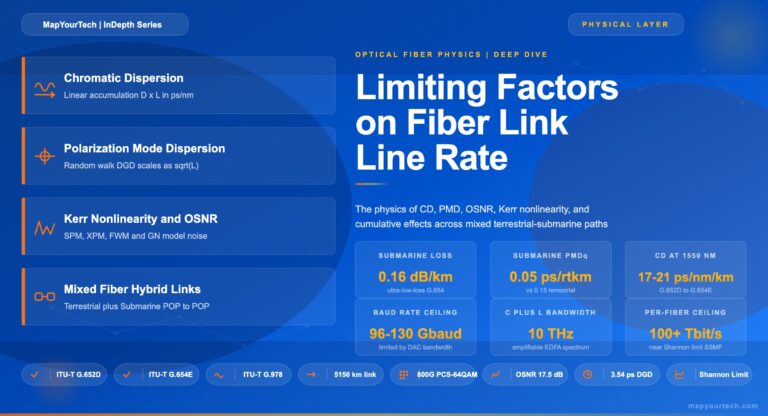
Four-Wave Mixing (FWM) is a nonlinear optical phenomenon that occurs when multiple wavelengths of light are transmitted through a fiber simultaneously. FWM is a third-order nonlinear effect, and it results in the generation of new wavelengths (or frequencies) through the interaction of the original light waves. It is one of the most important nonlinear effects in Wavelength Division Multiplexing (WDM) systems, where multiple wavelength channels are used to increase the system capacity.
Physics behind FWM
FWM occurs when three optical waves, at frequencies 1, 2 and 3, interact in the fiber to produce a fourth wave at a frequency 4, which is generated by the nonlinear interaction between the original waves. The frequency of the new wave is given by:
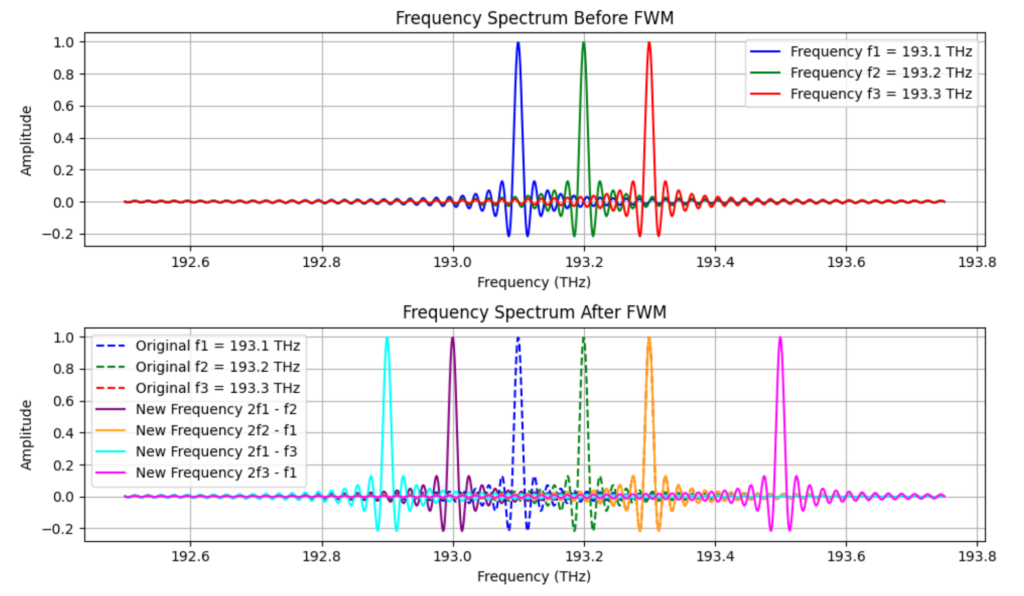 This process is often referred to as third-order intermodulation, where new frequencies are created due to the mixing of the input signals. For FWM to be efficient, the interacting waves must satisfy certain phase-matching conditions, which depend on the chromatic dispersion and the effective refractive index of the fiber.
Mathematical Expression
The general formula for FWM efficiency can be expressed as:
Where:
- FWM is the power of the generated FWM signal.
- 1, 2, 3 are the powers of the interacting signals.
- is the FWM efficiency factor which depends on the fiber’s chromatic dispersion, the effective area, and the nonlinear refractive index.
The efficiency of FWM is highly dependent on the phase-matching condition, which is affected by the chromatic dispersion of the fiber. If the fiber has zero or low dispersion, FWM becomes more efficient, and more power is transferred to the new wavelengths. Conversely, in fibers with higher dispersion, FWM is less efficient.
Impact of FWM in WDM Systems
FWM has a significant impact in WDM systems, particularly when the channel spacing between the wavelengths is narrow. The main effects of FWM include:
- Crosstalk:
-
-
-
-
- FWM generates new frequencies that can interfere with the original WDM channels, leading to crosstalk between channels. This crosstalk can degrade the signal quality, especially when the system operates with high power and closely spaced channels.
-
-
-
-
- Spectral Efficiency:
-
-
-
-
- FWM can limit the spectral efficiency of the system by introducing unwanted signals in the spectrum. This imposes a practical limit on how closely spaced the WDM channels can be, as reducing the channel spacing increases the likelihood of FWM.
-
-
-
-
- Performance Degradation:
-
-
-
-
- The new frequencies generated by FWM can overlap with the original signal channels, leading to increased bit error rates (BER) and reduced signal-to-noise ratios (SNR). This is particularly problematic in long-haul optical systems, where FWM accumulates over long distances.
-
-
-
-
FWM and Chromatic Dispersion
Chromatic dispersion plays a critical role in the occurrence of FWM. Dispersion-managed fibers can be designed to control the effects of FWM by increasing the phase mismatch between the interacting waves, thereby reducing FWM efficiency. In contrast, fibers with zero-dispersion wavelengths can significantly enhance FWM, as the phase-matching condition is more easily satisfied.
In practical systems, fibers with non-zero dispersion-shifted fibers (NZDSF) are often used to reduce the impact of FWM. NZDSF fibers have a dispersion profile that is designed to keep the system out of the zero-dispersion regime while minimizing the dispersion penalty.
Mitigation Techniques for FWM
Several techniques can be employed to mitigate the effects of FWM in optical communication systems:
- Increase Channel Spacing:By increasing the channel spacing between WDM signals, the interaction between channels is reduced, thereby minimizing FWM. However, this reduces the overall capacity of the system.
- Optimize Power Levels:Reducing the launch power of the optical signals can lower the nonlinear interaction and reduce the efficiency of FWM. However, this must be balanced with maintaining sufficient optical power to achieve the desired signal-to-noise ratio (SNR).
- Use Dispersion-Managed Fibers: As mentioned above, fibers with optimized dispersion profiles can be used to reduce the efficiency of FWM by increasing the phase mismatch between interacting wavelengths.
- Employ Advanced Modulation Formats:Modulation formats that are less sensitive to phase distortions, such as differential phase-shift keying (DPSK), can help reduce the impact of FWM on signal quality.
- Optical Phase Conjugation:Optical phase conjugation can be used to counteract the effects of FWM by reversing the nonlinear phase distortions. This technique is typically implemented in mid-span spectral inversion systems, where the phase of the signal is conjugated at a point in the transmission link.
Applications of FWM
Despite its negative impact on WDM systems, FWM can also be exploited for useful applications:
- Wavelength Conversion:
- FWM can be used for all-optical wavelength conversion, where the interacting wavelengths generate a new wavelength that can be used for wavelength routing or switching in WDM networks.
- Signal Regeneration:
- FWM has been used in all-optical regenerators, where the nonlinear interaction between signals is used to regenerate the optical signal, improving its quality and extending the transmission distance.
FWM in Submarine Systems
In submarine optical communication systems, where long-distance transmission is required, FWM poses a significant challenge. The accumulation of FWM over long distances can lead to severe crosstalk and signal degradation. Submarine systems often use large effective area fibers to reduce the nonlinear interactions and minimize FWM. Additionally, dispersion management is employed to limit the efficiency of FWM by introducing phase mismatch between the interacting waves.
Summary
Four-Wave Mixing (FWM) is a critical nonlinear effect in optical fiber communication, particularly in WDM systems. It leads to the generation of new wavelengths, causing crosstalk and performance degradation. Managing FWM is essential for optimizing the capacity and reach of optical systems, particularly in long-haul and submarine communication networks. Techniques such as dispersion management, power optimization, and advanced modulation formats can help mitigate the effects of FWM and improve the overall system performance.
- Four-Wave Mixing (FWM) is a nonlinear optical effect that occurs when multiple wavelengths of light travel through a fiber, generating new frequencies from the original signals.
- It’s a third-order nonlinear phenomenon and is significant in Wavelength Division Multiplexing (WDM) systems, where it can affect system capacity.
- FWM happens when three optical waves interact to create a fourth wave, and its efficiency depends on the phase-matching condition, which is influenced by chromatic dispersion.
- The formula for FWM efficiency depends on the power of the interacting signals and the FWM efficiency factor, which is impacted by the fiber’s dispersion and other parameters.
- FWM can cause crosstalk in WDM systems by generating new frequencies that interfere with the original channels, degrading signal quality.
- It reduces spectral efficiency by limiting how closely WDM channels can be spaced due to the risk of FWM.
- FWM can lead to performance degradation in optical systems, especially over long distances, increasing error rates and lowering the signal-to-noise ratio (SNR).
- Managing chromatic dispersion in fibers can reduce FWM’s efficiency, with non-zero dispersion-shifted fibers often used to mitigate the effect.
- Techniques to reduce FWM include increasing channel spacing, optimizing power levels, using dispersion-managed fibers, and employing advanced modulation formats.
- Despite its negative impacts, FWM can be useful for wavelength conversion and signal regeneration in certain optical applications, and it is a challenge in long-distance submarine systems.
Reference
- https://link.springer.com/book/10.1007/978-3-030-66541-8