Cross-Phase Modulation (XPM) is a nonlinear effect that occurs in Wavelength Division Multiplexing (WDM) systems. It is a type of Kerr effect, where the intensity of one optical signal induces phase shifts in another signal traveling through the same fiber. XPM arises when multiple optical signals of different wavelengths interact, causing crosstalk between channels, leading to phase distortion and signal degradation.
Physics behind XPM
In XPM, the refractive index of the fiber is modulated by the intensity fluctuations of different signals. When multiple wavelengths propagate through a fiber, the intensity variations of each signal affect the phase of the other signals through the Kerr nonlinearity:
Where:
- n0 is the linear refractive index.
- 2 is the nonlinear refractive index coefficient.
- is the intensity of the light signal.
XPM occurs because the intensity fluctuations of one channel change the refractive index of the fiber, which in turn alters the phase of the other channels. The phase modulation imparted on the affected channel is proportional to the power of the interfering channels.
The phase shift Δϕ experienced by a signal due to XPM can be expressed as:
Where:
- γ is the nonlinear coefficient.
- P is the power of the interfering channel.
- Leff is the effective length of the fiber.
Mathematical Representation
The total impact of XPM can be described by the Nonlinear Schrödinger Equation (NLSE), where the nonlinear term accounts for both SPM (Self-Phase Modulation) and XPM. The nonlinear term for XPM can be included as follows:
Where:
- A is the complex field of the signal.
- 2 represents group velocity dispersion.
- is the nonlinear coefficient.
In WDM systems, this equation must consider the intensity of other signals:
Where the summation accounts for the impact of all interfering channels.
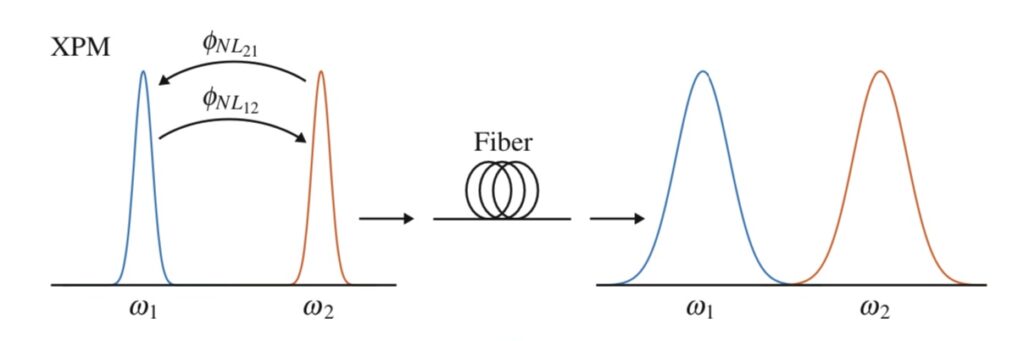
Fig: In XPM, amplitude variations of a signal in frequency ω1 (or ω2) generate a pattern-dependent nonlinear phase shift φNL12 (or φNL21 ) on a second signal of frequency ω2 (or ω1), causing spectral broadening and impairing transmission
Effects of XPM
- Crosstalk Between Wavelengths: XPM introduces crosstalk between different wavelength channels in WDM systems. The intensity fluctuations of one channel induce phase modulation in the other channels, leading to signal degradation and noise.
- Interference: Since the phase of a channel is modulated by the power of other channels, XPM leads to inter-channel interference, which degrades the signal-to-noise ratio (SNR) and increases the bit error rate (BER).
- Spectral Broadening: XPM can cause broadening of the signal spectrum, similar to the effects of Self-Phase Modulation (SPM). This broadening worsens chromatic dispersion, leading to pulse distortion.
- Pattern Dependence: XPM is pattern-dependent, meaning that the phase distortion introduced by XPM depends on the data patterns in the neighboring channels. This can cause significant performance degradation, particularly in systems using phase-sensitive modulation formats like QPSK or QAM.
XPM in Coherent Systems
In coherent optical communication systems, which use digital signal processing (DSP), the impact of XPM can be mitigated to some extent. Coherent systems detect both the phase and amplitude of the signal, allowing for more efficient compensation of phase distortions caused by XPM. However, even in coherent systems, XPM still imposes limitations on transmission distance and system capacity.
Impact of Dispersion on XPM
Chromatic dispersion plays a crucial role in the behavior of XPM. In fibers with low dispersion, XPM effects are stronger because the interacting signals travel at similar group velocities, increasing their interaction length. However, in fibers with higher dispersion, the signals experience walk-off, where they travel at different speeds, reducing the impact of XPM through an averaging effect.
Dispersion management is often used to mitigate XPM in long-haul systems by ensuring that the interacting signals separate spatially as they propagate through the fiber, reducing the extent of their interaction.
Mitigation Techniques for XPM
Several techniques are used to mitigate the impact of XPM in optical systems:
- Increase Channel Spacing:
- Increasing the spacing between wavelength channels in WDM systems reduces the likelihood of XPM-induced crosstalk. However, this reduces spectral efficiency, limiting the total number of channels that can be transmitted.
- Optimizing Power Levels:
- Reducing the launch power of the signals can limit the nonlinear phase shift caused by XPM. However, this must be balanced with maintaining an adequate signal-to-noise ratio (SNR).
- Dispersion Management:
- By carefully managing chromatic dispersion in the fiber, it is possible to reduce the interaction between different channels, thereby mitigating XPM. This is often achieved by using dispersion-compensating fibers or digital signal processing (DSP).
- Advanced Modulation Formats:
- Using modulation formats that are less sensitive to phase distortions, such as differential phase-shift keying (DPSK), can reduce the impact of XPM on the signal.
Applications of XPM
While XPM generally has a negative impact on system performance, it can be exploited for certain applications:
- Wavelength Conversion:
- XPM can be used for all-optical wavelength conversion in WDM systems. The phase modulation caused by one signal can be used to shift the wavelength of another signal, allowing for dynamic wavelength routing in optical networks.
- Nonlinear Signal Processing:
- XPM can be used in nonlinear signal processing techniques, where the nonlinear phase shifts induced by XPM are used for signal regeneration, clock recovery, or phase modulation.
XPM in Submarine Systems
In ultra-long-haul submarine systems, XPM is a significant limiting factor for system performance. Submarine systems typically use dense wavelength division multiplexing (DWDM), where the close spacing between channels exacerbates the effects of XPM. To mitigate this, submarine systems employ dispersion management, low-power transmission, and advanced digital signal processing techniques to counteract the phase distortion caused by XPM.
Summary
Cross-Phase Modulation (XPM) is a critical nonlinear effect in WDM systems, where the intensity fluctuations of one wavelength channel modulate the phase of other channels. XPM leads to inter-channel crosstalk, phase distortion, and spectral broadening, which degrade system performance. Managing XPM is essential for optimizing the capacity and reach of modern optical communication systems, particularly in coherent systems and submarine cable networks. Proper dispersion management, power optimization, and advanced modulation formats can help mitigate the impact of XPM.
- Cross-Phase Modulation (XPM) is a nonlinear optical effect where the phase of a signal is influenced by the intensity of another signal in the same fiber.
- It happens in systems where multiple channels of light travel through the same optical fiber, such as in Dense Wavelength Division Multiplexing (DWDM) systems.
- XPM occurs because the light signals interact with each other through the fiber’s nonlinear properties, causing changes in the phase of the signals.
- The phase shift introduced by XPM leads to signal distortion and can affect the performance of communication systems by degrading the quality of the transmitted signals.
- XPM is more significant when there is high power in one or more of the channels, increasing the intensity of the interaction.
- It also depends on the channel spacing in a DWDM system. Closer channel spacing leads to stronger XPM effects because the signals overlap more.
- XPM can cause issues like spectral broadening, where the signal spreads out in the frequency domain, leading to inter-channel interference.
- It becomes more problematic in long-distance fiber communication systems where multiple channels are amplified and transmitted together over large distances.
- To reduce the impact of XPM, techniques like managing the channel power, optimizing channel spacing, and using advanced modulation formats are applied.
- Digital signal processing (DSP) and compensation techniques are also used to correct the distortions caused by XPM and maintain signal quality in modern optical networks.
References
- Image : https://link.springer.com/book/10.1007/978-3-030-66541-8