Self-Phase Modulation (SPM) is one of the fundamental nonlinear effects in optical fibers, resulting from the interaction between the light’s intensity and the fiber’s refractive index. It occurs when the phase of a signal is modulated by its own intensity as it propagates through the fiber. This effect leads to spectral broadening and can degrade the quality of transmitted signals, particularly in high-power, long-distance optical communication systems.
Physics behind SPM
The phenomenon of SPM occurs due to the Kerr effect, which causes the refractive index of the fiber to become intensity-dependent. The refractive index of the fiber is given by:
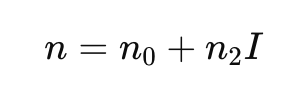
Where:
- 0 is the linear refractive index of the fiber.
- 2 is the nonlinear refractive index coefficient.
- is the intensity of the optical signal.
As the intensity of the optical pulse varies along the pulse width, the refractive index of the fiber changes correspondingly, which leads to a time-dependent phase shift across the pulse. This phase shift is described by:
Where:
- Δ is the phase shift.
- is the fiber’s nonlinear coefficient.
- is the optical power.
- eff is the effective fiber length.
SPM causes a frequency chirp, where different parts of the optical pulse acquire different frequency shifts, leading to spectral broadening. This broadening can increase dispersion penalties and degrade the signal quality, especially over long distances.
Mathematical Representation
The propagation of light in an optical fiber in the presence of nonlinearities such as SPM is described by the Nonlinear Schrödinger Equation (NLSE):
Where:
- ( , ) is the complex envelope of the optical field.
- is the fiber attenuation.
- 2 is the group velocity dispersion parameter.
- is the nonlinear coefficient, and
- ∣ ( , )∣2 represents the intensity of the signal.
In this equation, the term ∣ ( , )∣2 ( , ) describes the effect of SPM on the signal, where the optical phase is modulated by the signal’s own intensity. The phase modulation leads to frequency shifts within the pulse, broadening its spectrum over time.
Effects of SPM
SPM primarily affects single-channel transmission systems and results in the following key effects:
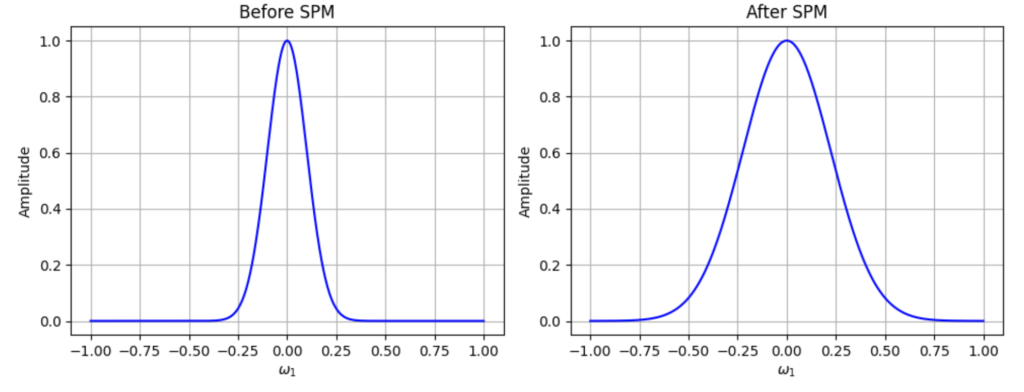
Fig: In SPM, amplitude variations of a signal generate a pattern-dependent nonlinear phase shift on itself, causing spectral broadening and impairing transmission.
-
Spectral Broadening:
- As the pulse propagates, the instantaneous power of the pulse causes a time-dependent phase shift, which in turn results in a frequency chirp. The leading edge of the pulse is red-shifted, while the trailing edge is blue-shifted. This phenomenon leads to broadening of the optical spectrum.
-
Impact on Chromatic Dispersion:
- SPM interacts with chromatic dispersion in the fiber. If the dispersion is anomalous (negative), SPM can counteract dispersion-induced pulse broadening. However, in the normal dispersion regime, SPM enhances pulse broadening, worsening signal degradation.
-
Phase Distortion:
- The nonlinear phase shift introduced by SPM leads to phase distortions, which can degrade the signal’s quality, especially in systems using phase modulation formats like QPSK or QAM.
-
Pulse Distortion:
- The interplay between SPM and fiber dispersion can lead to significant pulse distortion, which limits the maximum transmission distance before signal regeneration or dispersion compensation is required.
SPM in WDM Systems
While SPM primarily affects single-channel systems, it also plays a role in wavelength-division multiplexing (WDM) systems. In WDM systems, SPM can interact with cross-phase modulation (XPM) and four-wave mixing (FWM), leading to inter-channel crosstalk and further performance degradation. In WDM systems, the total nonlinear effect is the combined result of SPM and these inter-channel nonlinear effects.
SPM in Coherent Systems
In coherent optical systems, which use advanced digital signal processing (DSP), the impact of SPM can be mitigated to some extent by using nonlinear compensation techniques. Coherent systems detect both the phase and amplitude of the signal, allowing for more efficient compensation of nonlinear phase distortions. However, SPM still imposes limits on the maximum transmission distance and system capacity.
Mitigation of SPM
Several techniques are employed to reduce the impact of SPM in optical fiber systems:
-
Lowering Launch Power:
- Reducing the optical power launched into the fiber can reduce the nonlinear phase shift caused by SPM. However, this approach must be balanced with maintaining a sufficient signal-to-noise ratio (SNR).
-
Dispersion Management:
- Carefully managing the dispersion in the fiber can help reduce the interplay between SPM and chromatic dispersion. By compensating for dispersion, it is possible to limit pulse broadening and signal degradation.
-
Advanced Modulation Formats:
- Modulation formats that are less sensitive to phase distortions, such as differential phase-shift keying (DPSK), can reduce the impact of SPM on the signal.
-
Digital Signal Processing (DSP):
- In coherent systems, DSP algorithms are used to compensate for the phase distortions caused by SPM. These algorithms reconstruct the original signal by reversing the nonlinear phase shift introduced during propagation.
Practical Applications of SPM
Despite its negative effects on signal quality, SPM can also be exploited for certain beneficial applications:
-
All-Optical Regeneration:
- SPM has been used in all-optical regenerators, where the spectral broadening caused by SPM is filtered to suppress noise and restore signal integrity. By filtering the broadened spectrum, the regenerator can remove low-power noise components while maintaining the data content.
-
Optical Solitons:
- In systems designed to use optical solitons, the effects of SPM and chromatic dispersion are balanced to maintain pulse shape over long distances. Solitons are stable pulses that do not broaden or compress during propagation, making them useful for long-haul communication.
SPM in Submarine Systems
In ultra-long-haul submarine optical systems, where transmission distances can exceed several thousand kilometers, SPM plays a critical role in determining the system’s performance. SPM interacts with chromatic dispersion and other nonlinear effects to limit the achievable transmission distance. To mitigate the effects of SPM, submarine systems often employ advanced nonlinear compensation techniques, including optical phase conjugation and digital back-propagation.
Summary
Self-phase modulation (SPM) is a significant nonlinear effect in optical fiber communication, particularly in high-power, long-distance systems. It leads to spectral broadening and phase distortion, which degrade the signal quality. While SPM can limit the performance of optical systems, it can also be leveraged for applications like all-optical regeneration. Proper management of SPM is essential for achieving high-capacity, long-distance optical transmission, particularly in coherent systems and submarine cable networks.Some of the quick key take-aways are :-
-
-
- In coherent optical networks, SPM (Self-Phase Modulation) occurs when the intensity of the light signal alters its phase, leading to changes in the signal’s frequency spectrum as it travels through the fiber.
- Higher signal power levels make SPM more pronounced in coherent systems, so managing optical power is crucial to maintaining signal quality.
- SPM causes spectral broadening, which can lead to signal overlap and distortion, especially in Dense Wavelength Division Multiplexing (DWDM) systems with closely spaced channels.
- In long-haul coherent networks, fiber length increases the cumulative effect of SPM, making it necessary to incorporate compensation mechanisms to maintain signal integrity.
- Optical amplifiers, such as EDFA and Raman amplifiers, increase signal power, which can trigger SPM effects in coherent systems, requiring careful design and power control.
- Dispersion management is essential in coherent networks to mitigate the interaction between SPM and dispersion, which can further distort the signal. By balancing these effects, signal degradation is reduced.
- In coherent systems, advanced modulation formats like Quadrature Amplitude Modulation (QAM) and coherent detection help improve the system’s resilience to SPM, although higher modulation formats may still be sensitive to nonlinearities.
- Digital signal processing (DSP) is widely used in coherent systems to compensate for the phase distortions introduced by SPM, restoring signal quality after transmission through long fiber spans.
- Nonlinear compensation algorithms in DSP specifically target SPM effects, allowing coherent systems to operate effectively even in the presence of high power and long-distance transmission.
- Channel power optimization and careful spacing in DWDM systems are critical strategies for minimizing the impact of SPM in coherent optical networks, ensuring better performance and higher data rates.
-
Reference
- https://optiwave.com/opti_product/optical-system-spm-induced-spectral-broadening/