Stimulated Raman Scattering (SRS) is a nonlinear optical phenomenon that results from the inelastic scattering of photons when intense light interacts with the vibrational modes of the fiber material. This scattering process transfers energy from shorter-wavelength (higher-frequency) channels to longer-wavelength (lower-frequency) channels. In fiber optic communication systems, particularly in Wavelength Division Multiplexing (WDM) systems, SRS can significantly degrade system performance by inducing crosstalk between channels.
Physics behind SRS
SRS is an inelastic process involving the interaction of light photons with the optical phonons (vibrational states) of the silica material in the fiber. When a high-power optical signal propagates through the fiber, a fraction of the power is scattered by the material, transferring energy from the higher frequency (shorter wavelength) channels to the lower frequency (longer wavelength) channels. The SRS gain is distributed over a wide spectral range, approximately 13 THz, with a peak shift of about 13.2 THz from the pump wavelength.
The basic process of SRS can be described as follows:
- Stokes Shift: The scattered light is redshifted, meaning that the scattered photons have lower energy (longer wavelength) than the incident photons. This energy loss is transferred to the vibrational modes (phonons) of the fiber.
- Amplification: The power of longer-wavelength channels is increased at the expense of shorter-wavelength channels. This power transfer can cause crosstalk between channels in WDM systems, reducing the overall signal quality.
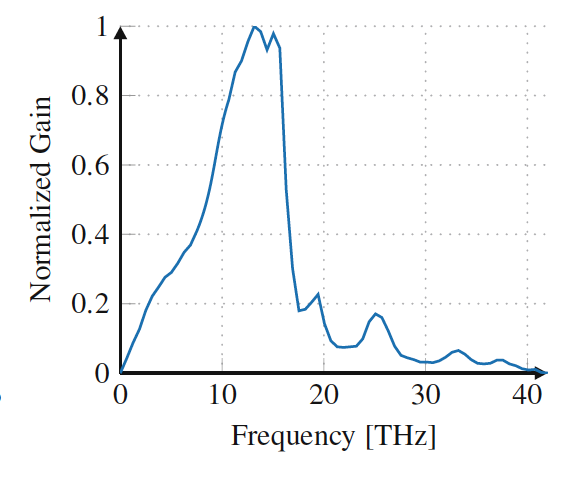
Fig: Normalized gain spectrum generated by SRS on an SSMF fiber pumped at 1430 nm. The SRS gain spectrum has a peak at 13 THz with a bandwidth of 20–30 THz
The Raman gain coefficient describes the efficiency of the SRS process and is dependent on the frequency shift and the fiber material. The Raman gain spectrum is typically broad, extending over several terahertz, with a peak at a frequency shift of around 13.2 THz.
Mathematical Representation
The Raman gain coefficient varies with the wavelength and fiber properties. The SRS-induced power tilt between channels can be expressed using the following relation:
Where:
- is the effective length of the fiber,
- is the effective core area of the fiber,
- is the output power,
- is the wavelength bandwidth of the signal.
This equation shows that the magnitude of the SRS effect depends on the effective length, core area, and wavelength separation. Higher power, larger bandwidth, and longer fibers increase the severity of SRS.
Impact of SRS in WDM Systems
In WDM systems, where multiple wavelengths are transmitted simultaneously, SRS leads to a power transfer from shorter-wavelength channels to longer-wavelength channels. The main effects of SRS in WDM systems include:
- Crosstalk:
-
-
-
-
-
- SRS causes power from higher-frequency channels to be transferred to lower-frequency channels, leading to crosstalk between WDM channels. This degrades the signal quality, particularly for channels with lower frequencies, which gain excess power, while higher-frequency channels experience a power loss.
-
-
-
-
-
- Channel Degradation:
-
-
-
-
- The unequal power distribution caused by SRS degrades the signal-to-noise ratio (SNR) of individual channels, particularly in systems with closely spaced WDM channels. This results in increased bit error rates (BER) and degraded overall system performance.
-
-
-
-
- Signal Power Tilt:
-
-
-
-
- SRS induces a power tilt across the WDM spectrum, with lower-wavelength channels losing power and higher-wavelength channels gaining power. This tilt can be problematic in systems where precise power levels are critical for maintaining signal integrity.
-
-
-
-
SRS in Submarine Systems
SRS plays a significant role in submarine optical communication systems, where long transmission distances and high power levels make the system more susceptible to nonlinear effects. In ultra-long-haul submarine systems, SRS-induced crosstalk can accumulate over long distances, degrading the overall system performance. To mitigate this, submarine systems often employ Raman amplification techniques, where the SRS effect is used to amplify the signal rather than degrade it.
Mitigation Techniques for SRS
Several techniques can be employed to mitigate the effects of SRS in optical communication systems:
- Channel Spacing:
-
-
-
-
- Increasing the spacing between WDM channels reduces the interaction between the channels, thereby reducing the impact of SRS. However, this reduces spectral efficiency and limits the number of channels that can be transmitted.
-
-
-
-
- Power Optimization:
-
-
-
-
- Reducing the launch power of the optical signals can limit the onset of SRS. However, this must be balanced with maintaining adequate signal power for long-distance transmission.
-
-
-
-
- Raman Amplification:
-
-
-
-
- SRS can be exploited in distributed Raman amplification systems, where the scattered Raman signal is used to amplify longer-wavelength channels. By carefully controlling the pump power, SRS can be harnessed to improve system performance rather than degrade it.
-
-
-
-
- Gain Flattening Filters:
-
-
-
-
- Gain-flattening filters can be used to equalize the power levels of WDM channels after they have been affected by SRS. These filters counteract the power tilt induced by SRS and restore the balance between channels.
-
-
-
-
Applications of SRS
Despite its negative impact on WDM systems, SRS can be exploited for certain beneficial applications, particularly in long-haul and submarine systems:
- Raman Amplification:
-
-
-
-
- Raman amplifiers use the SRS effect to amplify optical signals in the transmission fiber. By injecting a high-power pump signal into the fiber, the SRS process can be used to amplify the lower-wavelength signal channels, extending the reach of the system.
-
-
-
-
- Signal Regeneration:
-
-
-
-
- SRS can be used in all-optical regenerators, where the Raman scattering effect is used to restore the signal power and quality in long-haul systems.
-
-
-
-
Summary
Stimulated Raman Scattering (SRS) is a critical nonlinear effect in optical fiber communication, particularly in WDM and submarine systems. It results in the transfer of power from higher-frequency to lower-frequency channels, leading to crosstalk and power imbalance. While SRS can degrade system performance, it can also be harnessed for beneficial applications such as Raman amplification. Proper management of SRS is essential for optimizing the capacity and reach of modern optical communication systems, especially in ultra-long-haul and submarine networks
- Stimulated Raman Scattering (SRS) is a nonlinear effect that occurs when high-power light interacts with the fiber material, transferring energy from shorter-wavelength (higher-frequency) channels to longer-wavelength (lower-frequency) channels.
- SRS occurs due to the inelastic scattering of photons, which interact with the vibrational states of the fiber material, leading to energy redistribution between wavelengths.
- The SRS effect results in power being transferred from higher-frequency channels to lower-frequency channels, causing signal crosstalk and potential degradation.
- The efficiency of SRS depends on the Raman gain coefficient, fiber length, power levels, and wavelength spacing.
- SRS can induce signal degradation in WDM systems, leading to power imbalances and increased bit error rates (BER).
- In submarine systems, SRS plays a significant role in long-haul transmissions, as it accumulates over long distances, further degrading signal quality.
- Techniques like increasing channel spacing, optimizing signal power, and using Raman amplification can mitigate SRS.
- Raman amplification, which is based on the SRS effect, can be used beneficially to boost signals over long distances.
- Gain-flattening filters are used to balance the power across wavelengths affected by SRS, improving overall system performance.
- SRS is particularly significant in long-haul optical systems but can also be harnessed for signal regeneration and amplification in modern optical communication systems.
Reference
- https://link.springer.com/book/10.1007/978-3-030-66541-8
- Image : https://link.springer.com/book/10.1007/978-3-030-66541-8 (SRS)