Stimulated Brillouin Scattering (SBS) is an inelastic scattering phenomenon that results in the backward scattering of light when it interacts with acoustic phonons (sound waves) in the optical fiber. SBS occurs when the intensity of the optical signal reaches a certain threshold, resulting in a nonlinear interaction between the optical field and acoustic waves within the fiber. This effect typically manifests at lower power levels compared to other nonlinear effects, making it a significant limiting factor in optical communication systems, particularly those involving long-haul transmission and high-power signals.
Mechanism of SBS
SBS is caused by the interaction of an incoming photon with acoustic phonons in the fiber material. When the intensity of the light increases beyond a certain threshold, the optical signal generates an acoustic wave in the fiber. This acoustic wave, in turn, causes a periodic variation in the refractive index of the fiber, which scatters the incoming light in the backward direction. This backscattered light is redshifted in frequency due to the Doppler effect, with the frequency shift typically around 10 GHz (depending on the fiber material and the wavelength of light).
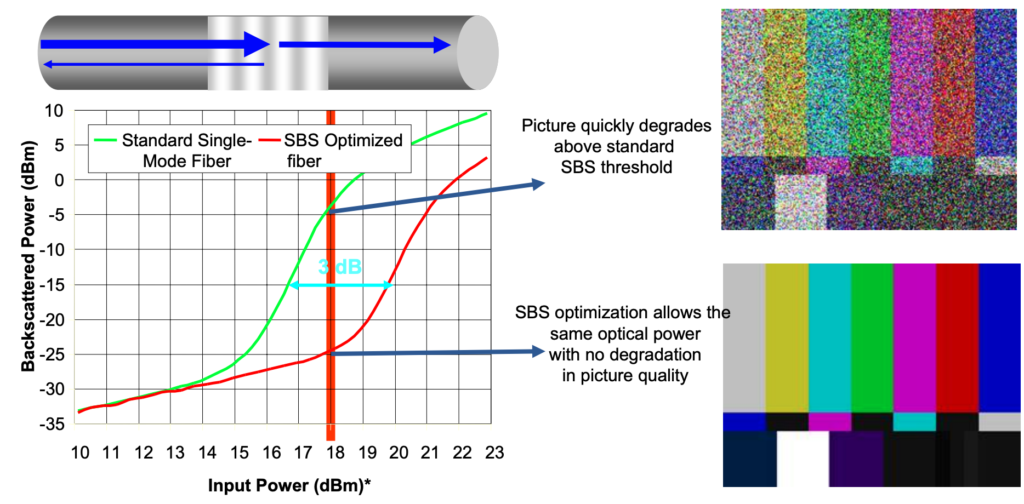
The Brillouin gain spectrum is relatively narrow, with a typical bandwidth of around 20 to 30 MHz. The Brillouin threshold power can be calculated as:
Where:
- is the effective area of the fiber core,
- is the Brillouin gain coefficient,
- is the effective interaction length of the fiber.
When the power of the incoming light exceeds this threshold, SBS causes a significant amount of power to be reflected back towards the source, degrading the forward-propagating signal and introducing power fluctuations in the system.

Image credit: corning.com
Impact of SBS in Optical Systems
SBS becomes problematic in systems where high optical powers are used, particularly in long-distance transmission systems and those employing Wavelength Division Multiplexing (WDM). The main effects of SBS include:
- Power Reflection:
- A portion of the optical power is scattered back towards the source, which reduces the forward-propagating signal power. This backscattered light interferes with the transmitter and receiver, potentially causing signal degradation.
- Signal Degradation:
- SBS can cause signal distortion, as the backward-propagating light interferes with the incoming signal, leading to fluctuations in the transmitted power and an increase in the bit error rate (BER).
- Noise Increase:
- The backscattered light adds noise to the system, particularly in coherent systems, where phase information is critical. The interaction between the forward and backward waves can distort the phase and amplitude of the transmitted signal, worsening the signal-to-noise ratio (SNR).
SBS in Submarine Systems
In submarine communication systems, SBS poses a significant challenge, as these systems typically involve long spans of fiber and require high power levels to maintain signal quality over thousands of kilometers. The cumulative effect of SBS over long distances can lead to substantial signal degradation. As a result, submarine systems must employ techniques to suppress SBS and manage the power levels appropriately.
Mitigation Techniques for SBS
Several methods are used to mitigate the effects of SBS in optical communication systems:
- Reducing Signal Power:
- One of the simplest ways to reduce the onset of SBS is to lower the optical signal power below the Brillouin threshold. However, this must be balanced with maintaining sufficient power for the signal to reach its destination with an acceptable signal-to-noise ratio (SNR).
- Laser Linewidth Broadening:
- SBS is more efficient when the signal has a narrow linewidth. By broadening the linewidth of the signal, the power is spread over a larger frequency range, reducing the power density at any specific frequency and lowering the likelihood of SBS. This can be achieved by modulating the laser source with a low-frequency signal.
- Using Shorter Fiber Spans:
- Reducing the length of each fiber span in the transmission system can decrease the effective length over which SBS can occur. By using optical amplifiers to boost the signal power at regular intervals, it is possible to maintain signal strength without exceeding the SBS threshold.
- Raman Amplification:
- SBS can be suppressed using distributed Raman amplification, where the signal is amplified along the length of the fiber rather than at discrete points. By keeping the power levels low in any given section of the fiber, Raman amplification reduces the risk of SBS.
Applications of SBS
While SBS is generally considered a detrimental effect in optical communication systems, it can be harnessed for certain useful applications:
- Brillouin-Based Sensors:
- SBS is used in distributed fiber optic sensors, such as Brillouin Optical Time Domain Reflectometry (BOTDR) and Brillouin Optical Time Domain Analysis (BOTDA). These sensors measure the backscattered Brillouin light to monitor changes in strain or temperature along the length of the fiber. This is particularly useful in structural health monitoring and pipeline surveillance.
- Slow Light Applications:
- SBS can also be exploited to create slow light systems, where the propagation speed of light is reduced in a controlled manner. This is achieved by using the narrow bandwidth of the Brillouin gain spectrum to induce a delay in the transmission of the optical signal. Slow light systems have potential applications in optical buffering and signal processing.
Summary
Stimulated Brillouin Scattering (SBS) is a nonlinear scattering effect that occurs at relatively low power levels, making it a significant limiting factor in high-power, long-distance optical communication systems. SBS leads to the backscattering of light, which degrades the forward-propagating signal and increases noise. While SBS is generally considered a negative effect, it can be mitigated using techniques such as power reduction, linewidth broadening, and Raman amplification. Additionally, SBS can be harnessed for beneficial applications, including optical sensing and slow light systems. Effective management of SBS is crucial for maintaining the performance and reliability of modern optical communication networks, particularly in submarine systems.
- Stimulated Brillouin Scattering (SBS) is a nonlinear optical effect caused by the interaction between light and acoustic waves in the fiber.
- It occurs when an intense light wave traveling through the fiber generates sound waves, which scatter the light in the reverse direction.
- SBS leads to a backward-propagating signal, called the Stokes wave, that has a slightly lower frequency than the incoming light.
- The effect typically occurs in single-mode fibers at relatively low power thresholds compared to other nonlinear effects like SRS.
- SBS can result in power loss of the forward-propagating signal as some of the energy is reflected back as the Stokes wave.
- The efficiency of SBS depends on several factors, including the fiber length, the optical power, and the linewidth of the laser source.
- In WDM systems, SBS can degrade performance by introducing signal reflections and crosstalk, especially in long-haul optical links.
- SBS tends to become more pronounced in narrow-linewidth lasers and fibers with low attenuation, making it a limiting factor for high-power transmission.
- Mitigation techniques for SBS include using broader linewidth lasers, reducing the optical power below the SBS threshold, or employing SBS suppression techniques such as phase modulation.
- Despite its negative impacts in communication systems, SBS can be exploited for applications like distributed fiber sensing and slow-light generation due to its sensitivity to acoustic waves.
Reference
- https://link.springer.com/book/10.1007/978-3-030-66541-8
- Image Credit : https://www.corning.com/au/en.html
Related Articles on MapYourTech




Continue Reading This Article
Sign in with a free account to unlock the full article and access the complete MapYourTech knowledge base.