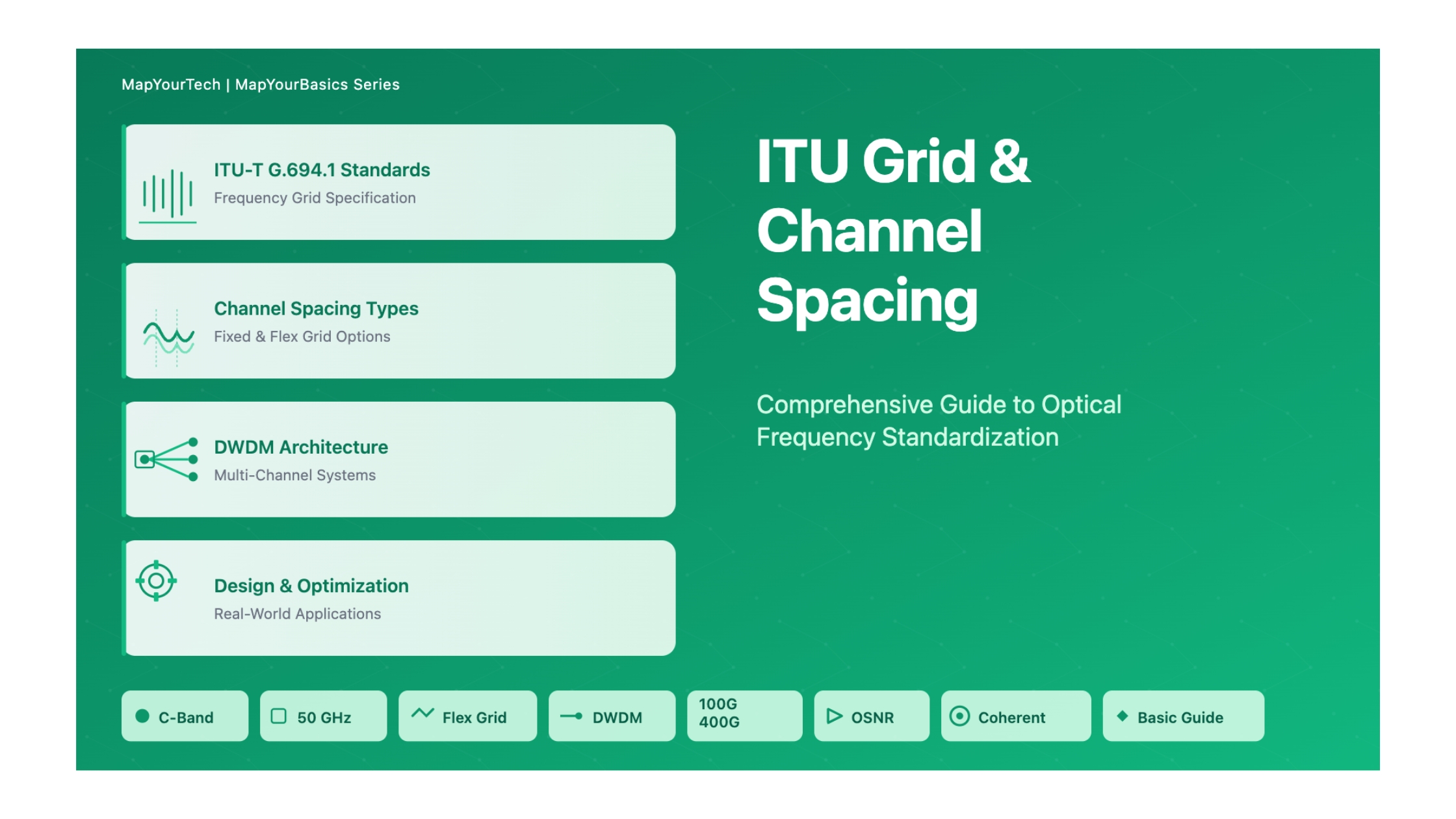

ITU Grid and Channel Spacing
A Comprehensive Professional Guide to Optical Frequency Standardization
Fundamentals & Core Concepts
What is ITU Grid and Channel Spacing?
The ITU Grid (International Telecommunication Union Grid) is a standardized frequency allocation scheme defined by the ITU-T G.694.1 recommendation. It establishes a precise frequency grid for Dense Wavelength Division Multiplexing (DWDM) optical networks, ensuring global interoperability and efficient spectrum utilization.
Key Definition: Channel spacing refers to the frequency or wavelength separation between adjacent optical channels in a DWDM system. It determines how many channels can be packed into the available optical spectrum while maintaining signal integrity and minimizing interchannel crosstalk.
Why Does It Exist?
The ITU Grid was established in 2002 to address critical challenges in optical networking:
Physical and Technical Origins
1. Interoperability: Without standardization, equipment from different vendors could not work together on the same fiber infrastructure, limiting network flexibility and increasing costs.
2. Spectral Efficiency: The finite optical bandwidth available in fiber (primarily C-band: 1530-1565 nm and L-band: 1565-1625 nm) required systematic organization to maximize capacity.
3. Economic Optimization: Standardized channel spacing enables mass production of multiplexers, demultiplexers, and filters, reducing costs and deployment time.
4. Crosstalk Mitigation: Proper channel spacing prevents adjacent channels from interfering with each other, which would otherwise cause bit errors and system degradation.
When Does It Matter?
ITU Grid and channel spacing become critical in several scenarios:
- High-Capacity Networks: Long-haul, metro, and submarine systems requiring 40+ wavelength channels
- Multi-vendor Environments: Networks integrating equipment from multiple manufacturers
- System Upgrades: Expanding capacity by adding channels to existing infrastructure
- Advanced Modulation: High-speed 100G, 400G, and beyond systems using coherent detection
- Flexible Networks: Elastic optical networks requiring dynamic bandwidth allocation
Why Is It Important?
Practical Significance:
• Capacity Planning: Determines maximum number of channels achievable in available spectrum
• System Design: Influences filter design, optical amplifier gain profiles, and dispersion compensation requirements
• Network Economics: Impacts cost per bit through spectral efficiency optimization
• Performance: Affects achievable transmission distance, data rates, and signal quality
• Future-proofing: Enables incremental capacity upgrades without replacing infrastructure
Real-World Analogy
Think of ITU Grid like FM Radio Station Allocation:
Just as radio stations are assigned specific frequencies (e.g., 101.1 FM, 101.5 FM) with defined spacing to prevent interference, optical channels are assigned specific frequencies on the ITU grid. The channel spacing is like the gap between radio stations—too narrow and they interfere; too wide and you waste spectrum. The ITU Grid provides the "dial positions" that all optical equipment manufacturers agree to use, ensuring your optical "radio" (transponder) can always find the right "station" (wavelength).
Mathematical Framework
Core Frequency-Wavelength Relationship
Where:
- c = Speed of light in vacuum ≈ 299,792.458 km/s (typically 3 × 10⁸ m/s)
- λ = Wavelength in meters (nm)
- f = Frequency in Hertz (THz)
Wavelength to Frequency Conversion
Example Calculation:
For λ = 1550 nm (common C-band wavelength):
ITU Grid Reference Frequency
Reference Frequency: 193.1 THz (corresponding to ~1552.52 nm)
Where:
- f(n) = Channel frequency in THz
- n = Channel number (integer: ...-2, -1, 0, 1, 2...)
- Δf = Channel spacing in THz (0.1, 0.05, 0.025, or 0.0125 THz)
Channel Spacing Standards
| Spacing (GHz) | Spacing (THz) | Approximate Wavelength Spacing @ 1550nm | Typical Applications |
|---|---|---|---|
| 12.5 | 0.0125 | ~0.1 nm | Ultra-dense flex-grid, future systems |
| 25 | 0.025 | ~0.2 nm | High-density DWDM, 100G coherent |
| 50 | 0.05 | ~0.4 nm | Standard DWDM, most common |
| 100 | 0.1 | ~0.8 nm | Legacy DWDM, 10G systems |
Frequency Spacing Calculation
Step-by-Step Example:
Calculate spacing between λ₁ = 1550.12 nm and λ₂ = 1550.52 nm:
- Convert wavelengths to meters: λ₁ = 1550.12 × 10⁻⁹ m, λ₂ = 1550.52 × 10⁻⁹ m
- Calculate: Δf = 3×10⁸ × (1/1550.12×10⁻⁹ - 1/1550.52×10⁻⁹)
- Result: Δf ≈ 50 GHz (0.05 THz)
Spectral Efficiency Formula
Where:
- ηs = Spectral efficiency (bit/s/Hz)
- B = Channel bit rate (Gb/s)
- Δνch = Channel spacing (GHz)
Example: 100 Gb/s at 50 GHz spacing: ηs = 100/50 = 2 bit/s/Hz
Total System Capacity
Example for C-band:
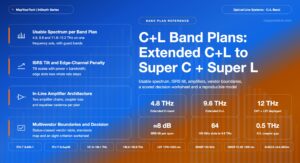
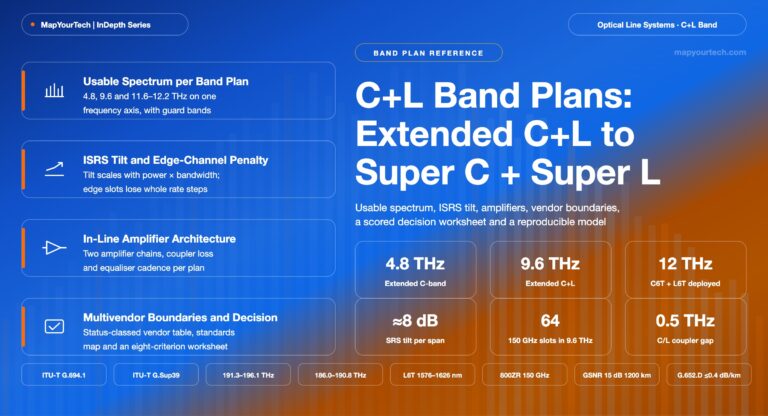
- Total C-band bandwidth: ~4.8 THz (1530-1565 nm)
- At 50 GHz spacing: N = 4800 GHz / 50 GHz = 96 channels
- At 25 GHz spacing: N = 4800 GHz / 25 GHz = 192 channels
- Total capacity = N × (bit rate per channel)
Types & Components
Classification of ITU Grid Types
1. Fixed Grid (Traditional ITU Grid)
Definition: Channel spacings are fixed at regular intervals (100 GHz, 50 GHz, 25 GHz, or 12.5 GHz) with uniform allocation across the spectrum.
Characteristics:
- Rigid frequency allocation
- Standardized channel positions
- Simple network management
- Predictable filter design
Frequency Range:
- C-band: 191.35 - 196.1 THz (approximately)
- Extended C-band: 191.325 - 196.125 THz
- L-band: 186.25 - 191.05 THz
2. Flex Grid (Flexible ITU Grid)
Definition: Variable channel spacing with a minimum granularity of 12.5 GHz, allowing channels to occupy different bandwidths based on requirements.
Characteristics:
- Slot width: 12.5 GHz (fundamental unit)
- Variable channel widths: 37.5 GHz, 50 GHz, 75 GHz, 100 GHz, etc.
- Adaptive spectral allocation
- Improved spectral efficiency (up to 33% gain over fixed 50 GHz grid)
Applications: High-capacity 400G/800G systems, elastic optical networks (EON), software-defined optical networks
Grid Component Breakdown
| Grid Type | Channel Spacing Options | Spectral Efficiency | Complexity | Cost | Best For |
|---|---|---|---|---|---|
| Fixed 100 GHz | 100 GHz only | 0.1-0.4 b/s/Hz | Low | Low | Legacy 10G systems, cost-sensitive metro |
| Fixed 50 GHz | 50 GHz only | 0.4-0.8 b/s/Hz | Low-Medium | Medium | Standard 40G/100G DWDM |
| Fixed 25 GHz | 25 GHz only | 1-4 b/s/Hz | Medium-High | Medium-High | High-density 100G coherent |
| Flex Grid | 12.5 GHz increments | 2-8+ b/s/Hz | High | High | 400G+, elastic networks, maximum efficiency |
Optical Band Utilization
C-Band (Conventional Band)
Wavelength Range: 1530 - 1565 nm
Frequency Range: 191.35 - 196.1 THz
Total Bandwidth: ~4.8 THz (~35 nm)
Why First Choice:
- Optimal EDFA (Erbium-Doped Fiber Amplifier) performance
- Lowest fiber attenuation (~0.19-0.22 dB/km)
- Well-established component ecosystem
- Best balance of cost and performance
Typical Channel Count:
- 100 GHz spacing: ~48 channels
- 50 GHz spacing: ~96 channels
- 25 GHz spacing: ~192 channels
L-Band (Long Band)
Wavelength Range: 1565 - 1625 nm
Frequency Range: 186.25 - 191.05 THz
Total Bandwidth: ~4.8 THz (~60 nm)
When to Use:
- C-band capacity exhausted
- Need to double system capacity without new fiber
- Long-haul networks requiring maximum throughput
Challenges:
- Slightly higher attenuation (~0.20-0.24 dB/km)
- L-band EDFA less efficient than C-band
- Higher component costs
Filter Response Types
| Filter Type | Passband Shape | Insertion Loss | Drift Tolerance | Bandwidth Utilization |
|---|---|---|---|---|
| Gaussian | Smooth bell curve | 3-4 dB | Low | 80% |
| Flat-top | Wide flat passband | 5-6 dB | High | 95% |
| Flex-grid | Configurable | 4-5 dB | Medium-High | 85-95% |
Effects & Impacts
System-Level Effects of Channel Spacing
1. Interchannel Crosstalk
Definition: Unwanted coupling of optical power from one channel to adjacent channels, causing interference and signal degradation.
Impact Mechanism:
- Filter non-ideal rolloff allows adjacent channel energy to leak through
- Tighter channel spacing increases overlap between adjacent channel spectra
- Cumulative effect through multiple ROADM nodes
Quantitative Assessment:
- Excellent: Crosstalk < -30 dB (negligible impact)
- Good: -30 to -25 dB (acceptable for most systems)
- Marginal: -25 to -20 dB (requires monitoring)
- Poor: > -20 dB (significant degradation)
2. Four-Wave Mixing (FWM)
Description: Nonlinear optical effect where three optical frequencies interact to generate a fourth frequency component.
Relationship to Channel Spacing:
FWM efficiency (η) depends on phase matching:
- η = [α² / (α² + Δk²)] × [1 + (4e^(-αL) sin²(ΔkL/2)) / (1-e^(-αL))²]
- Δk = -(Δω)² × (d²k/dω²) - depends on chromatic dispersion
- Closer spacing (smaller Δω) increases FWM efficiency
Mitigation Strategies:
- Use non-zero dispersion-shifted fiber (NZ-DSF, ITU-T G.655)
- Maintain chromatic dispersion > 2 ps/(nm·km) in C-band
- Reduce optical power per channel
- Use uneven channel spacing (not standard ITU grid)
3. Spectral Efficiency Impact
Formula: ηs = B / Δνch (bit/s/Hz)
| Channel Spacing | 10G System | 40G System | 100G System | 400G System |
|---|---|---|---|---|
| 100 GHz | 0.1 b/s/Hz | 0.4 b/s/Hz | 1.0 b/s/Hz | 4.0 b/s/Hz |
| 50 GHz | 0.2 b/s/Hz | 0.8 b/s/Hz | 2.0 b/s/Hz | 8.0 b/s/Hz |
| 25 GHz | 0.4 b/s/Hz | 1.6 b/s/Hz | 4.0 b/s/Hz | 16.0 b/s/Hz |
Performance Implications
Filter Cascade Effects
Problem: Signal passes through multiple optical filters in ROADM networks, causing:
- Bandwidth narrowing (spectral shaping)
- Accumulated insertion loss
- Increased OSNR penalties
Impact on Different Spacings:
- 100 GHz: Can tolerate 15-20 filter cascades
- 50 GHz: Limited to 8-12 filter cascades
- 25 GHz: Limited to 4-6 filter cascades before significant penalties
OSNR Penalty: Increases by 0.5-1.5 dB per filter node for tight spacing
Transmission Distance Effects
Reach Limitations by Spacing:
| System Type | Channel Spacing | Typical Reach | Limiting Factor |
|---|---|---|---|
| 10G NRZ | 100 GHz | 2000-4000 km | OSNR, CD |
| 40G NRZ | 50 GHz | 400-800 km | CD, PMD |
| 100G DP-QPSK | 50 GHz | 1000-2000 km | OSNR, nonlinearities |
| 100G DP-QPSK | 25 GHz | 500-1000 km | Filtering, OSNR |
| 400G DP-16QAM | 75 GHz (flex) | 100-300 km | OSNR, nonlinearities |
Tolerance Levels and Thresholds
Critical Thresholds for Channel Spacing Selection:
- Minimum OSNR Requirement:
- DP-QPSK (100G): ~11-13 dB for BER = 10^-3
- DP-16QAM (200G): ~17-19 dB for BER = 10^-3
- DP-64QAM (300G): ~24-26 dB for BER = 10^-3
- Maximum Chromatic Dispersion:
- 10G NRZ: ~1000 ps/nm
- 40G NRZ: ~100 ps/nm
- 100G Coherent: ~20,000 ps/nm (DSP compensated)
- PMD Tolerance:
- 10G: < 30 ps
- 40G: < 7.5 ps
- 100G: < 10 ps (with DSP)
Techniques & Solutions
Implementation Methods
1. Fixed Grid Implementation
Technology Approach:
- Arrayed Waveguide Grating (AWG): Most common for fixed 50/100 GHz spacing
- Based on optical interference in waveguide array
- Channel count: 40-96 channels
- Insertion loss: 3-5 dB
- Channel isolation: >30 dB
- Thin Film Filter (TFF): Cost-effective for lower channel counts
- Cascade of interference filters
- Channel count: 4-16 channels
- Insertion loss: 0.5-3 dB
- Excellent for add/drop applications
- Fiber Bragg Grating (FBG): Low loss, wavelength-specific
- Periodic refractive index variation in fiber
- Insertion loss: 0.1-0.5 dB
- Excellent for single channel add/drop
Advantages:
- Simple, proven technology
- Low cost per channel (high volume)
- Predictable performance
- Wide vendor support
Disadvantages:
- Inflexible - cannot adapt to varying bandwidth needs
- Spectrum inefficiency for mixed data rates
- Cannot optimize for individual connection requirements
2. Flex Grid Implementation
Technology Approach:
- Wavelength Selective Switch (WSS): Core technology for flex-grid
- LCoS (Liquid Crystal on Silicon) based
- Programmable filtering with 12.5 GHz granularity
- Dynamic bandwidth allocation
- Insertion loss: 5-7 dB
- Bandwidth-Variable Transponder (BVT):
- Tunable laser (C-band or C+L band coverage)
- Adjustable symbol rate (e.g., 28-96 Gbaud)
- Configurable modulation format (QPSK to 64QAM)
- Software-defined operation
Advantages:
- 33% spectral efficiency improvement over fixed 50 GHz
- Adaptive to traffic demands
- Optimized reach vs. capacity trade-off
- Future-proof architecture
Disadvantages:
- Higher cost (30-50% premium over fixed grid)
- Complex network management
- Requires advanced control plane
- Higher power consumption
Comparison of Techniques
| Technique | Flexibility | Spectral Efficiency | Cost | Complexity | Best For |
|---|---|---|---|---|---|
| Fixed Grid AWG | None | Medium | $ | Low | Metro, established networks |
| Fixed Grid TFF | None | Medium | $ | Low | Low channel count systems |
| WSS-based Fixed | Routing only | Medium | $ | Medium | ROADM networks |
| Flex Grid WSS | High | High | $$ | High | Long-haul, high capacity |
| Superchannel | Very High | Very High | $$ | Very High | 400G+, submarine |
Best Practices and Recommendations
Design Guidelines:
- Match Spacing to Data Rate:
- 10G systems: 100 GHz adequate
- 40G systems: 50 GHz recommended
- 100G coherent: 50 GHz standard, 37.5 GHz with flex-grid
- 400G: 75-150 GHz flex-grid depending on reach
- Consider Network Topology:
- Point-to-point: Can use tighter spacing
- ROADM rings: Account for filtering penalties
- Mesh networks: Need margin for diverse paths
- Plan for Growth:
- Leave guard bands for future channel additions
- Use flex-grid for networks requiring frequent reconfiguration
- Consider alien wavelength capability
- Balance Cost and Performance:
- Fixed grid for stable traffic patterns
- Flex-grid where optimization yields significant CAPEX/OPEX savings
- Hybrid approach: Fixed grid with flex-grid capability at key nodes
Real-World Application Scenarios
Scenario 1: Metro Aggregation Network
Requirements: 20-40 channels, 100G per channel, 80 km typical span
Recommendation: Fixed 50 GHz grid with AWG mux/demux
Rationale:
- Stable traffic patterns don't require flexibility
- 50 GHz provides adequate spectrum for 100G DP-QPSK
- AWG cost-effective at this scale
- Simple operations - no need for SDN control
Scenario 2: Long-Haul Core Network
Requirements: 80-96 channels, mixed 100G/400G, 500-2000 km reach
Recommendation: Flex-grid with 37.5-75 GHz adaptive spacing
Rationale:
- Optimization of reach vs. capacity critical for economics
- Mix of modulation formats (QPSK for long reach, 16QAM for short)
- 33% capacity improvement justifies flex-grid premium
- Future-proof for 800G migration
Scenario 3: Data Center Interconnect
Requirements: 40-80 channels, 400G-800G per channel, <100 km
Recommendation: Flex-grid or fixed 75 GHz with advanced modulation
Rationale:
- Short reach allows high-order modulation (16QAM, 64QAM)
- Maximum spectral efficiency needed for capacity
- Flex-grid enables superchannels for 800G
- Dynamic reconfiguration for traffic engineering
Design Guidelines & Methodology
Step-by-Step Design Process
Phase 1: Requirements Analysis
Step 1: Define Traffic Demand
- Current capacity requirements (Tb/s)
- Growth projection (3-5 year horizon)
- Traffic matrix (source-destination pairs)
- Quality of Service (QoS) requirements
Step 2: Network Characterization
- Topology (point-to-point, ring, mesh)
- Span lengths and count
- Fiber type (G.652, G.655, etc.)
- Existing equipment constraints
Step 3: Calculate Initial Parameters
Number of wavelengths needed:
N_wavelengths = Total_Capacity / Capacity_per_wavelength
Example:
Target: 10 Tb/s
Using 100G wavelengths: N = 10,000 / 100 = 100 wavelengths
Using 400G wavelengths: N = 10,000 / 400 = 25 wavelengths
Phase 2: Channel Spacing Selection
Decision Framework:
| Criteria | 100 GHz | 50 GHz | 25 GHz | Flex Grid |
|---|---|---|---|---|
| Max Channels (C-band) | 48 | 96 | 192 | Variable |
| Suitable Data Rates | ≤10G | 40G, 100G | 100G | 100G-800G |
| Filter Tolerance | High | Medium | Low | Medium |
| FWM Susceptibility | Low | Medium | High | Medium |
| Cost Level | $ | $ | $$ | $$ |
Selection Algorithm:
- If N_wavelengths ≤ 48 AND using 10G → Choose 100 GHz
- If N_wavelengths ≤ 96 AND using 40G/100G → Choose 50 GHz
- If N_wavelengths > 96 OR need future flexibility → Evaluate flex-grid
- If mixed data rates (100G + 400G) → Flex-grid recommended
- If cost critical AND traffic stable → Fixed grid
Phase 3: Link Budget Analysis
Calculate Available OSNR:
OSNR = P_out - L - NF_eff - 10log(N_span × h × ν × Δν)
Where:
- P_out = Amplifier output power per channel (dBm)
- L = Span loss (dB)
- NF_eff = Effective noise figure (dB)
- N_span = Number of amplifier spans
- h × ν × Δν ≈ -58 dBm (for 193.1 THz, 0.1 nm reference BW)
Practical Example:
- System: 10 spans × 80 km, G.652 fiber
- P_out = 0 dBm per channel
- L = 22 dB per span (80 km × 0.22 dB/km + margins)
- NF = 5 dB
- OSNR = 0 - 22 - 5 - 10log(10) - (-58) = 21 dB
- Result: Adequate for 100G DP-QPSK (requires ~13 dB)
Design Checklists
Pre-Deployment Checklist:
- ☐ Channel plan documented (frequencies, wavelengths, power levels)
- ☐ OSNR margin verified (>3 dB above required)
- ☐ Chromatic dispersion within limits for modulation format
- ☐ PMD budget analyzed (< 10% of bit period)
- ☐ Nonlinear effects assessed (FWM, XPM, SPM)
- ☐ Filter cascade penalty calculated (<2 dB end-to-end)
- ☐ Guard bands allocated for future channels
- ☐ Wavelength locking/stabilization specified (±2.5 GHz typical)
- ☐ Protection/restoration scheme defined
- ☐ Network management system configured
Common Pitfalls to Avoid
| Pitfall | Impact | Prevention |
|---|---|---|
| Tight spacing without filtering margins | Interchannel crosstalk, degraded BER | Ensure filter 3dB bandwidth < 80% of channel spacing |
| Ignoring FWM in G.653 fiber | Unexpected channel interference | Use G.655 (NZ-DSF) or maintain >2 ps/nm/km dispersion |
| Over-provisioning spacing | Wasted spectrum, higher cost per bit | Match spacing to actual spectral width of signal |
| Not accounting for ROADM cascade | Excessive OSNR penalty, reduced reach | Limit ROADM nodes to 10-15, or use flat-top filters |
| Inadequate wavelength control | Drift into adjacent channels | Use temperature-controlled lasers, wavelength lockers |
Interactive Simulators
Fixed Grid (50 GHz)
Flex Grid
Recommended Configuration
Optimization Recommendations
Practical Applications & Case Studies
Real-World Deployment Scenarios
Scenario 1: Regional Telecom Operator Network Upgrade
Background:
- Existing: 40-channel, 100 GHz grid, 10G per channel = 400 Gb/s
- Growth: 5-year traffic projection shows 10x growth to 4 Tb/s
- Network: 6-node metro ring, average span 60 km
- Budget constraint: Cannot install new fiber
Challenge: Increase capacity 10x on existing fiber infrastructure while maintaining service continuity
Solution Approach:
- Phase 1 - Channel Rate Upgrade (Year 1):
- Replace 10G transponders with 100G DP-QPSK
- Maintain 100 GHz spacing initially
- Result: 4 Tb/s capacity (40 × 100G)
- Cost: $2M (transponder refresh)
- Phase 2 - Grid Densification (Year 3):
- Add 40 additional channels on 100 GHz grid (fill empty slots)
- Install C-band+L-band EDFAs
- Result: 8 Tb/s capacity (80 × 100G)
- Cost: $1.5M (40 transponders + amplifiers)
- Phase 3 - Future Ready (Year 5):
- Deploy flex-grid WSS at 2 key nodes
- Migrate 20 critical paths to 400G using adaptive spacing
- Result: 12 Tb/s capacity
- Cost: $1M (WSS upgrade + 400G transponders)
Results & Benefits:
- ✓ 30x capacity increase (400 Gb/s → 12 Tb/s)
- ✓ Phased investment aligned with revenue growth
- ✓ No service disruption during upgrades
- ✓ Cost per bit reduced by 85%
- ✓ Future-ready for 800G migration
Scenario 2: Data Center Interconnect (DCI) Optimization
Background:
- Two data centers 150 km apart
- Current: 32 × 100G wavelengths on 50 GHz grid = 3.2 Tb/s
- Requirement: Scale to 20 Tb/s within 18 months
- Available: Single fiber pair, C-band only
Challenge: 6.25x capacity increase with limited spectrum (C-band = 4.8 THz)
Solution Approach:
- Technology Selection: 400G DP-16QAM with flex-grid
- Justification: Short 150km distance allows 16QAM (high spectral efficiency)
- Channel spacing: 75 GHz flex-grid (optimized for 400G)
- Channels achievable: 4800 GHz / 75 GHz = 64 channels
- Implementation:
- Deploy 50 × 400G wavelengths = 20 Tb/s
- Uses only 3.75 THz of C-band (78% utilization)
- Reserve 1.05 THz for future expansion
- Key Design Elements:
- Flex-grid WSS at both ends
- 400G CFP2-DCO coherent pluggables
- Pre-amplifiers for improved OSNR
- Dual-plane protection (1+1)
Results & Benefits:
- ✓ 6.25x capacity increase achieved
- ✓ 25% spectrum headroom for growth
- ✓ Cost per Gb/s reduced from $150 to $45
- ✓ Sub-millisecond latency maintained
- ✓ 99.999% availability with 1+1 protection
Scenario 3: Submarine Cable System Design
Background:
- Transoceanic route: 8,000 km
- Target capacity: 24 Tb/s initial, 48 Tb/s ultimate
- Constraints: Fixed submarine infrastructure, 50 km amplifier spacing
- Timeline: 3-year deployment, 15-year operational life
Challenge: Maximize capacity on fixed submarine infrastructure with ultra-long reach requirements
Solution Approach:
- Grid Selection: Fixed 50 GHz with C+L band
- Rationale: Submarine cables have fixed filter positions
- C-band: 96 channels × 50 GHz
- L-band: 96 channels × 50 GHz
- Total: 192 wavelength slots
- Modulation & Rate:
- Initial: 150 × 100G DP-QPSK = 15 Tb/s (conservative for reach)
- Phase 2: Add 80 × 100G = 23 Tb/s total
- Phase 3: Upgrade 40 channels to 200G DP-8QAM = 27 Tb/s
- Ultimate: Migrate all to 200G DP-8QAM = 38.4 Tb/s
- Key Technologies:
- Submarine-grade ultra-low loss fiber (0.17 dB/km)
- High-power EDFAs (20 dBm output)
- Advanced FEC (SD-FEC, 25% overhead)
- Raman amplification for improved OSNR
Results & Benefits:
- ✓ 24 Tb/s initial capacity with growth to 38+ Tb/s
- ✓ OSNR maintained >14 dB for DP-QPSK across 8,000 km
- ✓ Cost-effective phased approach reduces CAPEX risk
- ✓ 15-year technology refresh capability
- ✓ 50 GHz grid enables multi-vendor wavelength supply
Troubleshooting Guide
| Problem | Symptoms | Likely Cause | Solution |
|---|---|---|---|
| High BER on Edge Channels | BER > 10^-3 on first/last channels, center channels OK | EDFA gain tilt, unequal power | Adjust VOA per channel, enable dynamic gain equalization |
| Interchannel Crosstalk | Interfering tones at adjacent channel frequencies | Filter misalignment, temperature drift | Re-calibrate wavelength locker, verify ITU grid alignment |
| FWM Products Visible | Additional spectral lines between channels | Zero dispersion in G.653 fiber, high power | Reduce power 2-3dB, use G.655 fiber for new spans |
| Reach Shorter than Expected | OSNR < required at shorter distances | Filter cascade penalties, connector losses | Audit all connectors, minimize ROADM cascade, use flat-top filters |
| Cannot Add More Channels | New channels cause existing channels to degrade | EDFA gain saturation, SRS tilt | Add pre-emphasis, upgrade to higher power EDFAs, implement gain equalization |
| Spectral Broadening | Signal occupies >80% of channel spacing | SPM from excessive power, chirp | Reduce launch power, verify transmitter chirp, check dispersion compensation |
Quick Reference Tables
Channel Spacing Selection Quick Guide
| Application | Distance | Rate | Recommended Spacing | Grid Type |
|---|---|---|---|---|
| Metro Access | <80 km | 10-40G | 100 GHz | Fixed |
| Metro Core | 80-200 km | 100G | 50 GHz | Fixed |
| Regional | 200-600 km | 100-200G | 50 GHz / 37.5 GHz | Fixed / Flex |
| Long Haul | 600-2000 km | 100-400G | 50-75 GHz adaptive | Flex |
| Ultra Long Haul | >2000 km | 100-200G | 50 GHz | Fixed |
| DCI Short | <100 km | 400-800G | 75-150 GHz | Flex |
| DCI Long | 100-500 km | 400G | 75 GHz | Flex |
Modulation Format vs OSNR Requirements
| Modulation | Bits/Symbol | Required OSNR (0.1nm) | Typical Rate | Best Application |
|---|---|---|---|---|
| DP-BPSK | 2 | ~8 dB | 50-100G | Ultra-long haul, submarine |
| DP-QPSK | 4 | ~11-13 dB | 100-200G | Long haul, standard |
| DP-8QAM | 6 | ~15-17 dB | 150-300G | Regional, metro |
| DP-16QAM | 8 | ~19-21 dB | 200-400G | Short reach, DCI |
| DP-32QAM | 10 | ~23-25 dB | 250-500G | Very short reach |
| DP-64QAM | 12 | ~27-29 dB | 300-600G | Metro, <50 km |
Professional Recommendations
Design Best Practices
- Always maintain margin: Design for 3+ dB OSNR margin above theoretical requirement
- Consider lifecycle: 50 GHz grid offers best balance of capacity and future flexibility
- Start conservative: Deploy with QPSK, migrate to higher-order modulation as needed
- Test thoroughly: Lab validate channel spacing before field deployment
- Monitor continuously: Implement OSNR, CD, and PMD monitoring at key points
- Document everything: Maintain detailed channel plan, power levels, and performance baseline
- Plan for aliens: Consider multi-vendor wavelength interoperability from day one
- Optimize economics: Match technology to application - don't over-engineer short reaches
Operational Guidelines
- Wavelength accuracy: Maintain ±2.5 GHz (±0.02 nm @ 1550nm) wavelength stability
- Power management: Keep per-channel power variation within ±1 dB across band
- Temperature control: Maintain 20-25°C for uncooled lasers, or use TEC control
- Filter maintenance: Re-characterize filters annually, especially after temperature excursions
- Growth planning: Reserve 20% of spectrum for future capacity additions
- Protection schemes: 1+1 for critical paths, 1:N for cost-sensitive applications
- Software-defined: Implement control plane for flex-grid automation and optimization