Generic selectors
Exact matches only
Search in title
Search in content
Post Type Selectors
Articles
lp_course
lp_lesson
Back
HomeCoherent OpticsMeasuring Coherent System OSNR using integral method
osnr_dispersion

Measuring Coherent System OSNR using integral method

Last Updated: April 2, 2026
3 min read
168
For coherent signals with wide optical spectrum, the traditional scanning method using an OSA or inband polarization method (EXFO) cannot correctly measure system OSNR. Therefore, use the integral method to measure OSNR of coherent signals.

Perform the following operations to measure OSNR using the integral method:

1.Position the central frequency of the wavelength under test in the middle of the screen of an OSA.
2.Select an appropriate bandwidth span for integration (for 40G/100G coherent signals, select 0.4 nm).
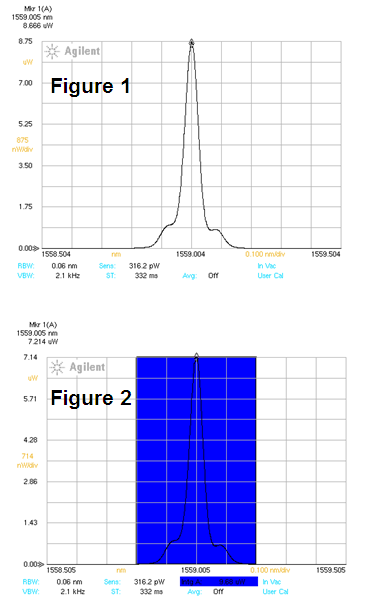
3.Read the sum of signal power and noise power within the specified bandwidth. On the OSA, enable the Trace Integ function and read the integral value. As shown in Figure 2, the integral optical      power (P + N) is 9.68 uW.
4.Read the integral noise power within the specified bandwidth. Disable the related laser before testing the integral noise power. Obtain the integral noise power N within the signal bandwidth      specified in step 2. The integral noise power (N) is 29.58 nW.
5.Calculate the integral noise power (n) within the reference noise bandwidth. Generally, the reference noise bandwidth is 0.1 nm. Read the integral power of central frequency within the bandwidth of 0.1 nm. In this example, the integral noise power within the reference noise bandwidth is 7.395 nW.
6.Calculate OSNR. OSNR = 10 x lg{[(P + N) – N]/n}

In this example, OSNR = 10 x log[(9.68 – 0.02958)/0.007395] = 31.156 dB

Measuring Coherent System OSNR using integral method - Image 1Measuring Coherent System OSNR using integral method - Image 2Measuring Coherent System OSNR using integral method - Image 3


We follow integral method because Direct OSNR Scanning Cannot Ensure Accuracy because of the following reason:

A 40G/100G signal has a larger spectral width than a 10G signal. As a result, the signal spectrums of adjacent channels overlap each other. This brings difficulties in testing the OSNR using the traditional OSA method, which is implemented based on the interpolation of inter-channel noise that is equivalent to in-band noise. Inter-channel noise power contains not only the ASE noise power but also the signal crosstalk power. Therefore, the OSNR obtained using the traditional OSA method is less than the actual OSNR. The figure below shows the signal spectrums in hybrid transmission of 40G and 10G signals with 50 GHz channel spacing. As shown in the figure, a severe spectrum overlap has occurred and the tested ASE power is greater than it should be .As ROADM and OEQ technologies become mature and are widely used, the use of filter devices will impair the noise spectrum. As shown in the following figure, the noise power between channels decreases remarkably after signals traverse a filter. As a result, the OSNR obtained using the traditional OSA method is greater than the actual OSNR..

Measuring Coherent System OSNR using integral method - Image 4Measuring Coherent System OSNR using integral method - Image 5


Measuring Coherent System OSNR using integral method - Image 6Measuring Coherent System OSNR using integral method - Image 7

Sanjay Yadav

Optical Communications & Network Automation Expert | Author of 3 Books for Optical Engineers | Founder, MapYourTech

Optical networking engineer with nearly two decades of experience across DWDM, OTN, coherent optics, submarine systems, and cloud infrastructure. Founder of MapYourTech.

Follow on LinkedIn

Leave A Reply

You May Also Like

30 min read 10 0 Like EDFA Noise Figure and ASE Accumulation Skip to main content MapYourTech | Amplifiers Series...
  • Free
  • June 1, 2026
55 min read 31 0 Like TM Forum Open Digital Architecture Explained Skip to main content MAPYOURTECH | INDEPTH SERIES...
  • Free
  • May 29, 2026
32 min read 12 0 Like Skip to main content MapYourTech | InDepth Series Migrating From Legacy OSS and BSS...
  • Free
  • May 29, 2026
Stay Ahead of the Curve
Get new articles, courses & exclusive offers first

Follow MapYourTech on LinkedIn for exclusive updates — new technical articles, course launches, member discounts, tool releases, and industry insights straight to your feed.

New Articles
Course Launches
Member Discounts
Tool Releases
Industry Insights
Be the first to know on our latest updates!.

Course Title

Course description and key highlights

Course Content

Course Details