
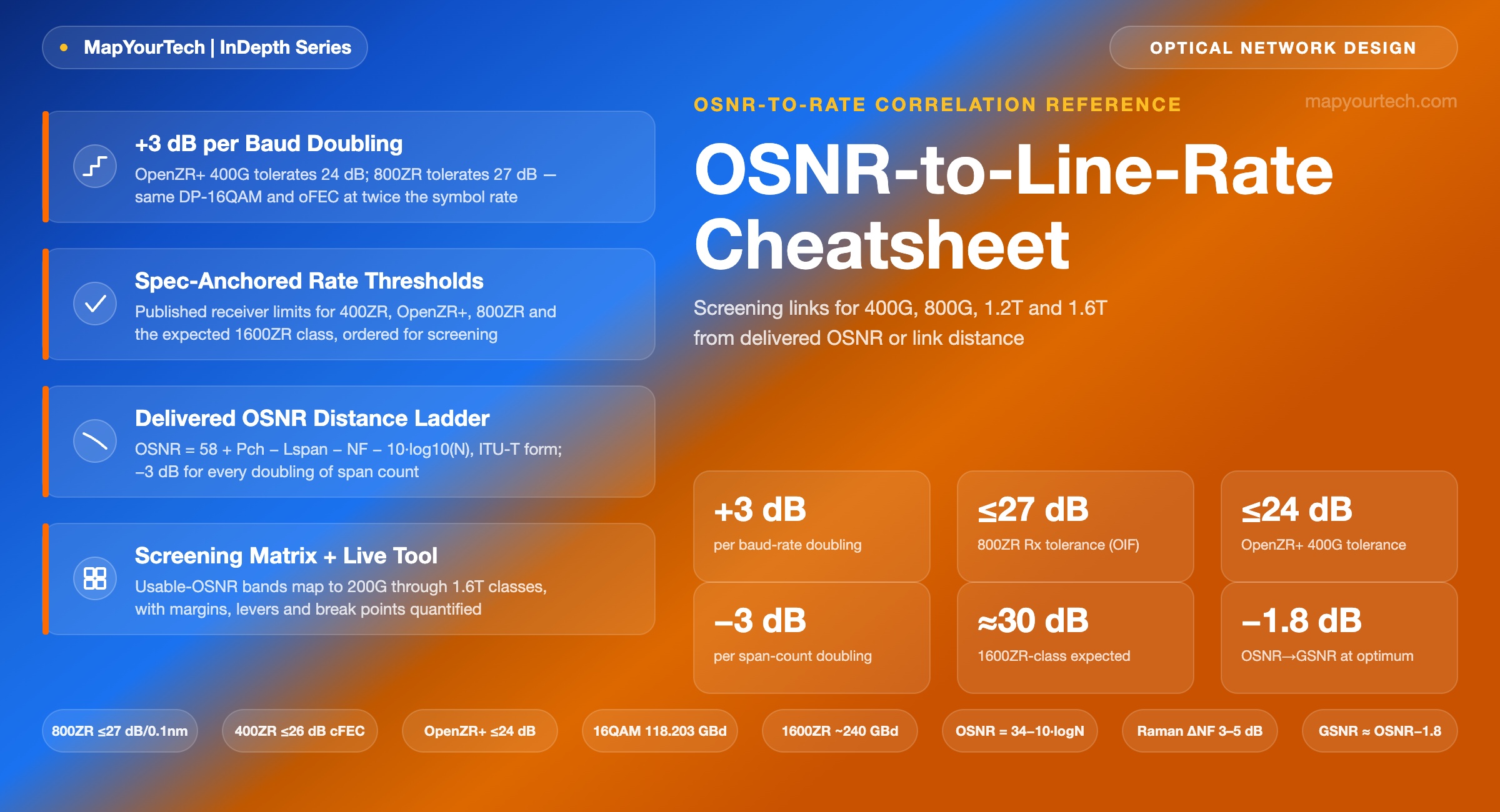
MapYourTech | InDepth Series
OSNR-to-Line-Rate Cheatsheet: Screening Links for 400G, 800G, 1.2T and 1.6T
A customer hands you a link distance or a delivered OSNR figure and asks what rate it will carry. This sheet turns that question into a three-step lookup: spec-anchored OSNR thresholds for every rate class, a delivered-OSNR-versus-distance ladder, and an interactive screener — with the boundaries where the shortcut stops working.
1. Introduction
The OpenZR+ Multi-Source Agreement (MSA) requires a 400G module running dual-polarization 16-state quadrature amplitude modulation (DP-16QAM) at roughly 60 Gbaud to keep working down to an Optical Signal-to-Noise Ratio (OSNR) of 24 dB. The Optical Internetworking Forum (OIF) 800ZR Implementation Agreement (IA) requires the same modulation at double the symbol rate — 118.203 Gbaud — to keep working down to 27 dB. Same constellation, same open Forward Error Correction (oFEC) family, twice the baud, +3 dB. This regularity is what makes the correlation usable: required OSNR moves in predictable steps with baud rate and constellation order, and delivered OSNR falls in predictable steps with distance. Put the two ladders side by side and a link distance or a quoted OSNR converts into a feasible line rate in under a minute. If the OSNR quantity itself needs a refresher first, the OSNR fundamentals reference covers the definition, the 0.1 nm measurement bandwidth, and the Q-factor bridge.
This sheet is a screening instrument. Use it when a customer quotes "23.5 dB end-of-life" or "eleven spans, mixed 78 to 86 km" and wants a rate answer on the call. It ranks options, exposes the gap in decibels, and tells you which lever closes that gap. It does not replace a full design pass: chromatic dispersion windows, polarization effects, filter narrowing through Reconfigurable Optical Add-Drop Multiplexer (ROADM) cascades, and nonlinear interference all sit outside a single OSNR number, and Section 8 marks exactly where the shortcut fails. The split between pluggable and embedded optics matters throughout — the two module families carry different transmit-power and OSNR ceilings, a boundary treated in depth in the transceiver application-boundaries analysis.
Read the Full Analysis with Premium
The remaining 88% of this article — the design numbers, trade-offs and field guidance — is part of MapYourTech Premium, along with the full premium library, courses and professional tools.
You May Also Like
-
Free
-
September 4, 2026
-
Premium
-
September 4, 2026
-
Premium
-
September 4, 2026