
Coherent vs Direct-Detect Transceivers: Application Boundaries and Technology Selection
A comprehensive engineering guide to the evolving boundary between coherent and intensity-modulation direct-detection optics — covering reach, power, cost, spectral efficiency, and a practical selection framework for metro, DCI, and long-haul applications.
1. Introduction
The optical transceiver landscape is defined by a fundamental architectural divide: coherent detection versus intensity-modulation direct-detection (IM/DD). For much of the past fifteen years, the boundary between these two approaches was relatively clear. Coherent transceivers, equipped with local oscillators, advanced digital signal processors (DSPs), and complex modulation formats, dominated long-haul and metro-core transport. Direct-detect modules, using simpler on-off keying (OOK) or pulse amplitude modulation (PAM4), served shorter reaches within data centers and enterprise campuses where cost and power efficiency mattered most.
That boundary is now shifting. The explosive growth in data center interconnect (DCI) bandwidth, driven by cloud computing, AI/ML training workloads, and hyperscale expansion, has pushed both technologies into overlapping territory. On the coherent side, miniaturization from CFP2 to QSFP-DD and OSFP form factors, combined with the OIF 400ZR standard, brought coherent optics into router faceplates for the first time. On the direct-detect side, PAM4 at 100G per lane and emerging 200G-per-lane signaling have extended IM/DD capabilities into reaches that once demanded coherent solutions.
This article provides a comprehensive engineering framework for understanding the application boundaries between these two detection methods. It examines the fundamental physics, traces the historical evolution from separate domains toward convergence, and delivers a practical selection guide based on reach, capacity, power consumption, cost, and spectral efficiency. The analysis draws from established ITU-T and OIF standards, current transceiver specifications, and the latest industry developments as of 2025, including the emergence of "coherent-lite" architectures that blur the traditional boundary further.
2. Fundamental Principles
2.1 Direct Detection (IM/DD)
Direct detection is the simplest form of optical signal recovery. The transmitter modulates the intensity of the optical carrier, and the receiver uses a photodetector (PIN diode or avalanche photodiode) that responds only to the optical power envelope. No information about the phase, frequency, or polarization of the optical field is recovered. The photodetector converts incident optical power directly to electrical current, and downstream electronics amplify and digitize this current for data recovery.
In its most basic form, direct detection uses on-off keying (OOK) with non-return-to-zero (NRZ) signaling, where the presence or absence of light represents binary 1 or 0. This approach achieves a spectral efficiency of approximately 0.5 to 1 bit/s/Hz. To increase data rates without proportionally widening the spectral footprint, the industry adopted PAM4 (4-level Pulse Amplitude Modulation), which encodes two bits per symbol using four distinct amplitude levels. A PAM4 transceiver operating at 53 GBaud carries 100 Gb/s per lane, and by using four parallel lanes (as in 400G-DR4 or 400G-FR4), the aggregate capacity reaches 400 Gb/s.
Because a photodetector responds only to optical intensity (the square of the electric field amplitude), all phase information is lost. This means IM/DD systems cannot digitally compensate chromatic dispersion (CD) or polarization mode dispersion (PMD) after detection. For PAM4 links exceeding approximately 5 to 8 km, external dispersion-compensating fiber (DCF) modules become necessary, adding cost and complexity to what is otherwise a simple architecture.
2.2 Coherent Detection
Coherent detection recovers the full optical field, including amplitude, phase, and polarization state, by mixing the incoming signal with a local oscillator (LO) laser at the receiver. The beating product between the signal field and the LO field preserves both amplitude and phase information in the electrical domain. A 90-degree optical hybrid and balanced photodetectors produce in-phase (I) and quadrature (Q) components on both x- and y-polarizations, yielding four independent electrical signals.
A high-speed DSP then digitizes these signals and performs a cascade of compensation algorithms: chromatic dispersion compensation (handling thousands of ps/nm), polarization demultiplexing, PMD compensation, frequency offset estimation, carrier phase recovery, and nonlinear impairment mitigation. This digital processing eliminates the need for optical dispersion compensation modules and allows coherent transceivers to operate over vastly longer distances without signal regeneration.
Coherent systems employ advanced modulation formats that encode multiple bits per symbol on both polarizations. Dual-polarization QPSK (DP-QPSK) encodes 4 bits per symbol (2 bits per polarization), while DP-16QAM encodes 8 bits per symbol, and DP-64QAM reaches 12 bits per symbol. The spectral efficiency ranges from 2 to 6 bits/s/Hz depending on the modulation order, far exceeding what IM/DD can achieve.
Figure 1: Simplified block diagram comparison of coherent and direct-detection transceiver architectures, showing the additional components (LO laser, 90-degree hybrid, DSP) that give coherent systems their superior reach and dispersion tolerance.
2.3 Key Formulas and Performance Metrics
Several fundamental relationships govern the performance trade-offs between coherent and direct-detect systems. The data rate achieved by any optical transceiver depends on the baud rate and the number of bits encoded per symbol:
Data Rate = Baud Rate x Bits per Symbol x Number of Polarizations

Where:
  Baud Rate      = Symbol rate in GBaud (e.g., 64 GBaud)
  Bits/Symbol   = log2(M), where M is modulation order
  Polarizations = 1 for IM/DD, 2 for dual-polarization coherent

Example — 400G Coherent DP-16QAM:
  Data Rate = 64 GBaud x 4 bits/symbol x 2 polarizations
           = 512 Gb/s gross (~400G net after FEC overhead)

Example — 400G PAM4 (4 x 100G lanes):
  Per-lane Rate = 53 GBaud x 2 bits/symbol x 1 polarization
               = 106 Gb/s gross (~100G net per lane)
  Total = 4 lanes x 100G = 400G
The OSNR required for a given bit error rate (BER) differs substantially between detection methods and modulation formats. For coherent systems, the required OSNR in a 0.1 nm reference bandwidth is calculated as:
OSNRrequired = (Eb/N0)required + 10 x log10(Bsignal / Bref)

Typical OSNR requirements (pre-FEC BER = 2x10⁻², SD-FEC):
  DP-QPSK 100G:   ~13-15 dB
  DP-16QAM 400G:  ~21-23 dB
  DP-64QAM 800G:  ~28-30 dB  (short reach only)

For PAM4 direct-detect systems:
  NRZ 10G:        ~20 dB OSNR
  PAM4 100G:      ~24-26 dB OSNR  (equivalent metric)
The spectral efficiency, which determines how efficiently the available optical bandwidth is used, also differs dramatically. Coherent systems with DP-16QAM achieve approximately 4 bits/s/Hz, while PAM4 IM/DD delivers roughly 1 bit/s/Hz. This means that in a 4.8 THz C-band window, a coherent system could theoretically carry up to 24 Tb/s with DP-16QAM, versus approximately 6 Tb/s for IM/DD with equivalent channel packing.
3. Historical Evolution and Technology Convergence
The evolution of optical detection technologies follows a pattern of divergence followed by convergence. In the 1980s and early 1990s, coherent detection was explored for long-haul systems to extend repeater spacing beyond 40 km to approximately 60 km. However, the invention of the erbium-doped fiber amplifier (EDFA) in the late 1980s made this early effort unnecessary, and coherent research was largely shelved for over a decade.
The resurgence of coherent optics began around 2008, when the first coherent 40G transport solutions combined DP-QPSK modulation with real-time DSP. This was driven by the need to push per-wavelength data rates beyond 10 Gb/s while maintaining dispersion tolerance across long-haul links. By 2010, 100G coherent DP-QPSK became the standard for long-haul DWDM transport, and by 2015, 200G systems using DP-16QAM were common in metro-core networks.
The pivotal shift began in 2020 with the OIF 400ZR standard, which defined a coherent pluggable transceiver operating at 400 Gb/s with DP-16QAM in a QSFP-DD or OSFP form factor, designed for single-span DCI links up to approximately 80 km. For the first time, coherent optics could fit directly into router line cards, eliminating standalone transport equipment and dramatically simplifying DCI architectures. The success of 400ZR was significant: by 2024, more than 70% of coherent bandwidth deployed was in pluggable form factors.
Meanwhile, PAM4 technology evolved rapidly from its introduction in 100G QSFP28 modules (100G-FR, 100G-LR) to 400G-DR4 and 400G-FR4 for intra- and inter-data-center links. The IEEE 802.3 standards defined these interfaces for reaches from 500 m to 10 km. In late 2024, the OIF published the 800ZR implementation agreement, and by early 2025, multiple vendors announced general availability of 800G ZR/ZR+ pluggable coherent modules. Simultaneously, the industry began working on 1.6T coherent pluggables using 200G-per-lane signaling and 3nm DSP technology.
The emergence of "coherent-lite" represents the newest twist in this story. Designed to consume significantly less power than full coherent solutions while offering longer reach and higher optical link budgets than PAM4, coherent-lite targets the 2 to 10 km campus DCI space at 800G and above. As the 2025-2026 generation of products matures, coherent-lite architectures may bring coherent detection inside the data center for the first time, driven by the physical limitations of IM/DD at 1.6T and beyond.
4. Detailed Technical Comparison
4.1 Comprehensive Parameter Comparison
| Parameter | Direct-Detect (IM/DD) | Coherent |
|---|---|---|
| Detection method | Intensity (power envelope only) | Full field (amplitude + phase + polarization) |
| Modulation formats | NRZ, PAM4 | DP-QPSK, DP-8QAM, DP-16QAM, DP-64QAM |
| Spectral efficiency | 0.5 - 1 bit/s/Hz | 2 - 6 bit/s/Hz |
| Maximum reach | Up to 80 km (with DCF/amplification) | 80 km to 2,000+ km (modulation-dependent) |
| Data rates (per wavelength) | Up to 800G (8 x 100G PAM4) | 100G to 800G (single carrier); 1.6T emerging |
| CD tolerance | Low (~800 ps/nm for PAM4 100G) | High (100,000+ ps/nm via DSP) |
| PMD tolerance | Low | High (up to 60 ps DGD via DSP) |
| Receiver sensitivity | -18 to -22 dBm (typical) | -35 to -45 dBm |
| Power consumption (400G) | 12-14 W (QSFP-DD) | 15-20 W (QSFP-DD ZR/ZR+) |
| Power consumption (800G) | 20 W (8 x 100G PAM4) | 20-25 W (800ZR/ZR+) |
| Relative cost | Lower (no LO, simpler DSP) | Higher (LO + complex DSP + FEC) |
| DWDM capability | Limited (CWDM4, LAN-WDM) | Full C-band / L-band DWDM, flex-grid |
| Wavelength tunability | Fixed or limited | Full C-band / L-band tunability |
| DSP requirements | Simple CDR or PAM4 equalizer | Complex: CD comp, PMD comp, phase recovery, FEC |
| OTN support | No (Ethernet framing only) | Yes (ZR+ / DCO modes) |
4.2 Reach vs Data Rate — Application Zones
Figure 2: Application zones for direct-detect (green) and coherent (blue) transceivers showing how reach and data rate determine technology selection. The overlap zone (40-120 km at 100-400G) is where the decision is most nuanced.
4.3 Power Consumption Convergence
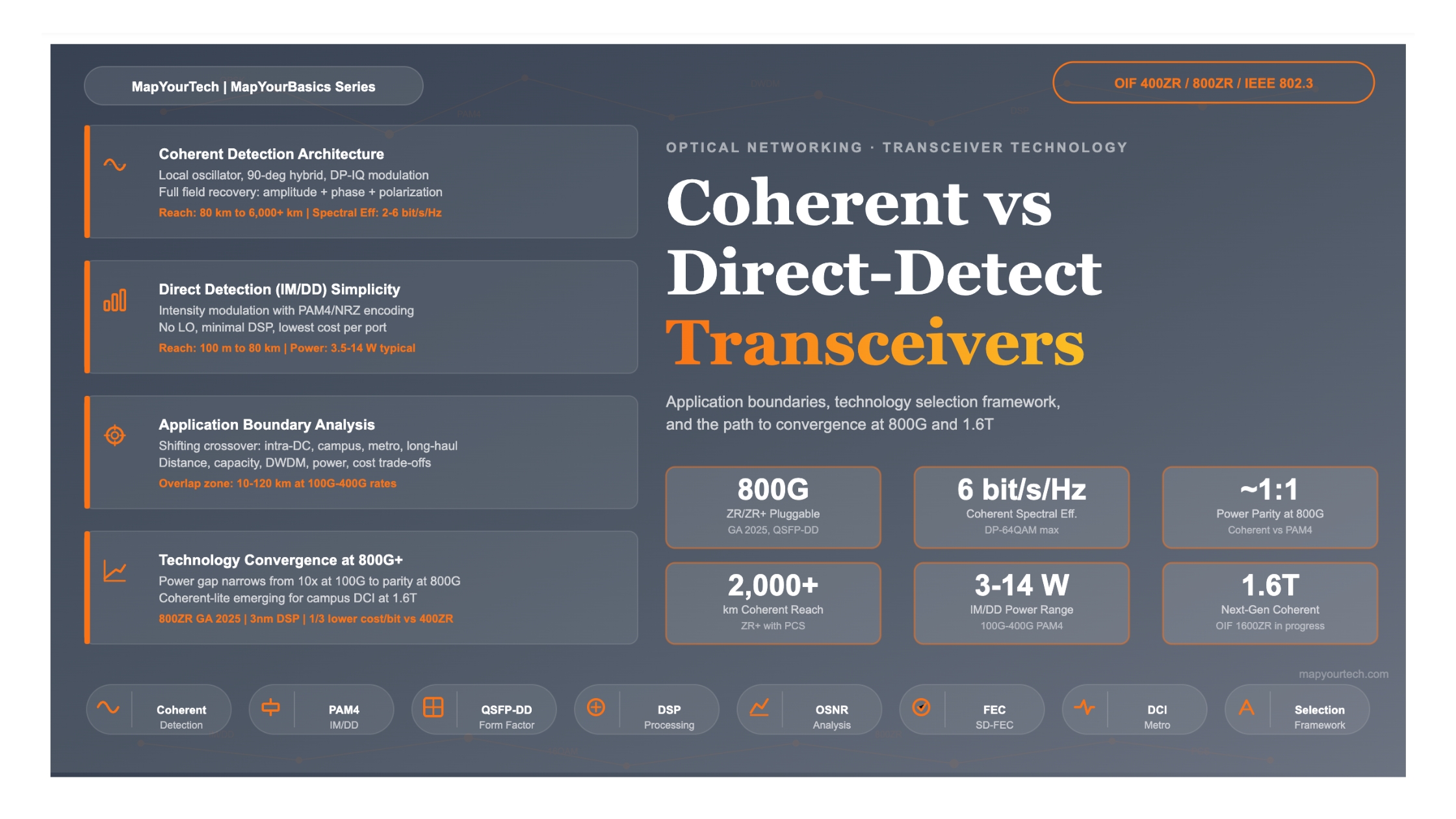
One of the most significant trends reshaping the coherent-vs-direct-detect boundary is the convergence of power consumption at higher data rates. At 100G, the power gap was dramatic: a PAM4 QSFP28 module consumed approximately 3.5 to 4.5 W, while a 100G coherent DWDM module in CFP2 form factor consumed 20 to 25 W, nearly a 10x difference. This gap made direct-detect the obvious choice for any application where its reach was sufficient.
At 400G, the gap narrowed considerably. A 400G-DR4 PAM4 QSFP-DD consumes approximately 12 W, while a 400G ZR coherent QSFP-DD consumes 15-20 W. The ratio dropped from 10x to roughly 1.3 to 1.7x. This narrowing occurred because PAM4 at 400G requires four parallel optical lanes, each with its own laser, modulator, and driver circuitry, while coherent achieves 400G on a single optical carrier.
At 800G, the technologies approach near-parity. An 800G PAM4 module (8 x 100G) consumes approximately 20 W, while an 800G coherent ZR/ZR+ pluggable also consumes approximately 20-25 W. The transition from 5nm to 3nm CMOS for coherent DSPs, as seen in the latest 800G pluggable designs, has been instrumental in driving down coherent power consumption. Looking ahead to 1.6T, coherent actually becomes competitive on power, since PAM4 at 1.6T would require 16 lanes of 100G or 8 lanes of 200G, each demanding more complex driver electronics and multiple optical components, while coherent can potentially serve the same capacity on a single carrier with a next-generation DSP.
Figure 3: Power consumption comparison between direct-detect (PAM4) and coherent transceivers across data rate generations. The gap narrows dramatically from ~10x at 100G to near-parity at 800G, with coherent projected to be competitive at 1.6T.
5. Application Boundaries by Network Segment
5.1 Intra-Data Center (less than 2 km)
Within the data center fabric, where links span from a few meters to about 2 km, direct-detect technology remains firmly dominant. The combination of multimode fiber with 850 nm VCSELs for very short reaches (SR modules, up to 100 m) and single-mode fiber with 1310 nm direct-modulated or externally modulated lasers for reaches up to 2 km (DR/FR modules) provides the lowest cost and lowest power solution. At 400G, the 400G-DR4 (500 m reach, 4 x 100G PAM4) and 400G-FR4 (2 km reach, 4 x 100G PAM4) are the workhorses of this segment, consuming approximately 12-14 W in QSFP-DD form factor.
At 800G, the ecosystem continues to favor IM/DD with 800G-DR8 (8 x 100G PAM4, 500 m reach) and similar variants. However, the transition to 1.6T creates a potential inflection point. With 200G-per-lane PAM4 still maturing and facing signal integrity challenges, coherent-lite solutions at 1.6T may offer a compelling alternative for data center links exceeding 500 m, particularly in hyperscale campuses where buildings are spread over larger distances.
5.2 Campus and Inter-Data Center (2 - 10 km)
The campus DCI segment, featuring distances typically below 10 km, was historically the exclusive domain of direct-detect products. At 100G, modules like 100G-LR4 (10 km reach, 4 x 25G NRZ) served this space perfectly with no amplification or dispersion compensation needed. At 400G, the 400G-FR4 (2 km) and 400G-LR4/LR8 (10 km) continue to serve shorter campus links.
The calculus changes at 800G and above. PAM4 at 200G per lane faces tighter dispersion budgets, and reaching 10 km with 800G direct-detect may require additional amplification, DCF, or more complex equalization. Coherent-lite, with its inherently higher dispersion tolerance and better loss budget (approximately 4 dB or more than IM/DD), becomes an attractive alternative. The first coherent-lite standards at 800G span reaches of 2 to 10 km, and these solutions target power consumption levels competitive with IM/DD while offering the operational simplicity of a single-carrier solution.
5.3 Metro DCI (10 - 120 km)
The metro DCI segment represents the most active battleground between the two technologies. At 100G, direct-detect solutions using PAM4 have pushed into this territory: a 100G QSFP28 PAM4 module can reach up to 80 km with DWDM capability, consuming approximately 4.5 W. Meanwhile, 100G coherent solutions in QSFP28 form factors (100ZR) offer similar reach with DWDM tunability and no external dispersion compensation, consuming approximately 6 W.
At 400G, the OIF 400ZR standard decisively established coherent as the solution of choice for metro DCI. A single 400G ZR pluggable provides 400 Gb/s on one C-band wavelength, tunable across the entire C-band, with reach up to 80 km (ZR) or up to 1,000 km (ZR+ with adaptive modulation). No separate amplifiers or dispersion compensation modules are needed for single-span links. The operational simplicity of plugging a coherent module directly into a router port, combined with DWDM scalability, makes 400G ZR the default choice for any metro DCI link where 100G is insufficient.
At 800G, the same pattern holds. The OIF 800ZR implementation agreement, published in Q4 2024, defines 800G coherent in QSFP-DD/OSFP for single-span DCI up to approximately 120 km. Multiple 800G ZR/ZR+ modules reached general availability in early 2025, offering more than 500 km reach in ZR mode, beyond 1,000 km in high-performance ZR+ modes with probabilistic constellation shaping, and over 2,000 km at reduced data rates. These modules use 3nm DSP technology to achieve power consumption of approximately 20-25 W, cutting cost per bit by up to one-third compared to 400G ZR/ZR+ technology.
5.4 Regional and Long-Haul (120 km to 2,000+ km)
For distances beyond 120 km, coherent detection is the only viable option. No IM/DD technology can operate at these distances without multiple stages of optical amplification and dispersion compensation that would negate its cost and power advantages. Coherent transceivers in this segment typically use DP-QPSK for maximum reach (up to 6,000 km in C-band) or DP-16QAM for higher capacity on shorter regional routes (up to approximately 800 km). Embedded coherent transponders (CFP2-DCO, line-card-based) remain the standard for long-haul and submarine applications where performance requirements exceed what pluggable form factors can deliver.
5.5 Application Boundary Summary
| Segment | Distance | Current Technology (2025) | 400G Solution | 800G Solution | 1.6T Outlook |
|---|---|---|---|---|---|
| Intra-DC Fabric | less than 2 km | IM/DD dominant | 400G-DR4/FR4 (PAM4) | 800G-DR8 (PAM4) | PAM4 or Coherent-lite |
| Campus DCI | 2 - 10 km | IM/DD, Coherent-lite emerging | 400G-LR4 (PAM4) | 800G-LR (PAM4/Coh-lite) | Coherent-lite likely |
| Metro DCI | 10 - 120 km | Coherent dominant | 400G ZR (Coherent) | 800G ZR (Coherent) | 1.6T ZR (Coherent) |
| Regional | 120 - 1,000 km | Coherent only | 400G ZR+ (Coherent) | 800G ZR+ (Coherent) | 1.6T ZR+ (Coherent) |
| Long-Haul | 1,000 - 6,000 km | Coherent only | 400G DCO (DP-QPSK) | 800G DCO (DP-QPSK) | 1.6T DCO (Coherent) |
| Submarine | 6,000+ km | Coherent only (embedded) | Embedded coherent | Embedded coherent | Embedded coherent |
6. Cost, Power, and Economic Analysis
6.1 Total Cost of Ownership Framework
Selecting between coherent and direct-detect transceivers requires analyzing total cost of ownership (TCO) rather than just transceiver unit price. The TCO equation includes the transceiver cost, any external optical components (amplifiers, DCF modules, multiplexers), the host platform (router or transport shelf), power consumption and cooling costs over the equipment lifetime, rack space, and operational complexity.
For a metro DCI link at 400G, consider a 40 km span. A direct-detect approach using four 100G-ER4 QSFP28 modules per direction would require a muxponder or aggregation device, external DWDM multiplexers, and potentially an EDFA for each direction. A coherent approach uses a single 400G ZR QSFP-DD plugged directly into a router port, requiring no external equipment for a single-span link. Despite the higher per-module cost of the coherent pluggable, the elimination of external transport equipment typically results in a lower TCO for the coherent solution at distances above approximately 10 km.
The crossover point where coherent becomes economically preferred has been moving steadily closer to the data center. At 100G, the crossover was around 80 km. At 400G, it dropped to approximately 10-40 km depending on fiber availability and link requirements. At 800G, with coherent pluggable costs declining and PAM4 complexity increasing, the crossover could fall below 10 km for some deployment scenarios by 2026.
6.2 Cost Per Bit Trends
The cost per bit transmitted tells a compelling story. Each new generation of coherent technology has reduced cost per bit by approximately 30-50%. The transition from 400G to 800G coherent pluggables continues this trend, with 800G modules reducing cost per bit by up to one-third compared to 400G ZR/ZR+ technology. Meanwhile, PAM4 cost per bit reduction has slowed because reaching higher aggregated rates requires proportionally more optical lanes, each adding cost.
Figure 4: Relative cost per gigabit comparison across technology generations, showing how coherent cost per bit is declining faster than direct-detect due to single-carrier scaling advantages.
7. Performance Optimization and Advanced Techniques
7.1 Probabilistic Constellation Shaping (PCS)
Probabilistic Constellation Shaping (PCS) is an advanced technique used in coherent transceivers to approach the Shannon capacity limit of the optical channel more closely than traditional uniform QAM constellations. PCS adjusts the probability distribution of constellation points so that lower-amplitude symbols (closer to the origin, more resistant to noise) are transmitted more frequently than higher-amplitude symbols. This effectively reduces the average transmit power while maintaining the same data rate, improving OSNR sensitivity and extending reach.
PCS enables a continuous trade-off between capacity and reach: the same transceiver hardware can be configured to operate at 800G for short metro links using aggressive shaping, or at 400G for regional links using conservative shaping that maximizes reach. This flexibility is a significant advantage of coherent systems that has no equivalent in IM/DD technology, where the modulation format (NRZ or PAM4) is essentially fixed.
7.2 Soft-Decision Forward Error Correction (SD-FEC)
Modern coherent transceivers employ soft-decision FEC algorithms that provide a net coding gain (NCG) of 11-13 dB, compared to approximately 6-9 dB for the hard-decision FEC used in most direct-detect systems. SD-FEC operates at a pre-FEC BER threshold of approximately 1-2 x 10⁻², meaning the system can tolerate a much higher raw error rate and still deliver a post-FEC BER of 10-15. This additional coding gain translates directly into either extended reach or relaxed component specifications.
Effective OSNR gain from SD-FEC vs HD-FEC:

  SD-FEC NCG  = 11-13 dB  (coherent systems, typical)
  HD-FEC NCG  = 6-9 dB    (direct-detect systems, typical)
  Advantage   = 3-6 dB additional margin

This 3-6 dB advantage translates to approximately:
  - 50-100% more transmission distance (for same OSNR budget)
  - 1-2 additional amplifier spans (in multi-span systems)
7.3 Capacity and Reach Trade-offs by Modulation Format
The relationship between modulation format, achievable capacity, and maximum reach is one of the most important engineering considerations in coherent system design. Higher-order modulation formats pack more bits per symbol but require higher OSNR, which limits the achievable distance. The table below summarizes these trade-offs for C-band and C+L band systems:
| Modulation Format | Bits/Symbol | Spectral Eff. (bit/s/Hz) | C-Band Capacity (Tb/s) | C-Band Reach (km) | Required OSNR (dB) |
|---|---|---|---|---|---|
| DP-BPSK | 2 | 1 | ~6 | ~10,000 | ~10-12 |
| DP-QPSK | 4 | 2 | ~12 | ~6,000 | ~13-15 |
| DP-8QAM | 6 | 3 | ~18 | ~2,200 | ~18-20 |
| DP-16QAM | 8 | 4 | ~24 | ~800 | ~21-23 |
| DP-64QAM | 12 | 6 | ~36 | ~80 | ~28-30 |
For direct-detect systems, the capacity-reach picture is simpler but more constrained:
| Module Type | Data Rate | Lanes x Rate | Modulation | Reach | Power (W) |
|---|---|---|---|---|---|
| 400G-DR4 | 400G | 4 x 100G | PAM4 | 500 m | ~12 |
| 400G-FR4 | 400G | 4 x 100G | PAM4 | 2 km | ~14 |
| 400G-LR4 | 400G | 4 x 100G | PAM4 | 10 km | ~14 |
| 800G-DR8 | 800G | 8 x 100G | PAM4 | 500 m | ~20 |
| 400G-ER4 | 400G | 4 x 100G | PAM4 | 40 km | ~15 |
| 100G-FR | 100G | 1 x 100G | PAM4 | 2 km | ~3.5 |
| 100G-LR4 | 100G | 4 x 25G | NRZ | 10 km | ~4.5 |
| 100G-ER4 | 100G | 4 x 25G | NRZ | 40 km | ~4.5 |
8. Technology Selection Framework
Choosing between coherent and direct-detect transceivers requires a structured evaluation across multiple dimensions. The following decision framework captures the key criteria and provides practical guidance for network architects.
8.1 Decision Tree
8.2 Quick Selection Guide
Link distance is below 10 km with no DWDM requirement. Cost per port is the dominant selection criterion, and current capacity needs are at or below 400G per link. The application is point-to-point within a data center campus with abundant fiber. No chromatic dispersion or PMD compensation is needed. Operational simplicity at the optical layer is paramount, and the 3-5 year roadmap does not anticipate exceeding 800G per link.
Link distance exceeds 10 km, or DWDM wavelength scalability is required. The application involves metro DCI, regional, or long-haul transport. Per-wavelength capacity of 400G or higher is needed. Fiber is scarce and must carry multiple wavelengths. IP-over-DWDM architecture is preferred to eliminate standalone transport equipment. Future-proofing for 800G and 1.6T upgrades is a priority. Dispersion compensation must be handled digitally without external DCF modules.
9. Challenges, Emerging Trends, and Future Outlook
9.1 Current Challenges
Both technologies face specific engineering challenges at current and next-generation data rates. For PAM4 direct-detect, the primary challenges are signal integrity at 200G per lane (required for 1.6T with 8 lanes), tighter dispersion budgets that limit reach without compensation, and increased sensitivity to optical noise from using more amplitude levels. The four-level signaling of PAM4 inherently has only one-third the voltage margin between levels compared to NRZ, making it significantly more susceptible to noise and requiring advanced equalization and FEC techniques.
For coherent systems, the challenges include power consumption and thermal management in pluggable form factors, the cost of silicon photonics or InP photonic integrated circuits, and the complexity of DSP algorithms at higher baud rates. The transition from 5nm to 3nm CMOS technology has helped address the power challenge, but further advances will be needed for 1.6T coherent in QSFP-DD form factor.
9.2 The Rise of Coherent-Lite
Perhaps the most significant trend reshaping the technology boundary is the emergence of coherent-lite. This architectural approach uses simplified coherent modulation (typically single-polarization or reduced-complexity DSP) to achieve reaches of 2 to 10 km at 800G and 1.6T while targeting power consumption competitive with PAM4 IM/DD. The rationale is straightforward: as data rates increase, the complexity difference between PAM4 and coherent shrinks, and the advantages of coherent (better dispersion tolerance, higher loss budget, DWDM scalability) become compelling even at shorter distances.
As of early 2025, several DSP vendors have announced coherent-lite products for the 800G and 1.6T generation. These are designed to consume significantly less power than full coherent solutions and be cost-competitive with IM/DD, targeting campus data center applications where PAM4 is reaching its physical limitations. The IEEE 802.3 standardization group has been working on defining 800GBASE-LR1 (10 km), 800GBASE-ER (20 km), and 800GBASE-ER1 (40 km) as interoperable interfaces based on coherent technology, signaling that standards bodies recognize the shift.
9.3 Roadmap to 1.6T and Beyond
The path to 1.6 Tb/s transceivers represents the next major inflection point. The OIF has begun defining 1600ZR for coherent pluggable modules, while IEEE 802.3dj is targeting 200G per lane signaling for Ethernet. At 1.6T, both PAM4 and coherent face significant challenges, but the trade-offs shift further in coherent's favor for several reasons. PAM4 at 1.6T requires either 16 lanes of 100G or 8 lanes of 200G, driving up both power consumption and module complexity. Coherent at 1.6T uses a single optical carrier with advanced modulation and higher baud rates (approximately 140-200 GBaud), leveraging 3nm or future 2nm CMOS for the DSP. This single-carrier approach offers inherently better spectral efficiency and fiber utilization.
The industry roadmap beyond 1.6T points toward 3.2T and eventually higher rates, where the OIF has launched the framework for 448 Gb/s per lane signaling. At these extreme data rates, the convergence of coherent and direct-detect may become complete, with some form of coherent modulation becoming the universal technology across all network segments.
Figure 6: Technology convergence timeline showing how the power-per-bit gap between coherent and IM/DD narrows with each generation, with a projected crossover at 1.6T.
10. Practical Deployment Examples
10.1 Hyperscale Data Center Campus
A hyperscale cloud provider operates a campus with multiple data center buildings separated by distances of 500 m to 5 km. Intra-building fabric uses 400G-DR4 PAM4 (500 m reach, 12 W) for spine-leaf connections. Inter-building links within 2 km use 400G-FR4 PAM4 (14 W). For connections to a centralized hub building at 5 km, the provider evaluates 400G-LR4 PAM4 versus 400G ZR coherent. The ZR option, while consuming 15-20 W versus 14 W for LR4, provides DWDM capability that allows multiple 400G wavelengths on each fiber pair, significantly reducing fiber consumption. The provider selects ZR for the 5 km hub links, achieving up to 38.4 Tb/s capacity (96 wavelengths x 400G) on a single fiber pair, versus 400G on separate fibers with LR4.
10.2 Metro Service Provider DCI
A service provider connects three metro data centers with spans of 40 km, 65 km, and 90 km. At these distances, direct-detect solutions would require external EDFAs, DWDM multiplexers, and dispersion compensation, creating a multi-component optical line system. The provider instead deploys 400G ZR pluggables directly in routers for the 40 km and 65 km spans, and 400G ZR+ with adaptive modulation for the 90 km span. The ZR+ transceivers automatically select the optimal modulation format based on the link conditions, operating at DP-16QAM for 400G where the OSNR is sufficient, or falling back to DP-8QAM at 300G for the longest span. This IP-over-DWDM architecture eliminates the separate transport layer, reducing total equipment count by approximately 40% and cutting power consumption by approximately 30% compared to a traditional architecture with external transponders.
10.3 Enterprise WAN with Mixed Distances
An enterprise operates a regional WAN connecting a headquarters to seven branch offices at distances ranging from 2 km to 200 km. For the three nearest branches (2-8 km), the enterprise uses 100G-LR4 direct-detect QSFP28 modules at approximately 4.5 W each. For the four distant branches (40-200 km), 100G coherent QSFP28 modules provide tunable DWDM capability at approximately 6 W. The coherent modules for the longer links also provide built-in CD and PMD compensation, eliminating the need for external dispersion compensation modules that would otherwise be required at 100G over fiber spans with significant accumulated dispersion.
11. Conclusion and Recommendations
The boundary between coherent and direct-detect transceivers is not a fixed line but a shifting zone influenced by data rate generation, transceiver technology maturity, and specific application requirements. As of 2025, a clear framework emerges from the analysis:
Direct-detect (IM/DD) remains the optimal choice for intra-data-center links below 2 km and campus links below 10 km, where its lower cost and simpler architecture provide clear advantages at 400G and below. PAM4 at 100G per lane has proven robust for these applications, and the ecosystem is mature with high-volume manufacturing driving costs down.
Coherent detection is established as the default for metro DCI (10-120 km) through 400ZR/800ZR, for all regional and long-haul transport, and for any application requiring DWDM wavelength scalability. The pluggable coherent revolution, enabled by miniaturization into QSFP-DD and OSFP form factors, has fundamentally changed how networks are designed by allowing IP-over-DWDM architectures that eliminate separate transport layers.
The emerging convergence at 800G and 1.6T is the most important trend to watch. As both technologies scale to higher data rates, their power consumption and cost per bit converge, while coherent's inherent advantages in dispersion tolerance, loss budget, and spectral efficiency become increasingly valuable. Coherent-lite architectures promise to extend coherent's reach into the data center campus segment, potentially inside the data center itself at 1.6T and beyond.
For network architects making technology decisions now, the recommendation is to use direct-detect for short-reach, cost-sensitive applications at current data rates, coherent for anything beyond 10 km or requiring DWDM, and to plan for coherent-lite evaluation as 1.6T requirements materialize. The optical transceiver industry is moving toward a future where some form of coherent modulation may become universal, but the transition will be gradual and application-specific.
- Direct-detect (PAM4) dominates intra-DC and campus links below 10 km, where cost and power efficiency are the primary selection criteria at data rates up to 800G.
- Coherent pluggables (400ZR/800ZR) have become the default for metro DCI (10-120 km), with the OIF 800ZR standard published in Q4 2024 and modules reaching general availability in early 2025.
- The power consumption gap between coherent and direct-detect has narrowed from approximately 10x at 100G to near-parity at 800G, driven by 3nm CMOS DSP technology in coherent systems.
- Coherent-lite architectures are emerging for the 2-10 km campus DCI segment at 800G and 1.6T, targeting power consumption competitive with IM/DD while offering superior loss budget and dispersion tolerance.
- At 1.6T and beyond, coherent is projected to become competitive on cost per bit even for shorter reaches, as PAM4 complexity and lane count increase faster than coherent DSP power consumption.
12. Glossary
13. References
[1] OIF Implementation Agreement — 400ZR, Optical Internetworking Forum.
[2] OIF Implementation Agreement — 800ZR, Optical Internetworking Forum.
[3] IEEE 802.3bs — 200 Gb/s and 400 Gb/s Ethernet.
[4] IEEE 802.3df — 200 Gb/s, 400 Gb/s, and 800 Gb/s Ethernet.
[5] IEEE 802.3dj — 200 Gb/s, 400 Gb/s, 800 Gb/s, and 1.6 Tb/s Ethernet Task Force.
[6] ITU-T Recommendation G.694.1 — Spectral grids for WDM applications: DWDM frequency grid.
[7] ITU-T Recommendation G.698.2 — Amplified multichannel DWDM applications with single channel optical interfaces.
[8] OpenROADM Multi-Source Agreement — Device and network models for coherent pluggable transceivers.
[9] Sanjay Yadav, "Optical Network Communications: An Engineer's Perspective" – Bridge the Gap Between Theory and Practice in Optical Networking.
Developed by MapYourTech Team
For educational purposes in Optical Networking Communications Technologies
Note: This guide is based on industry standards, best practices, and real-world implementation experiences. Specific implementations may vary based on equipment vendors, network topology, and regulatory requirements. Always consult with qualified network engineers and follow vendor documentation for actual deployments.
Feedback Welcome: If you have any suggestions, corrections, or improvements to propose, please feel free to write to us at [email protected]