
Stimulated Brillouin Scattering: Threshold Power, Line Narrowing Effect, and Launch Power Mitigation
1. Introduction
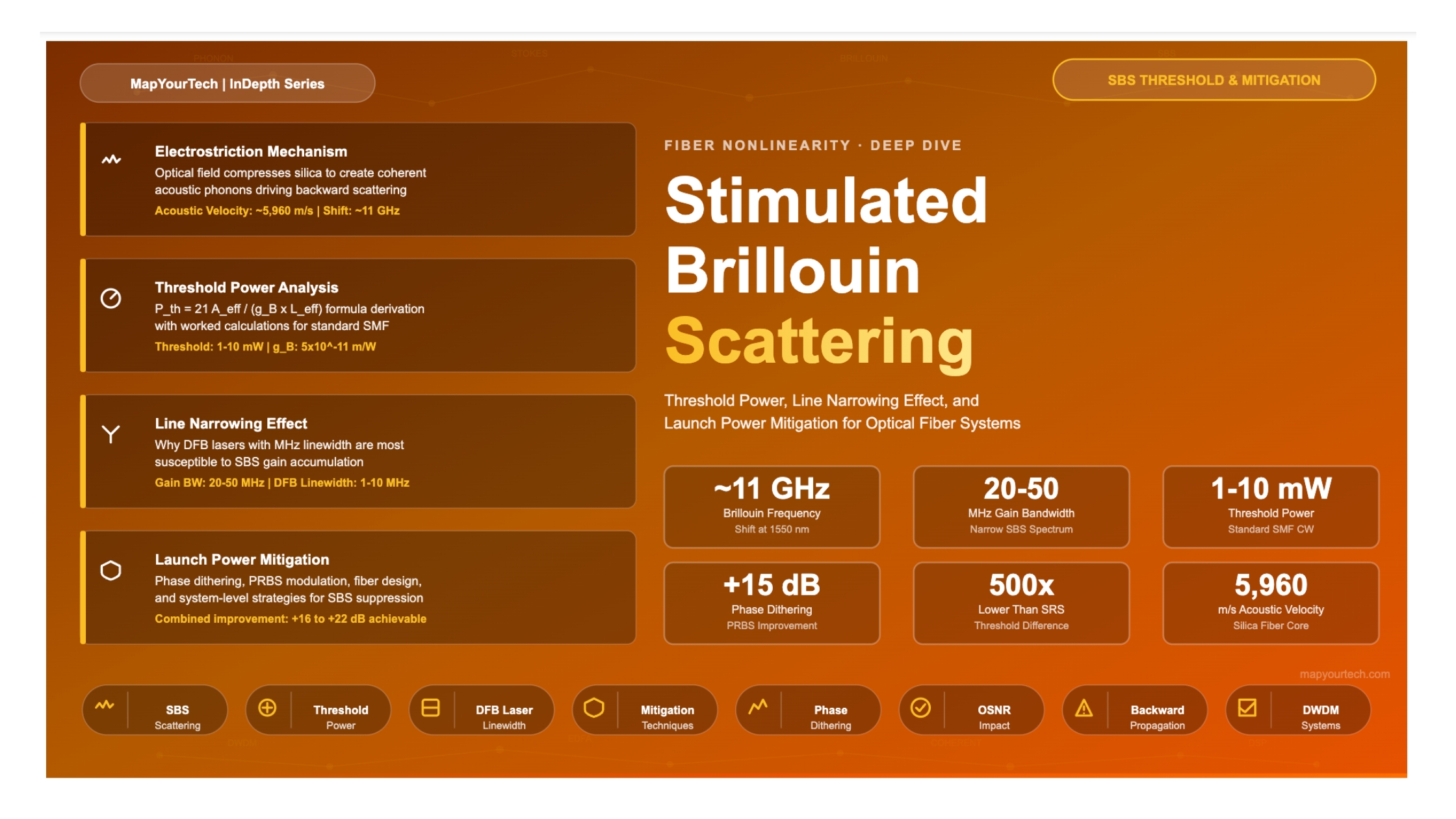
Every optical fiber transmission system operates within a power window bounded on the low side by receiver sensitivity and noise accumulation, and on the high side by fiber nonlinearities. Among the nonlinear effects that constrain the upper power boundary, Stimulated Brillouin Scattering (SBS) stands out for two reasons: it has the lowest power threshold of any major nonlinear impairment in standard single-mode fiber (SMF), and it is the only significant nonlinearity that propagates exclusively in the backward direction. These properties make SBS the most immediate per-channel power limiter for narrow-linewidth optical sources, with typical threshold values in the range of 6–10 dBm (4–10 mW) for continuous-wave (CW) signals in standard SMF spans.
SBS arises from the interaction between the optical field and thermally excited acoustic phonons within the silica glass core. When the launched optical power exceeds a critical threshold, this interaction becomes a positive-feedback loop: the optical field reinforces the acoustic wave through electrostriction, the strengthened acoustic wave scatters more light backward, and the backscattered Stokes wave grows exponentially. The result is a hard ceiling on forward-propagating power. Any optical energy that would have traveled toward the receiver is instead reflected back toward the transmitter.
Understanding SBS is important across multiple system contexts. In directly modulated Dense Wavelength Division Multiplexing (DWDM) systems using distributed feedback (DFB) laser sources — which have narrow intrinsic linewidths on the order of a few hundred MHz or less — SBS can dominate the nonlinear landscape. Even in modern coherent systems employing advanced modulation formats like Dual Polarization Quadrature Phase Shift Keying (DP-QPSK) or 16-level Quadrature Amplitude Modulation (16-QAM), SBS remains a design consideration when per-channel launch powers approach or exceed +3 dBm, particularly at lower baud rates where the spectral power density is higher.
This article provides a comprehensive engineering treatment of SBS, covering the electrostriction mechanism and acoustic phonon generation, the threshold power formula and the factors that govern it, the line narrowing effect that explains why narrow-linewidth sources are most susceptible, practical mitigation techniques including phase dithering and linewidth broadening, and the interaction between SBS and modern modulation formats. The goal is to equip network engineers and system designers with both the theoretical foundation and practical tools to manage SBS effectively in real-world deployments.
SBS sets a hard per-channel power ceiling that cannot be exceeded simply by increasing amplifier output. In a long-haul DWDM system where an erbium-doped fiber amplifier (EDFA) delivers +10 dBm per channel, but the SBS threshold sits at +7 dBm, the excess power is reflected backward — reducing the Optical Signal-to-Noise Ratio (OSNR) at the receiver, potentially damaging upstream components, and wasting amplifier capacity. Mitigation techniques exist, but they must be planned into the system design from the start.
2. Fundamental Principles of Stimulated Brillouin Scattering
2.1 Electrostriction and Acoustic Wave Generation
The physical origin of Brillouin scattering lies in electrostriction — the tendency of dielectric materials to compress in the presence of an electric field. When a high-intensity optical wave propagates through silica fiber, its oscillating electric field creates periodic regions of compression and rarefaction in the glass. These density fluctuations constitute a traveling acoustic wave (a coherent phonon field) that propagates along the fiber at the speed of sound in silica, approximately 5,960 m/s.
At low optical power levels, the fiber already contains thermally excited acoustic phonons at all frequencies. Spontaneous Brillouin scattering occurs when incident photons scatter from these thermal phonons, producing a weak backscattered wave that is frequency-downshifted by the Brillouin frequency shift. This spontaneous process is very weak — the seed for the backscattered wave comes from quantum fluctuations and thermal noise in the material.
The transition to stimulated Brillouin scattering occurs when the forward-propagating pump wave and the backward-propagating Stokes wave are both strong enough to coherently drive the acoustic wave through electrostriction. The pump and Stokes waves beat together, creating an interference pattern that moves at the acoustic velocity. This moving intensity pattern reinforces the acoustic wave, which in turn increases the scattering efficiency, which further amplifies the Stokes wave. This positive feedback loop is the hallmark of the stimulated process, and it causes the backscattered power to grow exponentially once the threshold is crossed.
Read the Full Analysis with Premium
The remaining 88% of this article — the design numbers, trade-offs and field guidance — is part of MapYourTech Premium, along with the full premium library, courses and professional tools.