
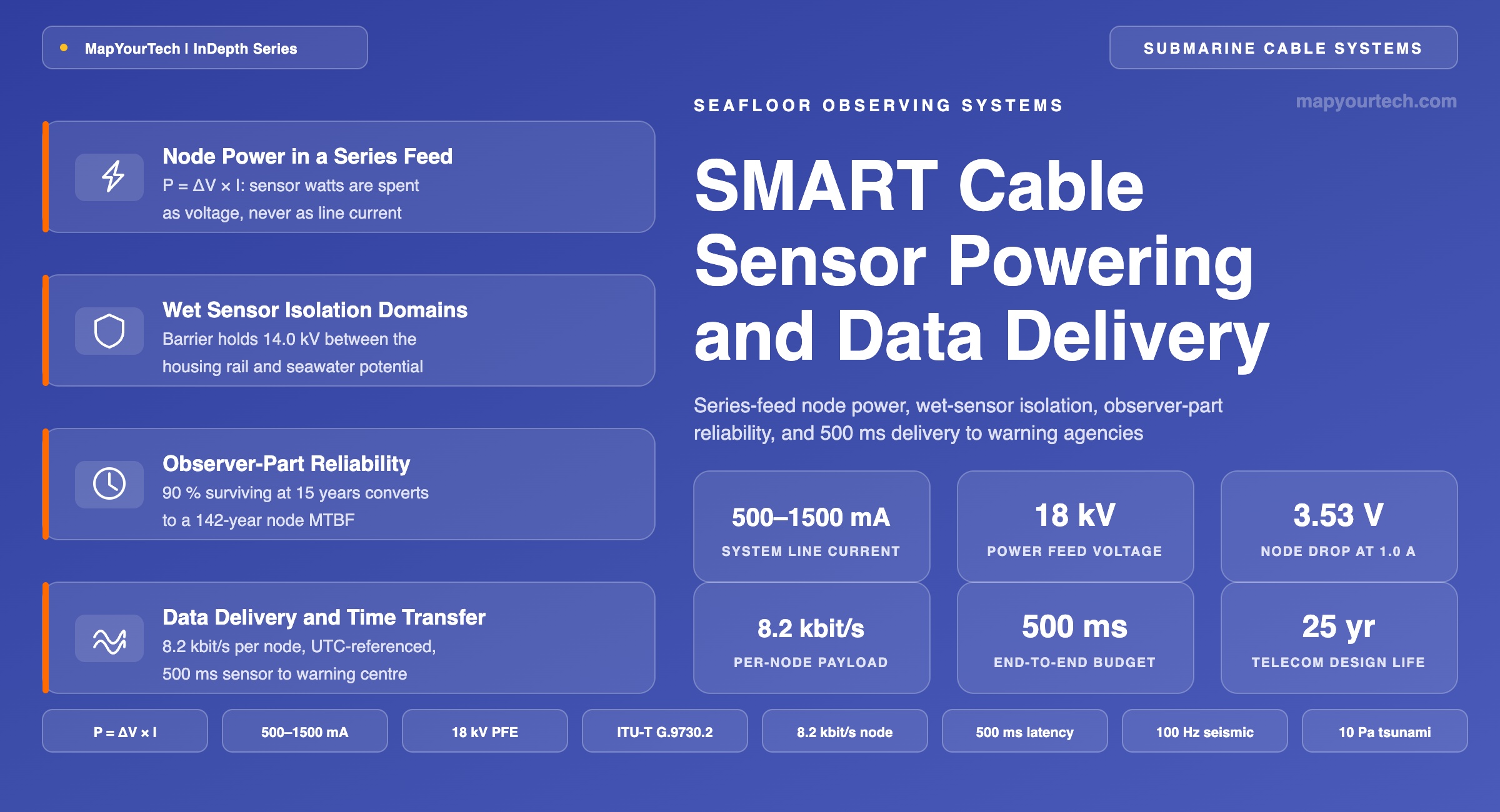
SMART Cable Sensor Integration, Powering and Data Delivery
Sensor pods powered from the system line current, wet sensors isolated from the node potential relative to seawater, observer-part reliability stated apart from the telecom part, and sensor records delivered to warning agencies and open repositories.
Fiber is the part of the network that outlives its designers.
What You Will Learn
- Define the scientific subsystem, the sensor set and the observer part in the terms fixed by ITU-T G.9730.2, and place each one on the anatomy of Fig. 1.
- Place temperature, pressure and three-axis acceleration sensors across repeater housings, external pods and dedicated nodes against the trade-offs in Table 2.
- Quantify the line-voltage overhead a node adds from ΔV = P_sci / I_line — 1.67 V at 1.5 W and 0.9 A, and 33.4 V across a twenty-node ring.
- Build the wet-sensor isolation chain of Fig. 3 so a sensor shunt fault stays off a power conductor sitting several kV above seawater.
- Convert a sampling configuration into a channel rate: three axes at 200 Hz and 24 bit per sample give 14.4 kb/s from one accelerometer.
- Anchor the delivery chain against a 500 ms sensor-to-centre budget and a timestamp target below 1 ms, using the contributions in Chart 2.
- State observer-part reliability separately from telecom reliability in the confidence-and-fraction form of Section 7, and price the consequence of no sensor repair.
- Select between SMART point sensors, distributed fibre optic sensing and cabled observatories using the comparison in Section 11.
1. Introduction
A sensor set on a SMART cable draws its power from the same constant direct current that energises the optical amplifiers along the route, and that single arrangement fixes most of the engineering that follows. ITU-T G.9730.2 expands SMART as Scientific Monitoring and Reliable Telecommunications; the Joint Task Force that promotes the concept writes it as Science Monitoring And Reliable Telecommunications. Either way the object is the same: a commercial telecommunications cable that also carries temperature, pressure and three-axis acceleration sensors at intervals along its length, with no separate power feed, no separate cable and no separate repair programme.
Deep-ocean coverage is the reason the concept exists. Seafloor pressure gauges and seismometers sit in a small number of locations, and the ocean basins that generate tsunamis are the places where instruments are hardest to install and hardest to maintain. Submarine telecommunications cables already cross those basins, already carry conductors energised from shore, and already have a fibre path back to a staffed terminal station. Adding a sensor set to a repeater span reuses all three, which is what makes the incremental cost per observing site a small fraction of a standalone observatory. The Joint Task Force behind the initiative is sponsored by the International Telecommunication Union (ITU), the World Meteorological Organization (WMO) and the Intergovernmental Oceanographic Commission of UNESCO (IOC-UNESCO), and has been running since 2012.
Three deployments now anchor the discussion in hardware rather than proposals. A 21 km wet demonstration system off Catania, Sicily, placed accelerometers and seismometers inside repeater housings with temperature and pressure sensors positioned about 30 m away, and has returned real-time data since December 2023 (project-reported). The Tamtam system between Vanuatu and New Caledonia carries four climate-change nodes across a 375 km route; its supply contract entered into force in December 2025 with service scheduled for the end of 2027 (supplier announcement). The Atlantic CAM ring linking mainland Portugal, the Azores and Madeira runs about 3,700 km with roughly twenty sensor nodes, several of them concentrated near the seismically active Gorringe Bank (project announcement). A universal sensor package built for retrofit was installed by remotely operated vehicle at the Ocean Networks Canada NEPTUNE observatory in September 2025 (developer announcement).
This article covers the five boundaries where the scientific subsystem meets the telecommunications system: how sensor sets are integrated and placed, how they are powered from the line current, how wet sensors are isolated from a node potential that reaches several kilovolts relative to seawater, how reliability is stated apart from the telecom part, and how records reach warning agencies and open repositories inside a usable latency. Two ITU-T Recommendations set the frame. G.9730.2 covers telecommunications cables carrying scientific sensors; G.9730.1 covers dedicated scientific sensing cable systems, where sensing is the purpose of the cable rather than an addition to it.
Vendor material uses names such as climate change node or CC node for the sensing assembly, while the ITU-T Recommendations use scientific subsystem and sensor set. The vendor name identifies a product; the Recommendation terms identify functions and are what a specification should reference. This article uses the Recommendation terms, and marks vendor names where deployment facts require them.
2. Scientific Subsystem Definition and Component Terms
A scientific subsystem is the monitoring assembly a SMART cable carries alongside its telecommunications equipment: a sensor set, its dedicated power supply, and its data transmission components. A sensor set is one temperature sensor, one pressure sensor and three accelerometers each sensing one axis, co-located at one point on the cable and reporting in natural units.
Natural units are degrees Celsius for temperature, pascals for pressure and metres per second squared for acceleration, carried through to the stored record so that no downstream user has to reverse a vendor scaling factor. Each sample also carries the time at which it was recorded, which Section 6 treats as a requirement in its own right.
Read the Full Analysis with Premium
The remaining 89% of this article — the design numbers, trade-offs and field guidance — is part of MapYourTech Premium, along with the full premium library, courses and professional tools.
You May Also Like
-
Free
-
August 22, 2026
-
Premium
-
August 22, 2026
-
Premium
-
August 22, 2026