
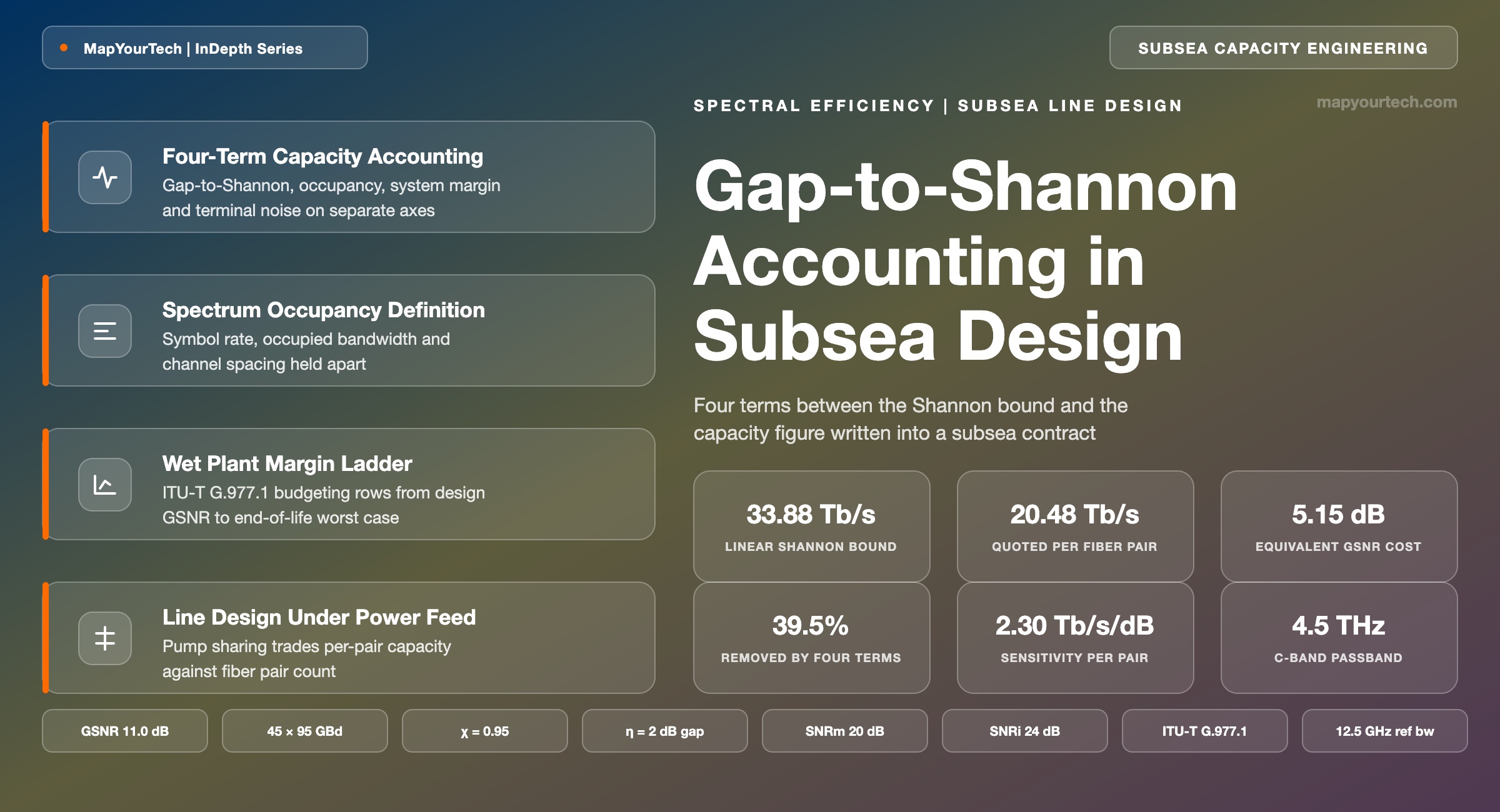
Spectral Efficiency Limits and Gap-to-Shannon Accounting in Subsea Line Design
Four terms separate a Shannon bound from the capacity written into a subsea contract: the gap-to-Shannon allowance near 2 dB, spectrum occupancy near 0.95, system margin, and terminal noise.
Spectral efficiency is a ratio, so name both of its terms.
What You Will Learn
- Define the gap-to-Shannon allowance, spectrum occupancy, system margin and terminal noise as four separate quantities, and state which axis of the capacity formula each one acts on (Section 2, Fig. 1).
- Convert a generalized optical signal-to-noise ratio of 19.8 dB in a 12.5 GHz reference bandwidth into a generalized signal-to-noise ratio of 11.0 dB at 95 GBd, and place the occupancy factor on one side of that conversion only.
- Build the reciprocal sum 1/SNRtot = 1/GSNR + 1/SNRm + 1/SNRi and reproduce the reference case value of 10.30 dB from a wet plant figure of 11.0 dB (Section 6).
- Work a 4.5 THz C-band fiber pair from a 33.9 Tb/s linear bound down to a quoted 20.5 Tb/s, and attribute each of the four deductions to a stage in the waterfall (Section 6, Fig. 1, Chart 2).
- Quantify the accounting as an equivalent wet plant cost of 5.15 dB of GSNR, and convert that figure into pump power and fiber pair count under a fixed power feed budget (Section 9).
- Select a margin allocation that matches the ITU-T G.977.1 budgeting rows rather than adding a second flat 2 dB on top of an end-of-life worst-case GSNR, which overstates the deduction by 4.4 Tb/s per fiber pair (Section 7, Fig. 4).
- Anchor sensitivity at 2.30 Tb/s per decibel per fiber pair and 36.8 Tb/s per decibel across a 16 fiber pair cable, then rank the four terms by capacity returned per decibel recovered (Section 8, Chart 4).
- Construct a capacity table for three line designs at 12, 20 and 32 fiber pairs and show cable capacity rising from 262 to 508 Tb/s while per-fiber capacity falls (Section 9, Table 5, Chart 3).
1. Introduction
A subsea supply contract quotes one capacity figure per fiber pair, and that figure is never the Shannon capacity of the fiber pair. On the reference system worked through this article, a 4.5 THz C-band passband delivering a generalized signal-to-noise ratio (GSNR) of 11.0 dB at the receive terminal, the linear Shannon bound evaluates to 33.88 Tb/s (theoretical limit, computed from the stated GSNR). The figure a supplier commits to on the same fiber pair is 20.5 Tb/s (computed from the four-term accounting derived in Section 6). The 13.4 Tb/s between those two numbers is 39.5% of the bound, and it is not measurement error, vendor conservatism, or a rounding convention. It is four named engineering allowances, each with a physical mechanism behind it, each owned by a different party to the contract, and each recoverable or forfeitable by specific design decisions.
Those four allowances are the subject of this article. The gap-to-Shannon allowance, conventionally about 2 dB on a modern coherent transceiver, covers the shortfall between an ideal capacity-achieving code operating on a Gaussian input distribution and a deployed forward error correction (FEC) engine operating on a probabilistically shaped quadrature amplitude modulation (QAM) constellation. Spectrum occupancy, conventionally about 0.95, covers the fraction of the amplifier passband that carries symbols rather than guard band, dead band, or monitoring channel. System margin, conventionally 2 dB on a transoceanic system, covers ageing of the pump lasers, splice loss added by cable repairs over a 25-year design life, and the spectral spread between the average and worst channel. Terminal noise, expressed as a modem signal-to-noise ratio SNRm near 20 dB and an impairment signal-to-noise ratio SNRi near 24 dB, covers everything the transceiver adds that the wet plant did not.
The reason these four terms need naming rather than lumping is that they do not act on the same axis of the capacity formula. Two of them divide the signal-to-noise ratio inside the logarithm, one multiplies the bandwidth outside it, and one enters by reciprocal addition before either. A single lumped penalty in decibels reproduces the right answer only at one operating point, and a subsea system moves across operating points every time the design changes fiber pair count, repeater output power, or span length. The linear Shannon bound for a fiber channel sets the ceiling; the accounting below sets the contract.
The commercial pressure on this arithmetic has increased sharply. Open cable procurement separates the wet plant from the terminal equipment, so the supplier who builds the repeaters is not the supplier who supplies the modems, and the capacity number has to be predicted from a wet plant metric before the modems exist. Open cable architectures formalise that split through GSNR, which describes the cable alone. Spectrum sharing agreements go further and sell a slice of the passband rather than a set of wavelengths, with the allocation frequently expressed as a percentage of the Shannon capacity of the slice. When a fraction of a bound becomes the unit of trade, the terms that convert the bound into deliverable throughput stop being an internal design detail and become a contract term.
Spatial division multiplexing (SDM) has raised the stakes again. Once cable capacity became limited by the electrical power that can be fed from shore rather than by the capacity of any single fiber, the design question changed from maximizing capacity per fiber to maximizing capacity per volt. Power-constrained subsea transmission pushes systems toward more fiber pairs at lower GSNR, which moves the operating point down the logarithm to where each decibel buys more capacity per decibel spent. A 2 dB allowance that looked like a modest deduction on a 20 dB GSNR turnkey system is a large deduction on an 8 dB GSNR SDM design. The accounting has to travel with the design, and the only way it travels correctly is if each term keeps its own identity.
This article defines each of the four terms from first principles, states the axis it acts on, builds the complete capacity expression, works one reference fiber pair from 33.88 Tb/s to 20.5 Tb/s with every intermediate value shown, and then extends the same accounting to three line designs at 12, 20 and 32 fiber pairs under a fixed power feed budget. It covers C-band repeatered transoceanic systems using single-mode fiber and coherent terminal equipment. It does not cover unrepeatered systems, multiband transmission beyond C+L, or the nonlinear modelling that produces GSNR in the first place, all of which are treated as inputs here rather than derived.
Takeaway: The distance between a Shannon bound and a quoted subsea capacity is four named allowances acting on two different axes of the same formula, not a single lumped penalty. On the reference fiber pair they remove 13.4 Tb/s from a 33.88 Tb/s bound, and each one is owned by a different party to the supply contract.
Read the Full Analysis with Premium
The remaining 89% of this article — the design numbers, trade-offs and field guidance — is part of MapYourTech Premium, along with the full premium library, courses and professional tools.
You May Also Like
-
Premium
-
August 22, 2026
-
Premium
-
August 21, 2026
-
Premium
-
August 21, 2026