Here the results are after evaluating the effect of a thermal variation on the output tilt. In this particular set-up the amplifier is kept at room temperature (25 °C) and only the active fiber spool undergo a thermal cycle. Temperature of the EDFA is varied from 0 °C to 65 °C and the amplifier gain is measured at four point : 0, 25, 40 and 65 °C.
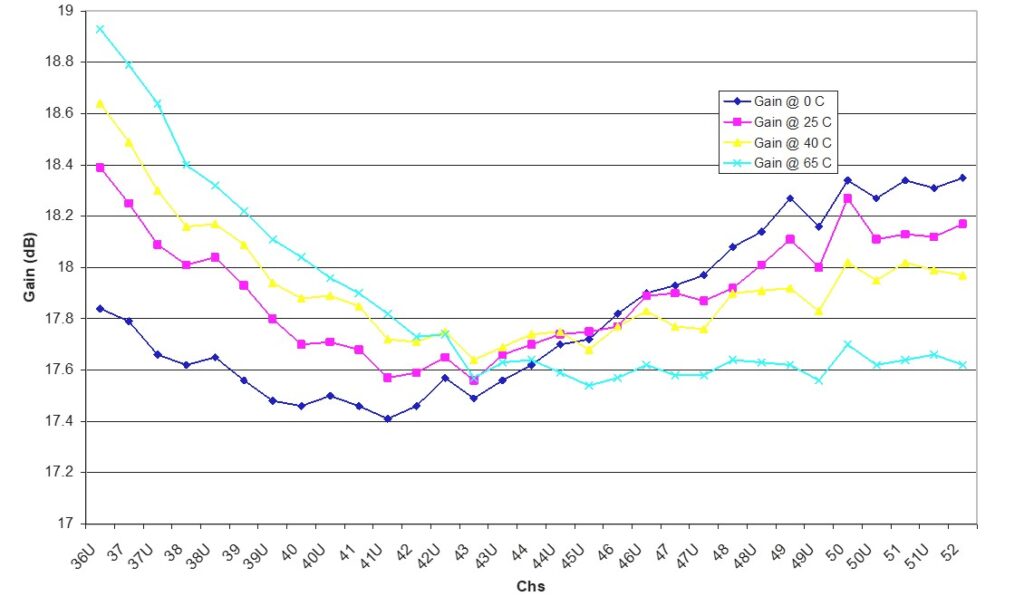
As can be seen a 65 °C temperature variation implies a 1.8 dB tilt variation. Considering a reduced temperature range (5-45 °C) the output tilt variation is about 1.1 dB.
It was tried to investigate the origin of the temperature dependency. First used a different EDFA with a lower erbium concentration (14 dB/m erbium peak absorption); then tried to reduce the saturation of the EDFA using lower power levels, but in both cases the output tilt variation was very similar to that of Figure .
Temperature variation has also effect on the EDFA efficiency: with high temperature the active fiber is less efficient than at low temperature.
With constant pumps power, a 65°C variation implies a 0.25 dB difference on the output power. To compensate this extra tilt we can act in two way: using the VOA ; heating the EDFA to a constant 65 °C.
First solution requires a thermal sensor to measure the EDFA temperature and a compensation table (stored in the firmware) to act on VOA attenuation.
Second solution requires a heater and special mechanics & software to store the EDFA spool and to keep their temperature constant.