Generic selectors
Exact matches only
Search in title
Search in content
Post Type Selectors
Articles
lp_course
lp_lesson
Back
HomeAnalysisUnderstanding multipliers and divisors value in calculating OTN frame rates (255,239,238,237 etc) for OPUk,ODUk and OTUk
otn-rates-1

Understanding multipliers and divisors value in calculating OTN frame rates (255,239,238,237 etc) for OPUk,ODUk and OTUk

Last Updated: August 16, 2025
3 min read
76

**Multiplicative factor is just a simple math :eg. for ODU1/OPU1=3824/3808={(239*16)/(238*16)}

Here value of multiplication factor will give the number of times for rise in the frame size after adding header/overhead.

Example:let consider y=(x+delta[x])/xIn terms of OTN frame here delta[x] is increment of Overhead.

As we are using Reed Soloman(255,239) i.e we are dividing 4080bytes in sixteen frames (The forward error correction for the OTU-k uses 16-byte interleaved codecs using a Reed- Solomon S(255,239) code. The RS(255,239) code operates on byte symbols.).Hence 4080/16=255.

Try to understand using OTN frames now. I have tried to make it legible.

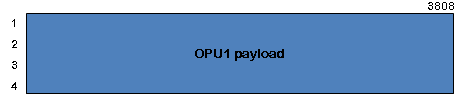
As we know that OPU1 payload rate= 2.488 Gbps (OC48/STM16) and is  frame size is 4*3808 as below.

Understanding multipliers and divisors value in calculating OTN frame rates (255,239,238,237 etc) for OPUk,ODUk and OTUk - Image 1Understanding multipliers and divisors value in calculating OTN frame rates (255,239,238,237 etc) for OPUk,ODUk and OTUk - Image 2

*After adding OPU1 and ODU1 16 bytes overhead: Frames could be fragmented into following number of chunks.

3808/16 = 238, (3808+16)/16 = 239

Understanding multipliers and divisors value in calculating OTN frame rates (255,239,238,237 etc) for OPUk,ODUk and OTUk - Image 3Understanding multipliers and divisors value in calculating OTN frame rates (255,239,238,237 etc) for OPUk,ODUk and OTUk - Image 4

So, ODU1 rate: 2.488 x 239/238** ~ 2.499Gbps

*Now after adding  FEC bytes

Understanding multipliers and divisors value in calculating OTN frame rates (255,239,238,237 etc) for OPUk,ODUk and OTUk - Image 5Understanding multipliers and divisors value in calculating OTN frame rates (255,239,238,237 etc) for OPUk,ODUk and OTUk - Image 6

OTU1 rate: ODU1 x 255/239 = 2.488 x 239/238 x 255/239

=2.488 x 255/238 ~2.667Gbps


Now let’s have a small discussion over different multiplier and divisor scenarios that will make it clearer to understand.

We know that an OTU frame 4 * 4080 bytes (= 255 * 16 * 4)
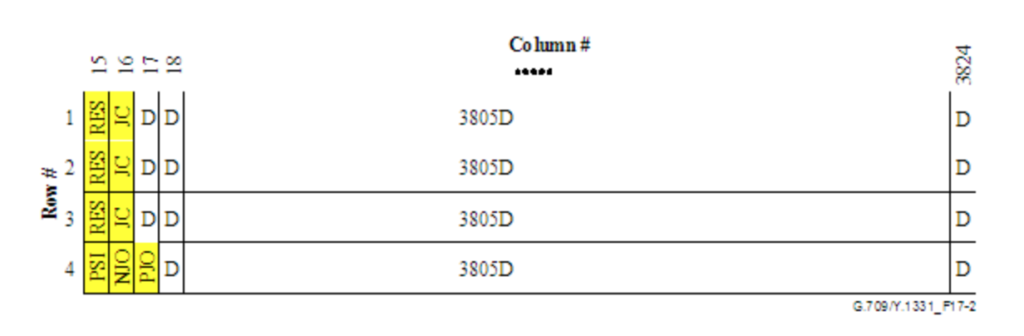
Understanding multipliers and divisors value in calculating OTN frame rates (255,239,238,237 etc) for OPUk,ODUk and OTUk - Image 7Understanding multipliers and divisors value in calculating OTN frame rates (255,239,238,237 etc) for OPUk,ODUk and OTUk - Image 8

OPU representing the Payload (3824-16) * 4 * 4 = 3808 bytes (= 238 * 16 * 4) .

OPU1 is exactly the rate of STM-16.

Now,

ODU1 = (3824/3808) * OPU1 = ((16 * 239) / (238 16 *)) * OPU1 = (239/238) * STM-16

OTU1 = (4080/3808) * OPU1 = ((255 * 16) / (238 * 16)) * OPU1 = (255/238) * STM-16
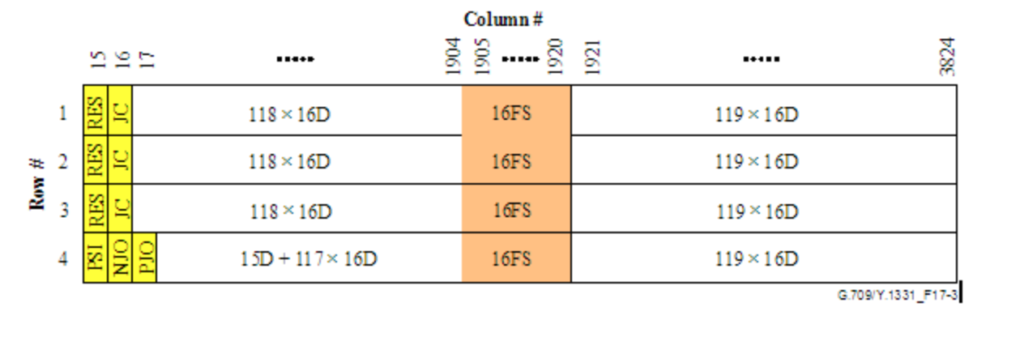
Understanding multipliers and divisors value in calculating OTN frame rates (255,239,238,237 etc) for OPUk,ODUk and OTUk - Image 9


OPU2 contains 16 * 4 = 64 bytes of fixed stuff (FS) added to the 1905 to 1920 .

OPU2 * ((238 * 16 * 4-16 * 4) / (238 * 16 * 4)) = STM-64 rate

OPU2 = 238 / (238-1) * STM-64 = 238/237* STM-64 rate

ODU2 = (239/237) * STM-64 rate ,

similarly


OTU2 = ( 255/237) * STM-64 rate
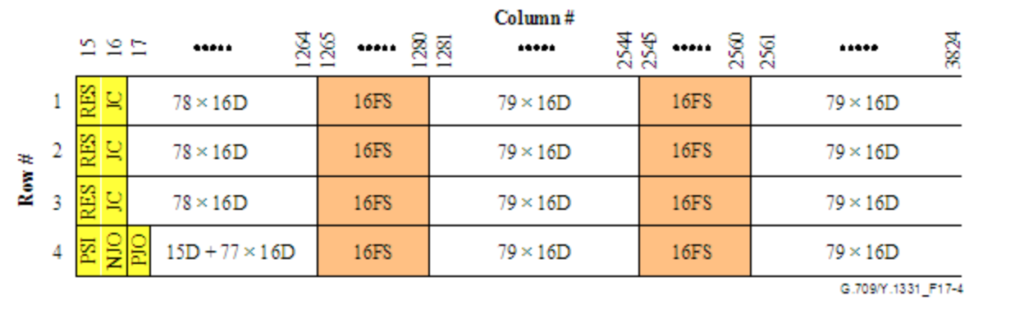
Understanding multipliers and divisors value in calculating OTN frame rates (255,239,238,237 etc) for OPUk,ODUk and OTUk - Image 10Understanding multipliers and divisors value in calculating OTN frame rates (255,239,238,237 etc) for OPUk,ODUk and OTUk - Image 11

OPU3 Including 2 * 16 * 4 = 128 fixed stuff (FS) bytes added to the 1265 ~ 1280 and 2545 ~ 2560

OPU3 * ((238 * 16 * 4-2 * 16 * 4) / (238 * 16 * 4)) = rate of STM-256

OPU3 = 238 / (238-2) * STM-256 = 238/236 * STM-256

ODU3 = (239 / 236) * STM-256

OTU3 = (255/236) * STM-256

The OTU4 was required to transport ten ODU2e signals, which have a non-SDH based clock frequency as basis. The OTU4 clock should be based on the same SDH clock as the OTU1, OTU2 and OTU3 and not on the 10GBASE-R clock, which determines the ODU2e frequency. An exercise was performed to determine the necessary divider in the factor 255/divider, and the value 227 was found to meet the requirements (factor 255/227). Note that this first analysis has indicated that a future 400 Gbit/s OTU5 could be created using a factor 255/226 and a 1 Tbit/s OTU6 using a factor 255/225.


Sanjay Yadav

Optical Communications & Network Automation Expert | Author of 3 Books for Optical Engineers | Founder, MapYourTech

Optical networking engineer with nearly two decades of experience across DWDM, OTN, coherent optics, submarine systems, and cloud infrastructure. Founder of MapYourTech.

Follow on LinkedIn

Leave A Reply

You May Also Like

35 min read 15 0 Like Advanced Deep Dive: CDC ROADMs – Colorless, Directionless, Contentionless Architecture Advanced Deep Dive: CDC...
  • Free
  • May 14, 2026
64 min read 33 0 Like Building Multivendor Optical Link Planning Tools Skip to main content MapYourTech | InDepth Series...
  • Free
  • May 9, 2026
45 min read 39 1 Like In-House Multivendor Optical Link Planning for Operators Skip to main content MapYourTech  |  InDepth...
  • Free
  • May 9, 2026
Stay Ahead of the Curve
Get new articles, courses & exclusive offers first

Follow MapYourTech on LinkedIn for exclusive updates — new technical articles, course launches, member discounts, tool releases, and industry insights straight to your feed.

New Articles
Course Launches
Member Discounts
Tool Releases
Industry Insights
Be the first to know when our mobile app launches.

Course Title

Course description and key highlights

Course Content

Course Details