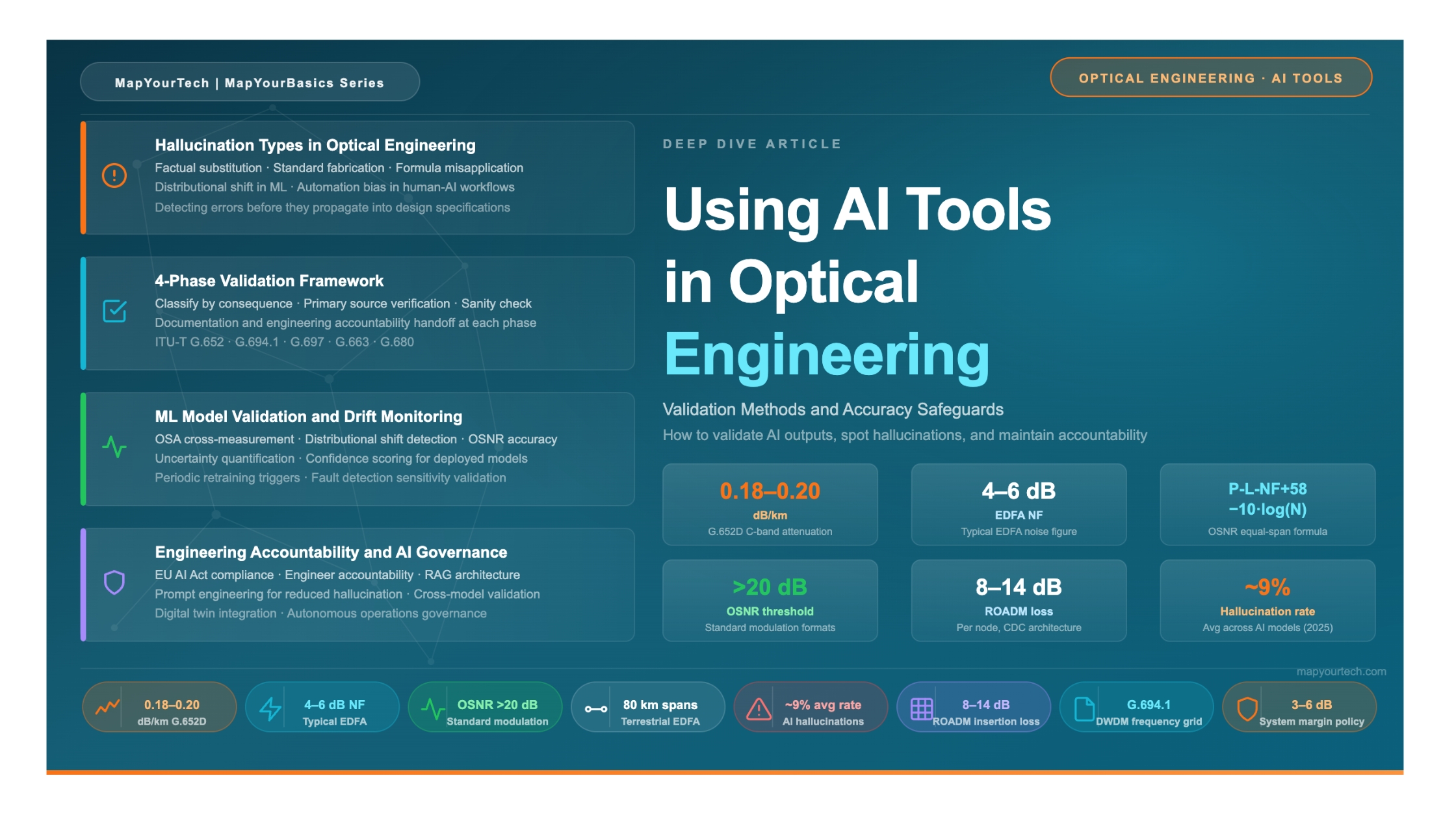

Using AI Tools in Optical Engineering:
Validation Methods and Accuracy Safeguards
Practical guidance for engineers using AI-generated content, designs, or calculations — how to validate outputs against standards, spot hallucinations in technical contexts, and maintain engineering accountability.
- Introduction
- AI Tools in Optical Engineering — Current Landscape
- Understanding AI Hallucinations in Technical Contexts
- How Hallucinations Surface in Optical Engineering
- Validation Framework for AI-Generated Outputs
- Validating AI-Generated Link Budget and OSNR Calculations
- Validating Machine Learning Model Outputs
- Generative AI in Network Operations — Challenges and Controls
- Engineering Accountability and Governance
- Practical Tools and Safeguard Techniques
- Future Directions
- Glossary
- References
1. Introduction
AI tools have moved from research curiosity to everyday utility in optical engineering. Engineers now routinely reach for large language models (LLMs) to draft technical documents, query standards, check calculation logic, and generate code for automation. Prediction models trained on telemetry data monitor optical signal quality around the clock. AI-driven design platforms suggest amplifier placements, channel plans, and dispersion compensation schemes. These tools genuinely accelerate work — but they also introduce a category of risk that the engineering profession has not faced before: outputs that are confidently stated and superficially plausible, yet factually wrong.
This article addresses the practical side of that problem. It does not argue against using AI tools — their value in optical engineering is real and growing. Instead, it builds the mental model and the systematic methods that engineers need to use those tools safely. The core question throughout is simple: given that an AI tool produced this output, how do I know whether to trust it?
Optical networks carry traffic on which hospitals, financial institutions, and national infrastructure depend. A design error introduced by an unvalidated AI output — a wrong noise figure, a misquoted dispersion coefficient, an invented ITU-T recommendation number — does not stay in a document. It propagates into procurement specifications, network designs, and eventually operational deployments. The engineer who uses the AI output is accountable for the result, not the tool. That accountability demands a structured approach to validation.
This article covers three broad classes of AI tools: generative AI and large language models (used for content, code, and analysis); predictive machine learning models (used for optical performance monitoring, fault detection, and demand forecasting); and AI-assisted design tools (used for link planning, capacity optimization, and network simulation). Validation principles differ by class, and each is addressed separately.
2. AI Tools in Optical Engineering — Current Landscape
The AI tooling landscape in optical engineering as of 2025 spans a wide spectrum, from general-purpose conversational models to domain-specific platforms trained on telemetry and network data. Understanding where each tool sits, and what it was designed to do, is the first step toward appropriate validation.
2.1 General-Purpose Large Language Models
General-purpose LLMs — trained on broad corpora of text drawn from technical publications, web content, code repositories, and standards documents — can produce coherent explanations of optical networking concepts, draft configuration scripts, summarize standards, and check the structure of engineering calculations. Their broad coverage makes them useful for orientation and initial drafting. Their limitation is that they have no privileged access to ground truth: they produce statistically likely continuations of text, not verified facts. When applied to narrow, high-precision domains like optical link engineering, that statistical confidence can produce outputs that sound authoritative while containing specific errors in numerical values, standard citation numbers, or formula application.
2.2 Domain-Specific Predictive ML Models
A second and technically distinct class covers predictive models trained on optical telemetry, performance monitoring data, and historical fault records. Neural networks and support vector machines have been applied to tasks including optical signal-to-noise ratio (OSNR) estimation from eye diagrams, modulation format identification in coherent receivers, chromatic dispersion monitoring, soft failure detection, and demand forecasting. Research published across the OFC and ECOC proceedings demonstrates that deep neural networks can estimate OSNR from asynchronously sampled signal data and identify modulation formats across heterogeneous links with high accuracy under controlled training conditions. These models are not generative — they do not produce free-form text — but they carry a different validation challenge: their accuracy degrades when the network conditions during inference differ from the conditions represented in the training dataset.
2.3 AI-Assisted Design and Planning Tools
Network design platforms have incorporated AI to accelerate link budget computation, amplifier placement optimization, and routing and spectrum assignment for dynamic optical networks. Automated simulation environments allow engineers to evaluate complex DWDM architectures against constraints including fiber type, span loss, ROADM insertion loss, amplifier noise figure, and required OSNR margins before physical deployment. These tools reduce design cycle time substantially, but they apply optimization algorithms that can converge to solutions that satisfy mathematical constraints without satisfying the engineering judgment embedded in a margin policy or a reliability target. The output of an AI design tool is a proposal, not a certified design.
Read the Full Analysis with Premium
The remaining 88% of this article — the design numbers, trade-offs and field guidance — is part of MapYourTech Premium, along with the full premium library, courses and professional tools.