
0dBm Transceivers: Key Takeaways
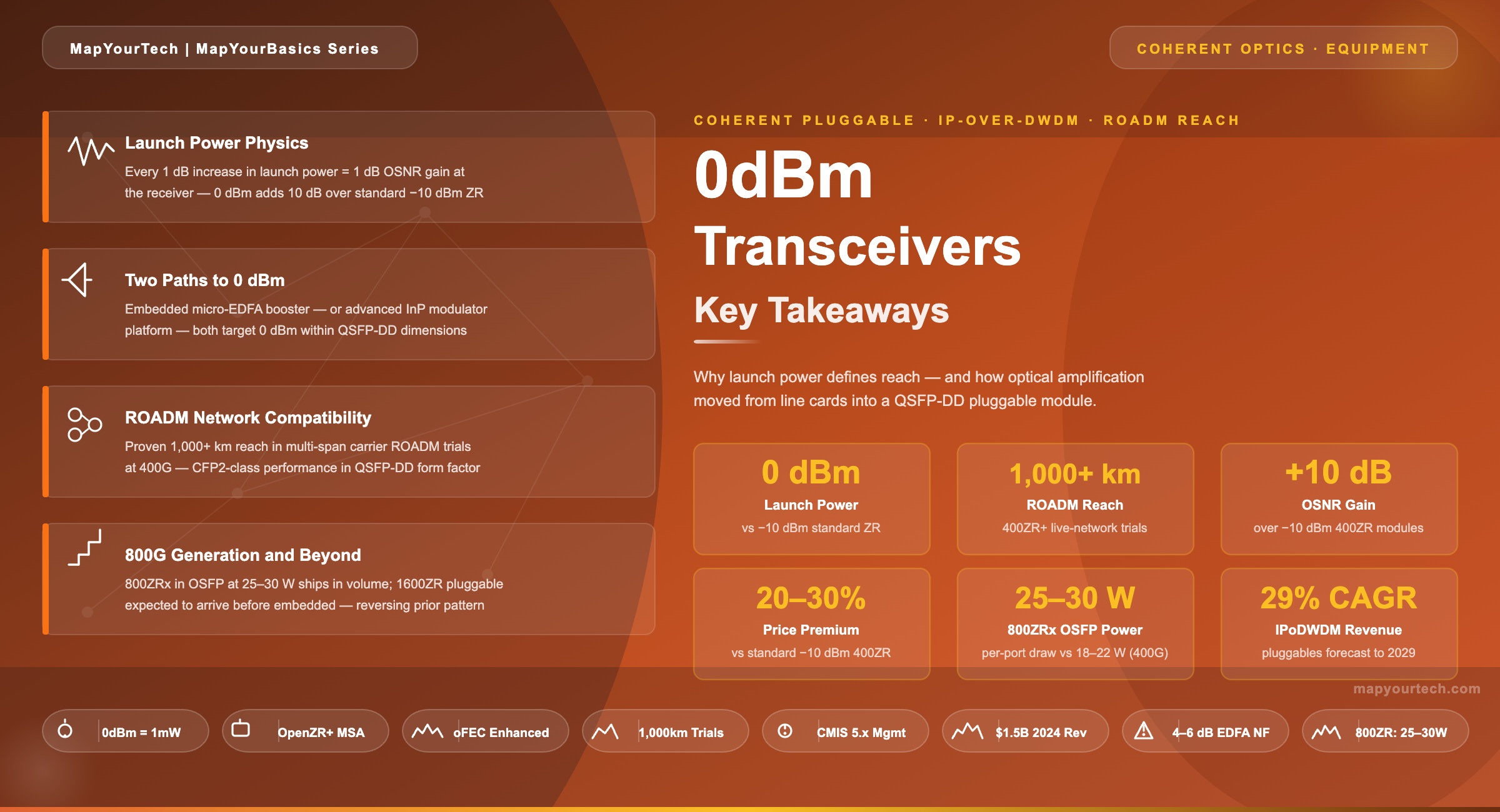
Why launch power defines reach — and how the industry packed an optical amplifier into a pluggable module to unlock long-haul ROADM compatibility at router-port density.
1. Introduction
Every coherent pluggable transceiver carries a specification that reads like a minor detail but has major consequences for where the device can be deployed: its transmit output power. Measured in dBm, this figure describes how much optical power the module places onto the fiber at the point of launch. For the majority of coherent pluggables introduced through the early 2020s — including the OIF-standard 400ZR — that figure sits at −10 dBm, equivalent to 0.1 milliwatt. The newer class of modules designated "0dBm" launches exactly 1 milliwatt, a 10 dB improvement that changes the physics of link budgeting and, with it, the range of network applications the module can address.
Understanding why this matters requires a short step back to the structure of carrier optical networks. A typical long-haul or metro service provider network is built around Reconfigurable Optical Add-Drop Multiplexers (ROADMs) connected by spans of fiber and inline Erbium-Doped Fiber Amplifiers (EDFAs). Each ROADM introduces insertion loss — typically several dB from its wavelength-selective switching elements alone — and each amplifier stage adds Amplified Spontaneous Emission (ASE) noise. The cumulative effect is that a signal reaching the far end of a multi-span ROADM chain carries both less power and more noise than when it left the source. The ratio of signal power to noise — expressed as Optical Signal-to-Noise Ratio (OSNR) — must remain above the threshold required by the receiver's Forward Error Correction (FEC) engine for the link to operate error-free.
Standard −10 dBm pluggables were designed primarily for point-to-point Data Center Interconnect (DCI) applications, where short distances and the absence of ROADMs in the optical path mean their modest launch power is adequate. Attempting to push the same module into a multi-span ROADM network results in an OSNR shortfall — the signal arrives at the receiver degraded below the FEC threshold. The 0dBm class solves this by starting with 10 dB more optical power, providing headroom to absorb the losses and noise accumulation of a real carrier network. This article explains how that extra power is generated, what it makes possible in practice, and where the technology is heading.
2. How 0dBm Transceivers Work
2.1 The Physics of Launch Power and OSNR
In an amplified optical link, the OSNR at the receiver accumulates noise from every amplifier in the chain. A simplified but instructive relationship shows how launch power feeds directly into that final OSNR figure:
/* OSNR in a single amplified span */

OSNR = P_tx - L_span - NF_amp - P_ase_ref   [all values in dB/dBm]

Where:
  P_tx      = Transmit launch power (dBm)
               −10 dBm (standard ZR)  vs  0 dBm (bright ZR+)
  L_span    = Span loss (dB) — typically 15 to 25 dB per span
  NF_amp    = Amplifier noise figure (dB) — typically 4 to 6 dB for EDFA
  P_ase_ref = ASE noise reference: 10·log₁₀(h·ν·B_n)
               ≈ −58 dBm at 193 THz over 0.1 nm reference bandwidth

Key insight: Every 1 dB increase in P_tx yields 1 dB improvement in OSNR.
Going from −10 dBm to 0 dBm = +10 dB OSNR margin — all else equal.

/* For N cascaded spans (equal length, equal amplifiers): */

OSNR_N = P_tx - L_span - NF_amp - P_ase_ref - 10·log₁₀(N)

  where N = number of spans

A 10 dB power increase allows ~10× more spans for the same received OSNR
(e.g., 1 span at −10 dBm ≡ ~10 spans at 0 dBm, in simplified terms).
This relationship is the core reason the industry invested in boosting pluggable module output power. With −10 dBm, a 400ZR module operating over a typical ROADM network exhausts its OSNR budget within one or two spans, limiting it to short point-to-point DCI hops. With 0 dBm and the enhanced OpenFEC (OFEC) used in 400ZR+ modules, the same QSFP-DD form factor can sustain 400 Gbps transport across metro, regional, and in proven trials even long-haul multi-span ROADM networks exceeding 1,000 km.
2.2 Achieving 0 dBm within a QSFP-DD Module
The challenge is one of physical integration: a QSFP-DD module measures roughly 78 mm × 18 mm × 9 mm. Standard coherent DSPs, lasers, and modulators — operating at −10 dBm — already consume the module's thermal and spatial budget. Producing 0 dBm requires either more efficient photonic components or a dedicated amplification stage, both of which demand additional silicon real estate, power, and heat management. As of 2026, two distinct engineering approaches have reached commercial deployment.
2.2.1 Embedded Optical Amplifier Approach
The first approach integrates a miniaturized optical booster — functionally a micro-EDFA — within the module package. The booster receives the modulated signal from the DSP and coherent optics at low power, amplifies it to the target launch level of 0 dBm or slightly above, and couples it to the output fiber. This approach allows module vendors to build on an established DSP and optics platform while adding the amplification stage as an incremental design element. The tradeoff is that the booster itself adds to the module's power consumption and thermal dissipation, and introduces a small amount of additional ASE noise — though at these power levels the noise penalty is negligible relative to the OSNR benefit gained at the receiver end of the link.
2.2.2 High-Performance InP Modulator Approach
The second approach uses a more advanced Indium Phosphide (InP) modulator platform that is inherently capable of producing higher optical output power without a separate amplification stage. InP modulators offer higher electro-optic efficiency than Silicon Photonics (SiPh) alternatives, which is why they have traditionally been the basis for embedded line card optics in high-performance optical transport systems. Bringing an InP modulator into a QSFP-DD form factor involves a more complex integration challenge but avoids the additional noise contribution of an embedded EDFA. Vendors pursuing this path can achieve 0 dBm while maintaining or improving the module's OSNR performance.
2.3 Power Budget Implications
The extra optical output power does come with an electrical cost. A standard −10 dBm 400ZR module typically consumes 14–16 W. A 0 dBm variant using an embedded EDFA booster draws in the range of 18–22 W, reflecting the additional power required to pump the amplifier. This increase is modest in the context of a router linecard — a few watts per port — but can compound across a densely populated chassis and must be accounted for in thermal design. At the 800G generation, the challenge becomes more pronounced: 800ZRx pluggables in OSFP form factor draw 25–30 W per module. This figure exceeds the per-port power budget of some GPU cluster network switches designed for AI workloads, which has shaped deployment architectures at hyperscale operators.
3. Advantages and Limitations
3.1 Key Advantages
The primary advantage of 0dBm transceivers is ROADM network compatibility. Before 0dBm modules existed in QSFP-DD form factors, a service provider wanting to route IP traffic via IP-over-DWDM across a multi-span amplified network had to use larger, more expensive CFP2-format modules — the OpenROADM standard — or rely on dedicated embedded optical line card interfaces. The 0dBm QSFP-DD delivered, for the first time, an MSA-standard pluggable module with performance matching CFP2 optics and, in many links, approaching the reach of embedded Gen60P interfaces. This opened IP-over-DWDM to service providers at router port density, without sacrificing the operational simplicity of a standard pluggable form factor.
Industry trials conducted prior to broad commercial availability demonstrated 400ZR+ 0dBm optics sustaining 400G transport over real-world ROADM networks at distances exceeding 1,000 km. This is a dramatic improvement over the ~120 km maximum for −10 dBm modules in amplified networks. The performance parity with CFP2 — achieved in a significantly smaller, denser form factor — proved a compelling case for carrier network operators evaluating infrastructure simplification.
A secondary advantage is ecosystem flexibility. Because 0dBm 400ZR+ modules use the QSFP-DD host interface and the OpenZR+ MSA optical specification, they can operate in both IP-over-DWDM (router-hosted) and pluggable transponder configurations. A single module variant can serve as a router-facing WDM interface or as the line-side optic in a dedicated optical transport platform, which reduces sparing complexity and purchasing fragmentation for operators managing mixed network environments.
3.2 Limitations and Trade-offs
Despite the performance gains, 0dBm modules carry real costs and constraints. The initial commercial ecosystem was narrow: when these modules first reached volume availability, only four vendors offered them. That limited supply concentration gave early buyers less price leverage than they enjoyed with the broader 400ZR market. Selling prices were 20–30% higher than standard 400ZR modules, reflecting both the lower production volume and the added engineering complexity. Price erosion has followed as more vendors brought 0dBm variants to market, but the premium relative to −10 dBm modules persists.
Power consumption is a genuine operational consideration. The higher wattage per module increases cooling requirements and limits the number of 0dBm ports that a given chassis or router design can support at full density. This is particularly relevant when evaluating 0dBm operation in GPU-based AI network switches, where the thermal envelope is tightly managed. The 800G generation amplifies this further, with OSFP-format 800ZRx modules drawing 25–30 W — well beyond the ~18 W per-port limit imposed by some back-end GPU fabric switches, which has required architectural workarounds or the use of intermediate pluggable transponders rather than direct router hosting.
On reach expectations: The 1,000 km figure comes from pre-commercial trials and represents an upper bound under favorable conditions. Practical reach depends on actual span losses, ROADM insertion loss, amplifier noise figures, fiber type, and the specific modulation rate selected. At full 400G with 16QAM modulation, reach is shorter than at 200G QPSK — operators evaluate reach versus capacity trade-offs per link, not a single blanket specification.
| Attribute | 400ZR (−10 dBm) | 400ZR+ (−10 dBm) | 400ZR+ (0 dBm) | 400G CFP2 OpenROADM |
|---|---|---|---|---|
| Form Factor | QSFP-DD | QSFP-DD | QSFP-DD | CFP2 |
| Launch Power | −10 dBm | −10 dBm | 0 dBm | ~0 to +1 dBm |
| FEC | cFEC | oFEC | oFEC | oFEC + OTN |
| Standards Body | OIF 400ZR | OpenZR+ MSA | OpenZR+ MSA | OpenROADM MSA |
| ROADM Compatible | No | No (limited) | Yes | Yes |
| Typical Reach (400G) | ~80–120 km | ~120 km | 500–1,000+ km | ~1,000+ km |
| Typical Power (W) | ~14–16 | ~14–16 | ~18–22 | ~20–30 |
| Primary Market | Cloud / DCI | Cloud / DCI | Service Provider | Service Provider |
| Price (relative) | Baseline | Baseline | +20–30% | 2× or more |
| OTN Overhead | No | No | No | Yes |
| Transponder Use | Limited | Limited | Yes | Yes |
Table 1: Comparison of 400G coherent pluggable module types by key technical and commercial attributes.
Section Summary
- 0dBm modules deliver ROADM compatibility and multi-span reach that −10 dBm modules cannot match, unlocking service provider IP-over-DWDM deployments.
- Performance is comparable to CFP2 OpenROADM optics, delivered in a smaller, denser QSFP-DD form factor.
- Price premium of 20–30% and higher power draw are real trade-offs that operators must factor into planning.
- The ecosystem of vendors supplying 0dBm QSFP-DD modules has expanded from an initial handful to a broader set, with ongoing price erosion expected.
4. Applications and Use Cases
4.1 Service Provider IP-over-DWDM
The defining application for 0dBm 400ZR+ modules is IP-over-DWDM in service provider networks. In this architecture, the router hosts the coherent DWDM interface directly as a pluggable optic, connecting to a line system without an intervening transponder. The economic argument is straightforward: eliminating a dedicated transponder per wavelength removes capital expenditure, reduces the number of physical network layers, and simplifies operations. Service providers were drawn to IP-over-DWDM conceptually for years, but −10 dBm modules could not deliver the reach or ROADM compatibility required in brownfield carrier networks designed around multi-span amplified topologies.
The 0dBm class changed this calculus. With these modules, service providers can connect carrier routers across metro, regional, and in some cases national ROADM networks using the same operational model hyperscalers apply to their DCI links. The transition has been gradual — service provider routers have proliferated at 400G more slowly than hyperscale equipment, and operational familiarity with IP-over-DWDM is still growing among carrier teams accustomed to dedicated transport layers. As of 2026, this adoption curve is accelerating, with 400G router refreshes expanding the addressable base for 400ZR+ 0dBm modules across North American and European carrier networks.
4.2 Pluggable Transponder Platforms
A closely related application is the use of 0dBm modules as the line-facing optic in pluggable transponders — dedicated optical transport platforms built around MSA-standard pluggable interfaces rather than embedded line card optics. In this configuration, a transponder chassis hosts multiple QSFP-DD or OSFP modules, aggregates client traffic (typically from 100G or 400G client interfaces), and maps it to coherent DWDM wavelengths using the pluggable line-side module.
Pluggable transponders benefit from the same multi-vendor ecosystem and price competition that drives IP-over-DWDM economics. They also offer a migration path for service providers that want transponder-level OAM and protection capabilities without committing to proprietary embedded optics. For this application, 0dBm capability is again a requirement: a transponder serving a carrier network must support the same multi-span ROADM reach as any other network element on the same link. While pluggable transponders carry roughly 25–50% additional cost compared to a direct IP-over-DWDM solution (accounting for the client-side optics and host platform hardware), they provide operational features — OTN overhead, network management integration, protection switching — that some operators require.
4.3 AI and Hyperscale Scale-Across Networks
A newer application context has emerged from the buildout of AI training infrastructure. Large-scale GPU clusters increasingly require distributed training across multiple physical sites — a topology known as "scale-across." In this model, coherent optical connectivity spans between data center buildings or campuses over distances that exceed the unamplified reach of DCI-oriented −10 dBm modules. The 0dBm class is a natural fit for scale-across links that traverse city-scale ROADM networks or dark fiber spans with significant loss budgets. The operational benefit of using the same pluggable module type across both intra-data center interconnect and inter-site scale-across links provides architectural simplicity that hyperscale operators value highly.
5. Standards and Ecosystem
5.1 Relevant Standards
The 0dBm capability is not defined in the base OIF 400ZR specification, which targets the simpler −10 dBm DCI use case. Instead, 0dBm 400ZR+ modules align with the OpenZR+ Multi-Source Agreement (MSA), which defines a more capable module class supporting flexible rates (100G, 200G, 300G, 400G), advanced FEC (OpenFEC), and a launch power of up to 0 dBm or slightly above. The OpenZR+ MSA is maintained by a consortium of optical networking companies and provides the interoperability framework that enables multi-vendor line interoperability — a feature critical for service providers who deploy equipment from multiple vendors on the same optical network.
Host interface management follows the Common Management Interface Specification (CMIS), now at version 5.x, which defines how the host system communicates with the module for configuration, performance monitoring, and alarm reporting. CMIS compatibility is essential for 0dBm modules entering service provider networks, where integration with Network Management Systems (NMS) and OSS/BSS layers is not optional.
For deployments that require OTN framing and overhead — common in carrier transport networks where performance monitoring, tandem connection monitoring (TCM), and OAM-grade fault management are required — the CFP2 OpenROADM variant remains the reference. The OpenZR+ 0dBm QSFP-DD does not include native OTN overhead, which is an architectural distinction operators must evaluate when planning network management and monitoring capabilities.
5.2 Vendor Landscape
The initial cohort of vendors delivering 0dBm QSFP-DD modules at commercial scale was limited to approximately four suppliers when the technology first reached volume shipments. The vendors that first developed high-output power QSFP-DD modules in the 400ZR+ category established early market positions that translated into significant share in the service provider IP-over-DWDM segment. As of 2026, the 800G generation is following a similar trajectory: leading coherent DSP and module vendors are shipping 800ZRx in OSFP format, with interoperability verified at industry events including OIF's multi-vendor interoperability demonstrations at OFC 2026.
The broader ecosystem includes router vendors who qualify and support specific pluggable modules for their platforms, line system vendors whose ROADMs and amplifiers must be validated for compatibility with higher launch power signals, and system integrators managing multi-vendor network deployments. Router OEMs from various companies and others support 400ZR+ 0dBm modules on their platforms with qualifying vendor lists. ROADM vendors must ensure their platforms handle the slightly higher per-channel power without cross-talk or nonlinear penalty, a generally manageable consideration for current-generation WSS-based ROADMs.
Interoperability note: OpenZR+ MSA defines the optical interface specification, enabling modules from different vendors to operate on the same amplified optical link. As of 2026, OIF multi-vendor interoperability demonstrations at OFC have confirmed 800ZR and 800G ZR+ line interop from multiple vendors, indicating that the multi-vendor ecosystem is maturing at the 800G generation in parallel with 400G reaching broad commoditization.
6. Looking Ahead
6.1 The 800G Generation
The technology trajectory that 0dBm 400ZR+ represents — bringing embedded-class performance into a pluggable module — is continuing at 800G. The 800ZRx generation (800ZR per OIF standard, 800G ZR+ per OpenROADM-compatible MSA) operates in OSFP form factors and uses fourth-generation coherent DSPs running at approximately 120–135 GBaud. The performance gap between embedded and pluggable interfaces at 800G is narrower than it was at 400G: a leading 800G ZR+ module can support 800G regional connectivity and 400G ultra-long-haul modes, covering substantially all service provider link requirements. As of 2026, hyperscalers are deploying 800ZRx optics in volume for scale-across AI connectivity, while service providers are beginning to deploy them in pluggable transponders as their 800G router infrastructure gradually scales up.
The power challenge at 800G is real but addressable. At 25–30 W per OSFP module, 800ZRx pluggables exceed the per-port budgets of some GPU cluster switches, which was designed for lower-power gray optics. Front-end merchant silicon router platforms from vendors such as Arista and Cisco are designed with higher per-port power budgets and are viable hosts. Dedicated pluggable transponder sleds also address this by providing the power and thermal infrastructure that pluggable modules require without placing that burden on the GPU switch ASIC design.
6.2 The 1600G Horizon
The 1600ZR generation is in active development as of 2026, targeting the OSFP form factor and a fifth-generation coherent DSP platform. A notable feature of this generation is its expected development sequence: unlike previous generations where the embedded high-performance interface (Gen240P) was expected to precede the pluggable compact version (Gen240C), the 1600ZR pluggable is anticipated to arrive first or concurrently. This reflects how mature the coherent pluggable engineering base has become — the integration challenges that once required embedded form factors to achieve high performance are increasingly solved within MSA-standard module packages. Leading vendors have demonstrated key building blocks for 1600ZR at OFC 2026, including silicon processes at 2 nm node under evaluation for next-generation DSP integration.
A consequence of this trend is convergence: at 1600G, a single DSP may serve both pluggable and embedded platform roles, with module packaging as the primary differentiator rather than a fundamental architectural division. This would represent a significant consolidation of the product roadmap for optical module vendors, who currently maintain parallel development paths for embedded and pluggable DSP generations.
6.3 Co-Packaged Optics
Looking further ahead, co-packaged optics (CPO) represent an architectural evolution that directly affects how the "pluggable versus embedded" discussion evolves. In a CPO architecture, optical transceivers are integrated directly onto the switch ASIC package, eliminating the electrical SerDes path between the ASIC and the pluggable module. CPO promises significant power and density advantages for intra-data center links at very high speeds. For coherent long-reach connections, CPO remains a longer-term possibility — current GPUs and network ASICs are designed around pluggable port interfaces, and coherent optics involve additional thermal and optical complexity that makes immediate CPO integration challenging. The timeline for coherent CPO in production deployments remains beyond the current 3–5 year planning horizon for most operators.
Section Summary
- 800ZRx in OSFP form factor is the active generation in 2026, with hyperscale deployments growing rapidly and service provider adoption building steadily.
- 1600ZR development is advancing, with the pluggable version likely to arrive before or alongside the high-performance embedded interface — a reversal of the historical pattern.
- The 25–30 W power draw of 800ZRx OSFP modules creates host compatibility constraints in power-limited AI cluster switches, requiring architectural adaptation.
- Co-packaged optics remain a longer-horizon evolution for coherent applications, with pluggable interfaces expected to dominate through the current generation cycle.
References
- OIF Implementation Agreement OIF-400ZR-01.0, "400ZR Coherent Optical Interface," Optical Internetworking Forum.
- OpenZR+ Multi-Source Agreement, "OpenZR+ MSA Technical Specification for 400G DWDM Coherent Optical Modules."
- OpenROADM Multi-Source Agreement, "OpenROADM Device Specification for Coherent Pluggable Transceivers."
- ITU-T G.694.1, "Spectral Grids for WDM Applications: DWDM Frequency Grid," ITU-T Study Group 15.
- CMIS Common Management Interface Specification, Revision 5.x, Small Form Factor Committee.
- Sanjay Yadav, "Optical Network Communications: An Engineer's Perspective" – Bridge the Gap Between Theory and Practice in Optical Networking.
Developed by MapYourTech Team
For educational purposes in Optical Networking Communications Technologies
Note: This guide is based on industry standards, best practices, and real-world implementation experiences. Specific implementations may vary based on equipment vendors, network topology, and regulatory requirements. Always consult with qualified network engineers and follow vendor documentation for actual deployments.
Feedback Welcome: If you have any suggestions, corrections, or improvements to propose, please feel free to write to us at [email protected]

Optical Communications & Network Automation Expert | Author of 3 Books for Optical Engineers | Founder, MapYourTech
Optical networking engineer with nearly two decades of experience across DWDM, OTN, coherent optics, submarine systems, and cloud infrastructure. Founder of MapYourTech. Read full bio →
Follow on LinkedIn