
Automatic Power Reduction (APR) and Eye Safety in Optical Systems
A research-grade technical reference covering IEC 60825 laser hazard classifications, APR and ALS mechanisms, open-fiber detection methods, and the complete power-restoration protocol after a fiber break — with worked examples and implementation details drawn from real-world DWDM and ROADM deployments.
Abstract
As deployed optical line power levels in Dense Wavelength Division Multiplexing (DWDM) and amplified transmission systems regularly surpass +20 dBm at booster outputs, unmanaged exposure following a fiber break or connector disconnection creates real hazards to maintenance personnel. This article provides a comprehensive technical examination of Automatic Power Reduction (APR) and Automatic Laser Shutdown (ALS) — the two principal mechanisms used in modern optical transport networks to bound accessible radiation at cut or open-fiber locations within internationally recognized safety limits. The article traces the regulatory foundation through IEC 60825-1 and IEC 60825-2:2021 hazard-level classification, explains the physical mechanisms by which EDFA booster amplifiers detect open-fiber conditions using Loss of Signal (LOS) and optical back-reflection monitoring, and sets out the deterministic protocol for restoring full transmission power once a repaired fiber is reconnected. Timing requirements per ITU-T G.664 (2012), power thresholds derived from real ROADM system requirements, worked examples of back-reflection-triggered APR, and a comparative analysis of ALS versus APR versus Automatic Power Shutdown (APSD) are all presented. The article targets transmission and field engineers who need a single authoritative reference for deploying, operating, and safely maintaining high-power amplified optical systems.
1. Introduction
Optical fiber communication systems have advanced dramatically since the first commercial EDFA-based long-haul deployments of the early 1990s. Where a single amplified span once carried a handful of channels at modest powers, today's DWDM systems routinely launch total composite powers exceeding +20 dBm into long-haul fiber, and Raman-pumped unrepeatered systems can push aggregate launch powers well above +27 dBm. This trajectory has created a fundamental tension between the need for high launch power — essential to achieving acceptable Optical Signal-to-Noise Ratio (OSNR) budgets over long spans — and the obligation to keep accessible optical power at any open or disconnected fiber interface within limits that are safe for human exposure, particularly to the human eye.
The eye is the organ most vulnerable to laser radiation in the wavelength range used by telecommunication systems (approximately 1260 nm to 1625 nm). Although radiation at these near-infrared wavelengths is invisible and produces no immediate pain response, focused or direct beam exposure above threshold power levels can cause irreversible retinal or corneal burns. The specific thresholds depend on wavelength, exposure duration, beam geometry, and whether optical aids (such as inspection instruments or optical test equipment) are being used.
Two complementary international standards frameworks address this challenge. The IEC 60825 series — specifically IEC 60825-1 (laser product classification) and IEC 60825-2:2021 (safety of optical fiber communication systems, OFCSs) — defines hazard levels and the maximum permissible accessible emission at any point in a fiber communication system. ITU-T Recommendation G.664 (latest edition 2012) translates those hazard levels into concrete operational procedures: how and when a transmitting amplifier must reduce power, how quickly it must respond to a detected loss of fiber continuity, and how it may safely restore full power after the fiber is reconnected. Together, these two frameworks define the behavior engineers refer to as Automatic Power Reduction (APR), Automatic Laser Shutdown (ALS), and Automatic Power Shutdown (APSD).
Understanding these mechanisms is not merely a compliance exercise. A field engineer who incorrectly bypasses an APR interlock during maintenance, or who reconnects a live amplified span without following the prescribed restart protocol, risks serious personal injury and may cause the optical system to re-enter full power before the link has been verified as properly connected. Conversely, an overly conservative or incorrectly implemented APR scheme can cause unnecessary traffic outages and impede fault localization during a genuine cable break.
This article covers the complete picture: the laser classification system that defines what "safe" means, the physical methods by which a system detects an open-fiber condition, the logic that governs APR and ALS activation, the timing constraints that apply to both shutdown and restart, and the practical operational protocols that maintenance technicians follow after a repair. Real system requirements drawn from DWDM ROADM platforms are used throughout to ground the discussion in actual deployed behavior.
2. Historical Context and Regulatory Evolution
2.1 From SDH to DWDM — A Power Problem Emerges
The original Automatic Laser Shutdown procedure was standardized in the late 1980s to address the comparatively modest optical powers of early SDH single-channel systems. A typical SDH transmitter operating to ITU-T G.957 launched at or below a few milliwatts, and the hazard at an open connector was manageable with the simple precaution of periodic pulsed restart attempts — a 2-second probe pulse at full power every few minutes, allowing a technician who reconnected the fiber to allow the system to restore service automatically.
The deployment of EDFAs in the early 1990s, and the subsequent explosive growth of DWDM capacity, changed the calculus entirely. EDFA booster amplifiers consolidate the power of many channels into a single fiber. A 96-channel DWDM system with 0 dBm per channel already deposits +19.8 dBm into the booster output fiber before any additional gain. Modern high-power booster amplifiers in terrestrial DWDM and unrepeatered submarine systems routinely produce output powers above +20 dBm, and Raman pump lasers used to extend reach inject powers of several hundreds of milliwatts or more in the near-infrared.
At these power levels, the legacy ALS pulse approach — emitting a full-power 2-second probe — was identified as inadequate. IEC 60825-1 and IEC 60825-2 underwent major revisions through the 2000s and 2010s, introducing the concept of "hazard levels" (replacing the older class-based system for OFCSs), and introducing specific requirements on the speed and magnitude of power reduction. The ALS pulse scheme, in particular, was found to present unacceptable hazard when applied to high-power DWDM systems. ITU-T G.664 (2012) formally notes that for systems operating above Hazard Level 3A, the repetitive full-power probe pulse is no longer considered appropriate and APR with automatic restart at safe power levels is the recommended approach.
2.2 The Standards Ecosystem Today
As of the current editions, the standards ecosystem governing optical safety in telecom systems spans three tiers. IEC 60825-1 defines the underlying laser safety framework, including hazard levels and Maximum Permissible Exposure (MPE). IEC 60825-2:2021 (the fourth edition, which superseded editions from 2004, Amendment 1:2006, and Amendment 2:2010) applies specifically to installed optical fiber communication systems and requires hazard-level assessment at each accessible location rather than component classification alone. ITU-T G.664 translates these requirements into network-level operational procedures covering when and how to shut down, how long the process must take, and how to perform safe automatic restart. IEC/TR 61292-4 provides supplementary guidance on maximum permissible optical power for optical amplifiers, addressing thermal damage, fiber fuse propagation, and connector contamination hazards that accompany high optical powers.
In the United States, the FDA under 21 CFR 1040.10 (Laser Notice 56) generally defers to IEC standards for product classification and labelling. ANSI Z136.1 tracks closely with IEC 60825-1 exposure limits.
3. Eye Safety Classifications Under IEC 60825
3.1 The IEC 60825-1 Hazard Level Framework
IEC 60825-1 defines laser product classes (Class 1, 1C, 1M, 2, 2M, 3R, 3B, and 4) based on whether accessible emission levels can cause eye injury under reasonably foreseeable conditions. For optical fiber communication systems, IEC 60825-2 maps these to "hazard levels" that account for the end-to-end installed system rather than individual component classification. The key hazard levels relevant to telecom systems are:
| Hazard Level | IEC 60825-1 Analog | Description | Telecom Context |
|---|---|---|---|
| 1 | Class 1 | Eye-safe under all reasonably foreseeable conditions. No safety measures required. | Low-power access network, SFP transceivers at standard levels |
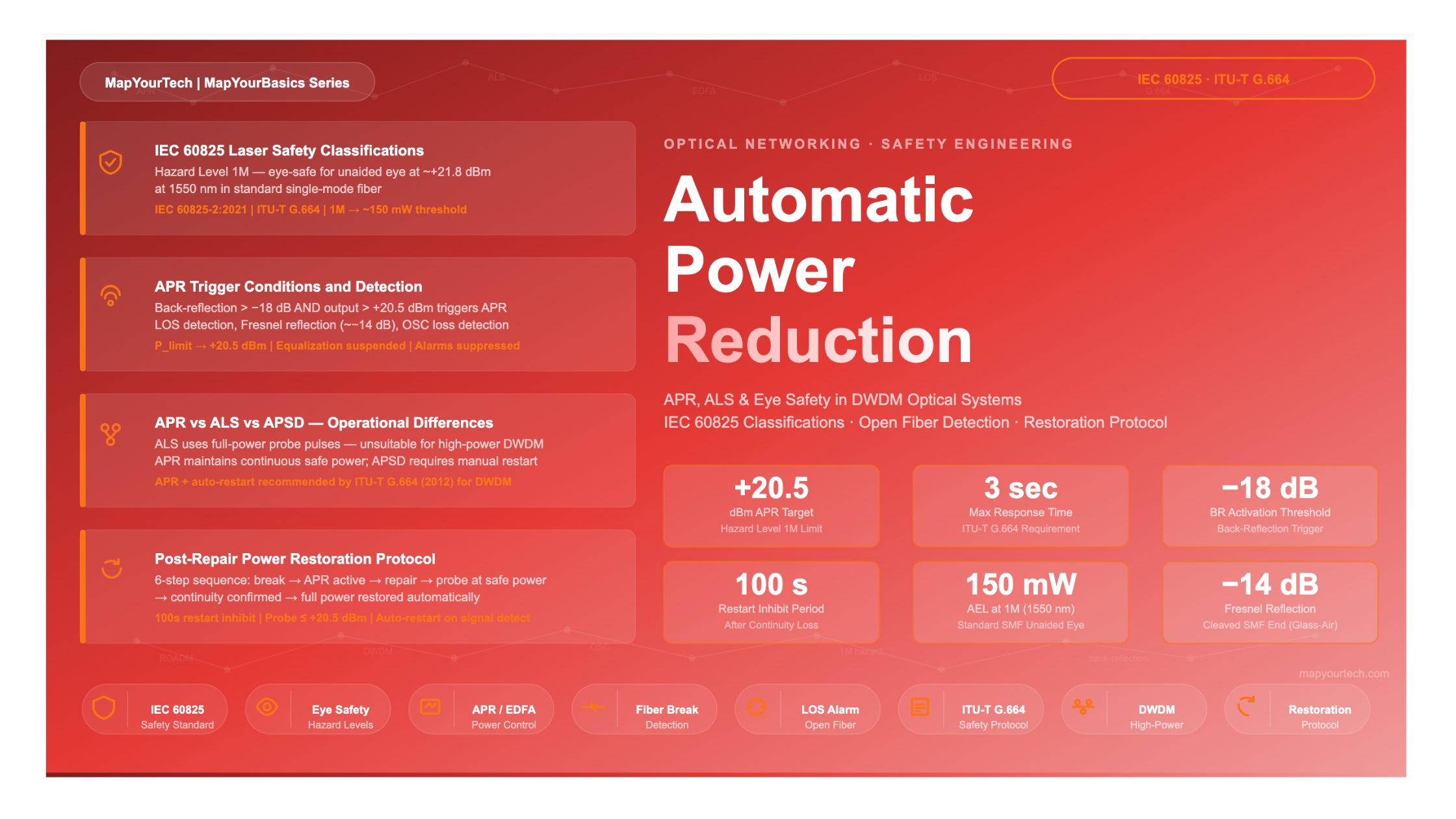
| 1M | Class 1M | Eye-safe for unaided eye. Hazardous if optical collecting instruments are used. At 1550 nm in standard SMF, the AEL is approximately 150 mW (~+21.8 dBm). | Target safe level for APR-protected DWDM booster output; open-fiber condition target |
| 3R | Class 3R | Small risk of eye injury for direct intrabeam viewing. Restricted location use. | Intermediate amplified systems in controlled environments |
| 3B | Class 3B | Hazardous for direct viewing. Diffuse reflection generally safe. Controlled location required. | High-power Raman pump outputs; high-power booster before APR activation |
| 4 | Class 4 | Hazardous for both direct and diffuse viewing. Fire hazard. Full controlled-access required. | Laser sources emitting more than 500 mW in the 1400–1600 nm range (e.g., high-power Raman pumps) |
Key Reference: IEC 60825-2 and Fiber System Assessment
IEC 60825-2:2021 requires assessment of hazard level at each accessible location of the installed fiber communication system as an engineered end-to-end assembly. This replaces simple component classification for installed OFCSs and means that the hazard level at an open connector or fiber break depends on the power being transmitted in the fiber at that point, not just on the nominal rating of the transmitter module.
3.2 The 1M Threshold in DWDM Practice
The Hazard Level 1M threshold at 1550 nm is approximately +21.8 dBm for standard single-mode fiber when assessed as accessible emission from a bare fiber end (the precise value depends on measurement aperture and distance as specified in the standard). This threshold is critical because it defines the target power level to which APR must reduce the booster output when an open-fiber condition is detected. In practice, DWDM amplifier specifications use a round figure of +20.5 dBm as the Hazard Level 1M equivalent for restricted-location operation, ensuring a conservative margin.
The relationship between location type and permitted hazard level is also important. IEC 60825-2 distinguishes between unrestricted locations (public areas), restricted locations (areas accessible only to trained personnel), and controlled locations (locked rooms with specific access controls). The maximum permitted hazard level in an unrestricted location is 1M for wavelengths outside 400–700 nm; in restricted locations, up to 1M, 2M, or 3R; and in controlled locations, up to 3B under specific conditions. Most telecom central office and outside-plant environments are classified as restricted locations.
3.3 Why the Eye Is Particularly Vulnerable
The human cornea and lens transmit near-infrared radiation in the 1300–1550 nm band. The ocular medium absorbs a significant fraction of this radiation before it reaches the retina, but at high enough irradiance the cornea itself can be damaged. At wavelengths above approximately 1400 nm, absorption in the pre-retinal ocular media increases substantially, making corneal injury the primary concern rather than retinal damage. The key protective feature of Hazard Level 1M is that its limits are set such that the unaided eye — with a natural pupil aperture of approximately 7 mm — cannot collect enough power from a fiber end to exceed the Maximum Permissible Exposure (MPE), even with extended direct viewing. However, if a technician uses an optical instrument such as an eye-loupe, optical power meter probe, or inspection microscope, the effective collection aperture increases and the radiation converges to a smaller retinal spot, potentially exceeding the MPE even at 1M power levels. This is why never look directly into a live fiber connector with an inspection instrument without first verifying the fiber is dark.
Safety Reminder for Field Operations
Even at Hazard Level 1M powers (approximately +20 to +22 dBm at 1550 nm), direct viewing through an optical inspection instrument can be hazardous. Always use the "power-off, verify-dark" check before connecting any inspection scope or optical test equipment to a fiber. Optical power meters should be checked against a live port only using purpose-built attenuated probe heads at appropriate input power ranges.
Figure 1: Approximate optical power ranges at 1550 nm in standard SMF associated with IEC 60825 hazard levels in restricted locations, with typical DWDM system operating regions overlaid. Values are illustrative guidance; precise limits require formal assessment per IEC 60825-2.
4. APR, ALS, and APSD — Definitions and Distinctions
Three terms appear in specifications and standards for optical safety response functions: Automatic Power Reduction (APR), Automatic Laser Shutdown (ALS), and Automatic Power Shutdown (APSD). Understanding the precise meaning of each, and how they relate to one another, is essential for correctly reading equipment specifications and design documents.
4.1 Automatic Laser Shutdown (ALS)
ALS is the original shutdown mechanism defined in ITU-T G.664 for single-channel SDH systems. When Loss of Input Signal (LOS) is detected at a receiver, the transmitter at the far end is instructed to shut down. An automatic recovery attempt using a short probe pulse is repeated periodically until the link is re-established. In the classic ALS protocol, the probe pulse operates at full transmitter power for approximately 2 seconds, allowing the receiving-end amplifier to detect the restoration of signal and re-enable its own transmitter (the "master/slave" or "buddy" scheme).
ALS remains appropriate for systems whose optical power stays within Hazard Level 1 or 3A (the old term, broadly equivalent to 1M in the revised framework) even under reasonable foreseeable conditions. For systems above these levels, particularly amplified DWDM and Raman systems, the full-power probe pulse during the ALS restart is itself potentially hazardous, which is why ITU-T G.664 (2012) notes that "the use of a repetitive pulse to restart the system is considered no longer appropriate" for high-power systems.
4.2 Automatic Power Reduction (APR)
APR is the preferred mechanism for high-power DWDM, Raman-amplified, and other systems where booster output power exceeds Hazard Level 1M in normal operation. Rather than shutting down the laser entirely and then pulsing at full power, APR reduces the output to a continuously maintained level at or below the Hazard Level 1M limit for the location type. The power can be held at this reduced level either as a constant low power or as a series of probe pulses that stay within the hazard-level limit throughout their duration.
The defining advantage of APR over ALS is that automatic restart can occur at safe power, eliminating the exposure window created by a full-power pulse. ITU-T G.664 (2012) recommends APR with automatic restart as the standard approach for high-power systems and states that APR techniques "must be in operation continuously" for systems that would otherwise exceed their permitted hazard level.
4.3 Automatic Power Shutdown (APSD)
APSD is a term that has been used interchangeably with ALS in some equipment specifications, particularly for amplifier sub-systems. ITU-T G.664 acknowledges the term exists and standardizes the use of "ALS" to avoid ambiguity, but notes that the underlying behavior of APSD and ALS is substantially similar. In modern documentation, APSD generally refers to a complete shutdown of optical output (power to zero or near-zero), typically used when an amplifier is placed in an standalone configuration where no master-slave coordination is possible.
4.4 APR Versus ALS — A Practical Comparison
| Attribute | ALS (Classic) | APR | APSD |
|---|---|---|---|
| Trigger condition | LOS at receiver; or LOS at amplifier input | LOS at amplifier input; or high back-reflection detection | LOS at amplifier input |
| Response action | Complete laser shutdown; periodic full-power probe pulse | Power reduced to ≤ Hazard Level 1M; maintained continuously at safe level | Complete output shutdown, no pulse |
| Restart probe | Full power (2 s pulse), repeated every few minutes | Continuous or pulsed at safe (≤ 1M) power level | Manual or remote restart only |
| Suitable system type | Low-to-medium power SDH/single-channel systems (≤ Hazard Level 3A) | High-power DWDM, Raman-amplified, unrepeatered systems | Standalone amplifiers, test environments |
| Standards basis | ITU-T G.664, IEC 60825-2 (older revisions) | ITU-T G.664 (2012), IEC 60825-2:2021 | Vendor-specific; ITU-T G.664 acknowledges the term |
| Traffic restoration | Automatic on successful probe | Automatic when fiber continuity confirmed at safe power | Manual or remote intervention required |
Section 4 Summary
- ALS uses periodic full-power probe pulses and is appropriate only for low-to-medium power systems.
- APR continuously maintains power at or below Hazard Level 1M and is the preferred method for high-power DWDM and Raman systems per ITU-T G.664 (2012).
- APSD is a complete shutdown with no automatic probe, requiring manual restart.
- APR and ALS operate independently of each other and may both be active simultaneously in a ROADM booster.
- APR must remain in operation continuously for systems that would otherwise exceed Hazard Level 1M.
5. Detecting Open Fiber Conditions — Trigger Mechanisms
Before APR or ALS can be activated, the system must reliably detect that fiber continuity has been lost. Optical transmission systems use two primary physical mechanisms for this detection: Loss of Signal (LOS) monitoring and optical back-reflection (OBR) monitoring. Each has different sensitivity, response latency, and application contexts.
5.1 Loss of Signal (LOS) Detection
LOS detection is the simplest and most universally deployed method. Each amplified span has a photodetector at the amplifier input monitoring the received optical power. When a fiber break occurs, the signal power at the downstream amplifier input drops below the LOS threshold. The LOS alarm is then used to trigger APR on the upstream transmitting amplifier.
In a typical ROADM booster configuration, the Booster EDFA monitors its own input signal (from the ROADM switch fabric or multiplexer). When the input drops to zero or below a defined threshold, the system infers that the fiber carrying its output has been cut or disconnected. The booster's APR mode is then engaged to limit output power.
An important architectural point: in a bidirectional fiber pair, the LOS at one end propagates information about the link state to both ends. When the upper fiber in a pair is cut, the receiver at the far end detects LOS, triggering shutdown of the transmitter at the far end that feeds back into the broken fiber in the lower direction. This cascade is the foundation of the bilateral safety propagation described in ITU-T G.664.
5.2 Optical Back-Reflection (OBR) Detection
Back-reflection detection is a more specific trigger mechanism used in EDFA booster amplifiers for APR activation. When a fiber is cut or a connector is disconnected, the abrupt fiber end creates a Fresnel reflection at the glass-air interface. Standard single-mode fiber has a Fresnel reflection of approximately −14 dB at a cleaved end (relative to the incident optical power). A polished connector presents a similar or slightly higher reflection. This reflected light travels back through the optical path toward the booster amplifier output.
The Booster EDFA monitors the ratio of backward-traveling power to forward output power. If the back-reflection ratio exceeds a defined threshold, the APR mode is activated to limit booster output. In deployed ROADM booster specifications, the back-reflection threshold for APR activation is typically set at approximately −18 dB relative to the amplifier output power.
Back-Reflection Threshold in Practice
In a deployed ROADM booster EDFA, APR mode activates when both of the following conditions are simultaneously true: (1) back-reflection level is above −18 dB (relative to EDFA output power), and (2) EDFA output power is above +20.5 dBm (the Hazard Level 1M target). APR is deactivated when either the back-reflection drops back below the threshold, or when the required amplifier output would fall below +20.0 dBm independently of APR. This dual-condition logic prevents spurious APR triggering from normal connector reflections during low-power operation.
5.3 Optical Supervisory Channel (OSC) Loss Detection
Many high-power amplified systems, particularly unrepeatered and submarine systems, use a dedicated Optical Supervisory Channel (OSC) operating on a wavelength outside the main DWDM traffic band (typically around 1510 nm in older systems, or 1625/1510/1490 nm in modern designs). The OSC carries management and monitoring traffic between amplifier sites and can serve as an additional trigger for APR and ALS. When the OSC signal is lost at the receiving amplifier, the system can immediately initiate power reduction on the associated transmit path without waiting for LOS on the traffic channels.
This approach is particularly valuable in configurations where the OSC travels counter-propagating to the main signal traffic, since loss of the counter-propagating OSC immediately signals that the fiber in the traffic direction has been interrupted at some point along the span. ITU-T G.664 (2012) includes detailed examples of APR behavior in counter-propagating OSC configurations.
5.4 Cascade of Detection Across Multiple Amplifier Stages
In a multi-span amplified link, a break at any point in the fiber does not just affect the two immediately adjacent amplifiers — it can affect the entire optical multiplex section (OMS). ITU-T G.664 specifies that secondary actions on other amplifiers within the impacted OMS section should also be initiated after APR has been triggered on the directly impacted transmitting interface. The standard requires that the power reduction to Hazard Level 1M at all optical outputs within the impacted OTS shall be completed within 3 seconds of the moment fiber continuity is interrupted.
Figure 2: Detection cascade in a multi-span DWDM link following a fiber break. When the upper fiber is cut, Fresnel back-reflection triggers APR at the upstream amplifier (Site A) while LOS propagation triggers APR at both Site A and Site B in their respective transmit directions. The OSC provides an additional detection path. Both directions must be reduced to Hazard Level 1M within 3 seconds.
6. APR Activation Logic and System Behavior
The implementation of APR in a booster EDFA involves a defined state machine that governs the amplifier's operating modes, hardware pin states, and alarm reporting behavior. Drawing on the requirements from real ROADM EDFA specifications, the following describes the full operational behavior of an APR implementation.
6.1 APR Activation Conditions
APR mode is activated when both of the following conditions are simultaneously true:
| Condition | Parameter / Threshold | Notes |
|---|---|---|
| Back-reflection above threshold | Back-reflection ratio > −18 dB (default threshold) | Measured at EDFA output; threshold is configurable |
| EDFA output above safe level | Pout > +20.5 dBm | The Hazard Level 1M target power for restricted locations |
The dual-condition logic prevents APR from triggering unnecessarily during low-power operation where back-reflections from connectors or splices in the near-field of the amplifier would otherwise cause nuisance trips. When output power is already below +20.5 dBm, the system is inherently within the Hazard Level 1M limit and APR intervention is not needed.
6.2 Actions on APR Activation
When APR mode activates, the following actions take place within the EDFA:
Output Power Clamping
The output power limit (Plimit) is set to +20.5 dBm. The amplifier's gain is automatically reduced as needed to maintain this ceiling, regardless of the requested gain or input power level.
APR Indicator Signal Assertion
A hardware indicator pin (designated APR mode indication in EDFA firmware) becomes active-high, providing an external alarm interface to the network management system and to any slave amplifiers in the chain.
Equalization Suspension
Automatic spectral equalization based on the Optical Channel Monitor (OCM) is suspended. Equalizing an under-powered or un-loaded channel plan in APR state would produce incorrect adjustments that could interfere with recovery. Equalization resumes only when APR mode is cleared.
Alarm Suppression
Certain alarms that would be triggered by the constrained operating condition — specifically "Gain Failure" and "Out of Required Gain" — are suppressed while APR mode is active. This prevents the management system from generating misleading alarm cascades during the safety-constrained period.
Back-Reflection Alarm Remains Active
Regardless of APR mode status, the back-reflection alarm indicator remains active whenever the back-reflection ratio exceeds the threshold. This provides continuous visibility to the management system of the physical cause of the APR condition.
6.3 APR Deactivation Conditions
APR mode is cleared when either (not both) of the following conditions is met:
Back-Reflection Returns Below Threshold
The monitored back-reflection at the EDFA output drops back below the −18 dB threshold, indicating that the open-fiber condition has been resolved (the fiber has been reconnected and the Fresnel reflection from the end-face is no longer visible).
Requested Output Falls Below Safe Level Independently
The required EDFA output power — calculated as Pamp-in + Requested Gain — falls below +20.0 dBm. At this point the system is intrinsically within safe limits without needing APR clamping, and the constraint is removed.
APR and ALS Interaction
APR and ALS operate independently. When APR mode is removed (back-reflection clears), but ALS mode is still active because the input LOS condition persists, the output power limit remains at +20.5 dBm until ALS mode is also cleared. Neither function overrides the other — both constraints remain in effect simultaneously if both conditions apply, and the most restrictive constraint governs the amplifier output.
6.4 Eye-Safety Verification and Output Power Classification
Some ROADM EDFA designs require a formal "eye-safety verification" process before the amplifier is permitted to operate at its full high-power mode. This process confirms that the fiber path is properly connected and that the amplifier output will be within the correct hazard level for the installed configuration. The verification follows a state machine:
| Verification State | HW Safety Pin | ALS Status | Plimit | Psat | APR |
|---|---|---|---|---|---|
| Not-Verified / Fail | Active-high (restricted) | Disabled (like 1M amplifier) | +21.3 dBm (HW) | +20.5 dBm | Disabled |
| In-Progress | Active-high (restricted) | Disabled | +21.3 dBm (HW) | — | Disabled |
| Pass | Active-low (unlocked) | Enabled | +22.8 dBm (HW) | +22.0 dBm | Enabled |
This staged approach means that a newly provisioned or restarted amplifier cannot immediately operate at full high-power mode. Only after the verification procedure confirms the safety configuration is in place (proper fiber connections, no open-fiber condition, correct path topology) does the hardware pin unlock the higher Plimit and enable APR. Until then, the amplifier operates in a limited-power mode functionally equivalent to a Hazard Level 1M device.
7. Mathematical Framework — Exposure, Thresholds, and Timing
7.1 Maximum Permissible Exposure (MPE) and Hazard Level Assessment
The maximum permissible exposure (MPE) is the level of laser radiation to which an unprotected eye or skin can be exposed without suffering adverse biological effects. IEC 60825-1 specifies MPE values in terms of irradiance (W/cm²) or radiant exposure (J/cm²) as a function of wavelength and exposure duration. The accessible emission limit (AEL) for a given hazard level is derived from the MPE corrected for the collection geometry of the human eye.
For optical fiber systems at 1550 nm, the calculation of whether a given fiber output power falls within Hazard Level 1M uses the following relationship between emitted power P (in watts), the fiber numerical aperture, and the measurement aperture defined by IEC 60825-1. For single-mode fiber with a small numerical aperture, the AEL for Hazard Level 1M at 1550 nm is approximately 150 mW (approximately +21.8 dBm), reflecting the fact that the unaided eye's 7 mm pupil intercepts only a small fraction of the diverging beam from an SMF end.
MPE-based Hazard Level Assessment (Simplified for 1550 nm SMF)

P_accessible  = Power accessible at fiber end [W or dBm]
NA            = Numerical aperture of fiber (~0.12 for standard SMF)
d_pupil       = Pupil diameter of human eye (~7 mm at 1550 nm)
z             = Distance from fiber end to eye [m]

Collection efficiency at distance z (geometric approximation):
η = (π × (d_pupil/2)²) / (π × (NA × z)²)   [for z >> fiber Rayleigh range]

For Hazard Level 1M condition (unaided eye):
P_accessible ≤ AEL_1M(λ)   →   Eye-safe for unaided viewing

Typical AEL_1M at 1550 nm: approximately 150 mW (+21.8 dBm)

Practical APR Target Power (restricted location, conservative margin)
P_APR_limit = +20.5 dBm   (≈ 112 mW, below 150 mW AEL for margin)

Back-Reflection Ratio Calculation
BR_ratio [dB] = P_reflected [dBm] - P_output [dBm]

Fresnel reflection from cleaved SMF end (glass-air interface):
R_Fresnel = ((nglass - nair) / (nglass + nair))²  ≈  ((1.468 - 1.0) / (1.468 + 1.0))²  ≈  3.6%
→  BR_Fresnel ≈ -14.4 dB  (relative to incident power)

APR activation threshold: BR_threshold = -18 dB
→ Any Fresnel reflection from an open connector (~-14 dB) EXCEEDS this threshold.
→ APR activates correctly for any open-fiber or disconnected connector condition.

Worked Example:
P_output = +22.0 dBm  (normal booster operation)
P_reflected = +22.0 - 14.4 = +7.6 dBm   (fiber break, Fresnel reflection)
BR_ratio = +7.6 - 22.0 = -14.4 dB  → exceeds threshold of -18 dB
APR condition 1 (BR > -18 dB): TRUE
APR condition 2 (P_out > +20.5 dBm): TRUE
→  APR ACTIVATES → P_limit set to +20.5 dBm
7.2 APR Timing Requirement Derivation
The ITU-T G.664 requirement that power reduction shall be completed within 3 seconds of fiber continuity interruption is derived from the MPE specification in IEC 60825-1. The MPE for extended single-pulse exposure to 1550 nm radiation is specified as a function of exposure duration. For exposure durations below a certain threshold, the MPE is lower (the eye accumulates energy). Above that threshold, the MPE is determined by the continuous-wave irradiance limit.
For 1550 nm radiation, the skin MPE and pre-retinal ocular damage thresholds allow sustained exposure at Hazard Level 1M powers for indefinite periods. However, the window between full-power DWDM booster output (+22 dBm typical) and the 1M AEL (~+21.8 dBm) is narrow enough that the ITU-T standard specifies a 3-second maximum response time as a conservative practical bound that can be reliably implemented in EDFA firmware while allowing time for propagation of the LOS signal across multiple amplifier stages. The restart inhibit period of 100 seconds following interruption provides an additional margin to ensure that no repair personnel are still near the open fiber end when full power is restored.
ITU-T G.664 Power Reduction Timing Requirements Summary

T_response_max:
  Power reduction from operational to ≤ Hazard Level 1M:  ≤ 3 seconds
  (from the moment continuity interruption is detected)

T_restart_inhibit:
  No restart attempt within:  100 seconds
  (from interruption or end of last unsuccessful restart attempt)
  — UNLESS fiber continuity is independently guaranteed

P_restart_probe:
  Power during restart probe (APR method):  ≤ Hazard Level 1M limit
  (≤ +20.5 dBm in restricted locations)
  Probe may be constant or pulsed as long as it stays within 1M limit

P_operational (after confirmed restart):
  Full operational power restored:  upon confirmation of fiber continuity
  via detection of received signal or OSC presence at safe probe power

ALS Legacy Timing (SDH systems only, informational)
  Shutdown: within a few hundred milliseconds of LOS detection
  Restart pulse: 2 s at full power
  Repeat interval: typically 60–180 s
  (NOT appropriate for DWDM/Raman systems above Hazard Level 3A)
Figure 3: APR timing sequence — booster output power profile following fiber break detection, showing the 3-second response window, the APR-reduced operating level, the 100-second restart inhibit period, the probe phase, and restoration to full operational power. Values are representative of a +22 dBm booster system with +20.5 dBm APR target.
8. Power Restoration Protocol After Fiber Break Repair
Restoring full transmission after a fiber break or cable repair is a safety-critical procedure that must follow a defined sequence. The risks are asymmetric: restoring power too early — before the repair has been completed and fiber ends secured — can expose repair personnel to hazardous radiation. Restoring power too conservatively can prolong traffic outages. The protocol below represents the standard approach derived from ITU-T G.664 (2012) for APR systems with automatic restart.
8.1 Step-by-Step Restoration Sequence
Step 1 — Fiber Break Confirmed, APR Active
The break occurs. Within 3 seconds, all transmitting amplifiers in the affected Optical Transmission Section (OTS) reduce power to ≤ +20.5 dBm. Both terminals (Site A and Site B) detect Loss of Signal (LOS-P and/or LOS-O). APR indicators assert on all affected amplifiers. Equalization is suspended. Gain-related alarms are suppressed. A restart timer is started.
Step 2 — Repair Work in Progress
Repair personnel splice or reconnect the fiber. During this period, both ends of the broken fiber span are radiating at APR-limited safe power (≤ +20.5 dBm, Hazard Level 1M). No restart attempt is made until the 100-second inhibit timer from the last LOS event has elapsed and the restart condition is met.
Step 3 — Restart Probe Initiated (APR Method)
After the inhibit period, the system initiates automatic restart by maintaining the APR-level output power (+20.5 dBm) as a continuous probe. This probe travels down the repaired fiber span. Both the probe power level and any response detected at the far end remain within Hazard Level 1M. At no point does a full-power probe pulse radiate onto an open fiber end.
Step 4 — Continuity Confirmed
When the repaired fiber is successfully reconnected, the probe signal traverses the span and is detected at the far-end receiver. The back-reflection level at the transmitting amplifier drops below the −18 dB APR threshold (the Fresnel reflection from a properly mated connector is typically below −40 dB, well below the activation threshold). Both conditions for APR are no longer satisfied.
Step 5 — APR Cleared, Full Power Restoration
Both the APR condition and the LOS condition clear simultaneously on successful signal detection. The APR output power limit is removed. The eye-safety verification state transitions to "Pass." The amplifier's Plimit and Psat return to their normal operational values. Equalization resumes based on OCM measurements. Gain alarms are re-enabled. Full operational output power is restored within normal amplifier response time.
Step 6 — Traffic Restoration
With both amplifier ends of the repaired span operating at full power, the optical path is restored and traffic recovery proceeds through the upper-layer protection and restoration mechanisms (OTN APS, ROADM path switching, etc.). OSNR and channel power levels are verified by the network management system against pre-fault baselines.
8.2 Manual Intervention Cases
Automatic restart is the preferred and recommended mode for APR systems. However, there are situations where operator intervention is necessary before restart can proceed:
Planned Maintenance Window
If a fiber is intentionally opened for maintenance or route reconfiguration, the network operations center may lock out automatic restart to prevent the system from attempting to re-establish a connection before all work is complete and safety is confirmed.
Eye-Safety Verification Failure
If the post-repair eye-safety verification process fails (e.g., the system detects an abnormal back-reflection pattern suggesting a partially mated connector or unintended intermediate open end), the amplifier remains in the limited-power not-verified state and a manual clearing procedure is required.
Persistent High Back-Reflection
A connector that is reconnected but contaminated or damaged may present elevated back-reflection above the −18 dB APR threshold even though signal has been partially restored. In this case APR remains active and a manual inspection and connector cleaning procedure is required.
APSD-Mode Systems
Amplifiers configured in APSD mode (complete shutdown, no automatic probe) always require explicit operator intervention — typically via the network management system or local craft terminal — to authorize restart after power has been restored to the fiber path.
8.3 Operational Protocol for Field Teams
When repair personnel respond to a fiber break on an amplified DWDM span, the following operational sequence represents best practice aligned with ITU-T G.664 and IEC 60825-2:
| Step | Action | Safety Note |
|---|---|---|
| 1 | Confirm APR active at both terminals via NMS. Verify output power is ≤ +20.5 dBm at affected span. | Do not begin repair until APR is confirmed active at all feeding amplifiers. |
| 2 | If performing planned maintenance: lock out automatic restart via NMS to prevent unintended restoration during work. | Prevents unexpected full-power exposure if fiber is reconnected without team awareness. |
| 3 | Perform splice or connector repair. Use proper fiber handling tools; treat all fiber ends as potentially live at Hazard Level 1M. | APR-limited power (~112 mW) is still hazardous with optical instruments. Never view a live fiber with inspection equipment. |
| 4 | After repair, confirm all personnel are clear of fiber openings and connectors. | Full-power restoration will occur automatically once restart completes. |
| 5 | Release automatic restart lockout if applied. Monitor NMS for APR clearance and signal restoration. | APR should clear within seconds of a good connection. Persistent APR active indicates incomplete or faulty reconnection. |
| 6 | Verify OSNR and channel power levels post-restoration against pre-fault baseline. | Degraded OSNR may indicate residual splice loss or contaminated connector. |
9. Special Considerations — Raman Systems and Unrepeatered Links
Raman-amplified systems and high-power unrepeatered submarine systems present amplified safety challenges compared to conventional EDFA-only terrestrial links. Raman pump lasers inject high optical power — often several hundred milliwatts to over one watt in the near-infrared Raman pump band (typically around 1450–1480 nm for C-band gain) — directly into the transmission fiber. Laser sources in the 1400–1600 nm range emitting more than 500 mW are classified as Class 4 hazards under IEC 60825-1, requiring the highest level of safety controls.
For systems employing Raman amplification, ITU-T G.664 specifies that the APR procedure must address not just the forward-propagating DWDM signal channels but also the backward-propagating Raman pump power. When a fiber continuity interruption is detected at the receiver interface, both the forward signal output at the transmitting interface and any reverse pump power injected at the receiving interface must be reduced to safe levels simultaneously. This bilateral power reduction is illustrated in Figure 2 for the back-propagating direction.
In unrepeatered systems, where a single amplified span may span several hundred kilometers with no intermediate monitoring points, the detection latency between a cable break and the LOS reaching the terminal station depends on fiber propagation delay. At the speed of light in fiber (approximately 2×10⁸ m/s), a 300 km span presents a one-way propagation delay of approximately 1.5 ms. The 3-second APR response window is therefore the dominant constraint, and detection systems at each terminal must respond to LOS immediately upon its occurrence without waiting for any kind of round-trip confirmation.
Fiber fuse propagation is an additional concern in high-power systems. A fiber fuse is a phenomenon where a localized hot spot in an optical fiber propagates as a self-sustained burning front along the fiber at speeds of up to several meters per second, driven by the incident optical power. While APR is not designed primarily to prevent fiber fuse (its primary objective is human safety), reducing optical power promptly following a cable break does limit the energy available to sustain fuse propagation and is considered a beneficial secondary effect.
10. Implementation Architecture and Design Considerations
10.1 EDFA Firmware-Based APR
In modern ROADM platforms, APR and ALS are implemented within the EDFA firmware rather than at the system software layer. This is deliberate: firmware implementation provides deterministic, low-latency response that cannot be delayed by operating system scheduling, management plane processing, or network control plane convergence. The 3-second ITU-T G.664 response requirement is easily achievable in firmware running on the EDFA control board with direct access to photodetector readings and VOA/pump control registers.
The system software layer (NMS integration, management plane) receives notifications from the EDFA firmware about APR state transitions (assertions and de-assertions of the APR indicator pin) and presents these as network alarms to the operator. However, the APR activation and deactivation decisions are made entirely within the EDFA firmware without requiring management plane involvement. This architecture ensures that a management plane outage or NMS failure does not compromise the safety function.
10.2 Hardware Safety Pin Architecture
In the amplifier hardware design, a dedicated safety pin (the eye-safe input pin in the EDFA module interface) controls whether the amplifier is permitted to operate above the restricted Hazard Level 1M power ceiling. This pin is normally driven by the system software following the eye-safety verification process. When the pin is in the restricted state (active-high), the EDFA hardware limits its own output to the lower Plimit value regardless of any software gain setting requests. This provides a hardware failsafe that cannot be overridden by software alone, ensuring that even a software malfunction cannot cause the amplifier to inadvertently deliver above-limit power to an open fiber.
10.3 OCM Integration and Equalization Interaction
As noted in Section 6, automatic spectral equalization based on OCM measurements is suspended during APR mode. This design choice is important: the OCM measures per-channel power at the EDFA output and uses that data to calculate VOA or WSS adjustments to equalize the channel load. When APR is active, the channel loading may be abnormal (all or most channels absent due to the fiber break), and the channel power measurements would be entirely unrepresentative of normal operating conditions. Attempting to equalize based on these readings would apply incorrect adjustments that could interfere with the recovery sequence. The equalization algorithm instead holds its last known-good state and resumes updating only when APR has been cleared and normal channel loading is confirmed.
10.4 Compatibility with Fault Sectionalization
A key design requirement for ALS and APR implementations is that they must not impair fault sectionalization capability when the loss of signal is caused by equipment failure at the transmitter or receiver (as opposed to a cable break). ITU-T G.664 explicitly notes this requirement. The practical implication is that APR-triggered power reduction should not prevent the management system from determining whether the root cause of LOS is a fiber cut, a transmitter failure, a connector problem at the amplifier output, or an intermediate amplifier failure. Systems achieve this by maintaining back-reflection and input power monitoring data even while APR is active, and by presenting both the APR state and the underlying raw measurements to the management plane.
11. Performance Analysis and System Impact
APR and ALS mechanisms are designed to be transparent to normal operations — they must activate rapidly and decisively when needed, and equally must clear cleanly without leaving residual effects on system performance after restoration. The following discusses the key performance dimensions.
11.1 Response Time Performance
Firmware-based APR implementations in commercial EDFA platforms can typically achieve power reduction from full operational level to the +20.5 dBm APR limit within 10–50 milliseconds of LOS detection. This is substantially faster than the 3-second ITU-T G.664 maximum, providing ample safety margin. The dominant latency in the cascade is not typically the EDFA firmware response time but rather the propagation delay of the LOS signal across the amplifier chain and the time for the management plane to receive and log the events.
11.2 Traffic Impact During APR
Once a fiber break has occurred, all channels in the affected span are lost regardless of whether APR is applied or not — the break itself terminates traffic. APR does not worsen the traffic impact; it is invoked in response to an event that has already caused complete traffic loss on the affected span. The only traffic-relevant aspect of APR performance is the restoration time: how quickly the system re-establishes service after the fiber is repaired. Systems with APR implemented correctly and with automatic restart achieve restoration times limited primarily by the physical repair time, not by the safety mechanism itself.
It is worth noting that in ROADM-based networks with optical protection switching (such as 1+1 or shared protection ring architectures), a fiber break on the working path will trigger optical protection switching to the protect path within tens of milliseconds, typically well before APR has even been triggered. In these cases, APR is invoked on an already-protected-away span, and traffic has already recovered on the protect path. The APR mechanism then operates "in the background" on the broken working path without affecting the protected traffic.
Figure 4: Optical power level comparison across system operating states — normal operation, APR-active state, and legacy ALS probe pulse. The horizontal lines indicate Hazard Level thresholds. APR maintains continuous safe operation; the ALS probe pulse (for legacy SDH systems only) briefly exceeds the 1M level, which is why it is not appropriate for high-power DWDM systems.
11.3 False-Trigger Rate and Nuisance APR Events
The dual-condition APR activation logic (both back-reflection AND output power above threshold) is specifically designed to minimize false triggers. Normal connector reflections within the EDFA module itself are typically at or below −40 dB, well below the −18 dB activation threshold. Partial reflections from misaligned connectors could in principle approach the threshold range, but at EDFA output powers below +20.5 dBm, the second activation condition is not met and APR would not trigger. In practice, nuisance APR events most commonly arise from dirty connectors at the EDFA output presenting elevated back-reflection, or from connectors being partially mated during commissioning activities.
12. Challenges, Limitations, and Future Directions
12.1 Wideband and Multi-Band Systems
The extension of DWDM systems from the conventional C-band to C+L or even C+S+L configurations substantially increases the total optical power in a single fiber, as the aggregate channel count doubles or triples. A C+L system with 96 channels in each band at 0 dBm per channel presents a composite power at the multiplexer output of approximately +22.8 dBm — already above the 1M AEL without any additional booster gain. This makes the hazard level calculation for wideband systems more complex, and means that booster amplifiers in these architectures must have APR mechanisms with accurately calibrated total-power monitoring across the full wavelength range of the combined band.
Ultra-wideband (UWB) systems now being explored for S+C+L deployment at 150+ nm optical bandwidth will push aggregate powers further, and the associated APR implementations will need to account for the fact that traditional photodetectors may not be equally sensitive across the full UWB range. Spectral power distribution monitoring via integrated OCMs may need to feed the APR decision logic rather than simple total-power photodetector readings.
12.2 Software-Defined Networking and APR
The migration of optical transport toward software-defined networking (SDN) and open optical line systems raises new questions about APR implementation. In a disaggregated open line system where the EDFA hardware is sourced from one vendor and the control software from another, the assurance that APR firmware is correctly implemented, tested, and cannot be disabled by the SDN controller requires explicit agreement in interoperability specifications. The separation of the safety function (firmware-resident, deterministic) from the control function (software-defined, flexible) must be maintained. Any standardized optical amplifier interface (such as those being developed under OpenROADM and TAPI initiatives) should explicitly address the APR state machine and its interaction with the control plane.
12.3 Automated Testing and Compliance Verification
As networks scale to thousands of amplifier sites, manual verification that APR is correctly implemented and performing within the specified timing limits is impractical. Automated test sequences run during commissioning — where a controlled LOS event is generated on a test fiber and the amplifier's output power profile is captured and verified against the ITU-T G.664 timing requirements — are increasingly needed as part of standard acceptance testing. Some equipment vendors include built-in APR test modes that simulate a fiber break and verify response time without requiring an actual disconnect.
13. Conclusion
Eye safety in optical transmission systems is not a peripheral concern — it is a mandatory engineering requirement with defined standards (IEC 60825-1 and 60825-2), international operational protocols (ITU-T G.664), and direct implications for how amplifiers are designed, commissioned, and maintained. The central mechanism, Automatic Power Reduction (APR), is a precisely specified function: upon detecting loss of fiber continuity via LOS signal monitoring or abnormal back-reflection, a booster EDFA must reduce its output to or below the Hazard Level 1M threshold (+20.5 dBm in restricted locations) within 3 seconds, maintain that level during an inhibit period, probe the repaired link at safe power only, and restore full power only upon confirmed reconnection.
The relationship between APR and the legacy ALS scheme reflects the evolution of optical transmission technology: ALS was adequate for low-power single-channel SDH systems but is inappropriate for modern DWDM and Raman-amplified systems where full-power probe pulses would constitute a safety hazard in themselves. APR with automatic restart addresses this by operating continuously at safe power levels rather than generating hazardous probes.
For field engineers, the operational lesson is straightforward: confirm APR is active before approaching open fiber ends on amplified spans, treat all fiber ends at Hazard Level 1M power as potentially hazardous to optical instruments, and follow the defined restart protocol to ensure that full power restoration occurs only after the link is confirmed safe. These disciplines, backed by correctly implemented amplifier firmware and eye-safety verification logic, keep personnel safe while preserving the ability to restore traffic rapidly after any fiber break.
Summary — Key Points
- IEC 60825-2:2021 requires hazard-level assessment at every accessible location in an installed OFCS; Hazard Level 1M (~+21.8 dBm at 1550 nm) is the maximum permitted for unrestricted accessible emission in standard fiber.
- APR is mandatory for DWDM and Raman systems operating above Hazard Level 1M; ALS is restricted to lower-power SDH applications where full-power probe pulses do not exceed the hazard limit.
- Open-fiber detection uses dual triggers: LOS at the amplifier input and back-reflection monitoring at the output (threshold typically −18 dB below output power).
- ITU-T G.664 (2012) requires power reduction to ≤ Hazard Level 1M within 3 seconds of continuity interruption, a restart inhibit of 100 seconds, and restart probes at safe power only.
- APR and ALS operate independently; if both are active simultaneously, the more restrictive constraint (lower Plimit) governs. APR does not disable ALS and vice versa.
- After a fiber break repair, automatic restart proceeds at APR-limited safe power; full power restores only when the EDFA detects normal fiber continuity (low back-reflection and received signal present).
Glossary
- AEL (Accessible Emission Limit)
- The maximum accessible emission level permitted for a given hazard level, derived from MPE values in IEC 60825-1 for the specified wavelength and exposure duration.
- ALS (Automatic Laser Shutdown)
- A safety shutdown mechanism, defined in ITU-T G.664, for SDH and low-power optical systems that responds to loss of signal by shutting down the transmitter and periodically emitting probe pulses for automatic restart.
- APR (Automatic Power Reduction)
- A safety mechanism that reduces EDFA output power to or below Hazard Level 1M upon detection of an open-fiber condition, and maintains this safe power level continuously. Preferred over ALS for high-power DWDM and Raman systems.
- APSD (Automatic Power Shutdown)
- A complete optical power shutdown mechanism used on some amplifier platforms, requiring manual restart; equivalent in purpose to ALS but without the automatic probe-pulse restart cycle.
- Back-reflection (BR)
- Optical power reflected back toward the transmitter from a fiber end, connector face, or splice. A Fresnel reflection from a cleaved SMF end is typically approximately −14 dB relative to the incident power.
- Hazard Level 1M
- An IEC 60825-2 hazard level designating that emission is eye-safe for the unaided eye but potentially hazardous when viewed with optical instruments. The approximate AEL is 150 mW (~+21.8 dBm) at 1550 nm in standard SMF.
- LOS (Loss of Signal)
- An alarm condition triggered when optical power at an amplifier input or receiver drops below a defined threshold, indicating a fiber break, disconnection, or upstream transmitter failure.
- MPE (Maximum Permissible Exposure)
- The level of laser radiation to which an unprotected person may be exposed without suffering adverse effects, as specified in IEC 60825-1 as a function of wavelength and exposure duration.
- OCM (Optical Channel Monitor)
- An optical monitoring component within an amplifier node that measures per-channel optical power levels across the DWDM spectrum, used to drive channel equalization and provide visibility to the management system.
- OFCS (Optical Fiber Communication System)
- The complete installed system for generating, transferring, and receiving optical radiation via fiber, as defined in IEC 60825-2:2021 for the purpose of safety assessment.
- OSC (Optical Supervisory Channel)
- A dedicated wavelength channel, typically outside the main DWDM traffic band, used to carry management and monitoring signals between amplifier nodes; can serve as an additional trigger for APR via loss of the counter-propagating OSC.
- OTS (Optical Transmission Section)
- A segment of the optical transport network between two optical nodes (e.g., terminal to ILA, or ILA to ILA), within which APR must ensure hazard-level compliance at all accessible points.
References
- IEC 60825-2:2021 – Safety of laser products – Safety of optical fibre communication systems (OFCSs). International Electrotechnical Commission.
- IEC 60825-1:2014 – Safety of laser products – Equipment classification and requirements. International Electrotechnical Commission.
- ITU-T Recommendation G.664 (10/2012) – Optical safety procedures and requirements for optical transport systems. International Telecommunication Union.
- IEC/TR 61292-4 – Optical Amplifiers : Maximum permissible optical power for damage free and safe use of optical amplifiers.
- ITU-T Recommendation G.872 – Architecture of optical transport networks.
- ITU-T Recommendation G.798 – Characteristics of optical transport network hierarchy equipment functional blocks.
- Sanjay Yadav, "Optical Network Communications: An Engineer's Perspective" – Bridge the Gap Between Theory and Practice in Optical Networking.
Developed by MapYourTech Team
For educational purposes in Optical Networking Communications Technologies
Note: This guide is based on industry standards, best practices, and real-world implementation experiences. Specific implementations may vary based on equipment vendors, network topology, and regulatory requirements. Always consult with qualified network engineers and follow vendor documentation for actual deployments.
Feedback Welcome: If you have any suggestions, corrections, or improvements to propose, please feel free to write to us at [email protected]