
Generic selectors
Exact matches only
Search in title
Search in content
Post Type Selectors
Articles
lp_course
lp_lesson
Back
HomeCoherent OpticsCoherent Optical Time Domain Reflectometry (COTDR)
Coherent Optical Time Domain Reflectometry (COTDR)

Coherent Optical Time Domain Reflectometry (COTDR)

Last Updated: April 2, 2026
13 min read
102
Coherent Optical Time Domain Reflectometry (COTDR) - Comprehensive Visual Guide
Coherent Optical Time Domain Reflectometry (COTDR) - Image 1

Coherent Optical Time Domain Reflectometry (COTDR)

Technical Guide for Optical Professionals

Practical Information based on Industry Requirements and Experience

Introduction

Coherent Optical Time Domain Reflectometry (COTDR) represents a significant advancement in optical fiber testing and monitoring technology. As optical networks have evolved from simple point-to-point links to complex amplified systems spanning thousands of kilometers across oceans and continents, the need for sophisticated monitoring and fault location tools has become critical.

COTDR extends the capabilities of conventional Optical Time Domain Reflectometry (OTDR) by employing coherent detection techniques, enabling fault location and performance monitoring in long-haul amplified optical systems where traditional OTDR cannot operate effectively. This technology has become essential for submarine cable systems, terrestrial long-haul networks, and advanced distributed sensing applications.

What is COTDR?

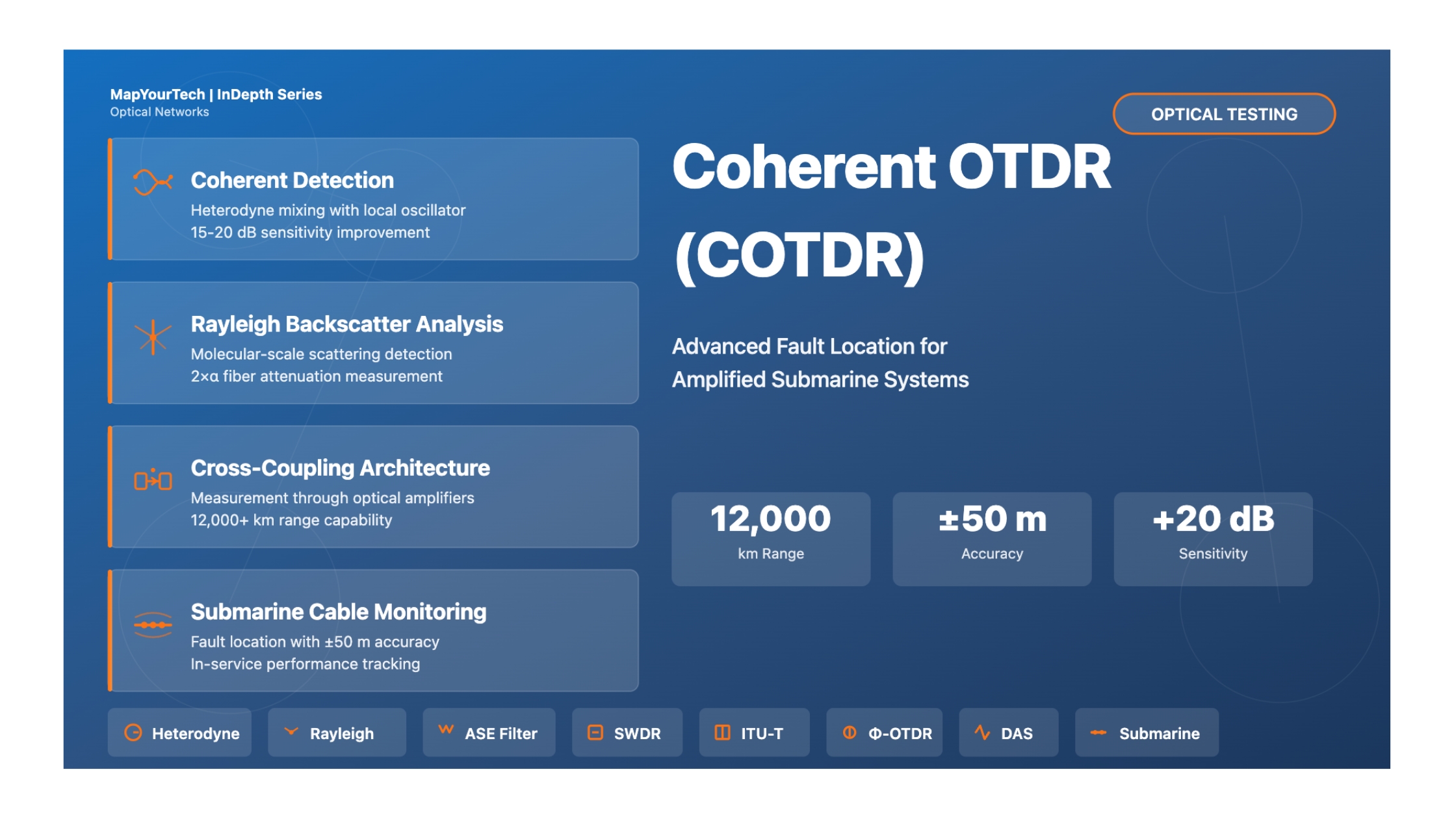
COTDR is an advanced optical testing technique that uses coherent detection instead of direct detection to analyze Rayleigh backscattered light from optical fibers. By mixing the received backscattered signal with a local oscillator (a highly coherent laser source), COTDR achieves significantly higher sensitivity and frequency selectivity compared to conventional OTDR.

The fundamental principle involves injecting a probe optical pulse into the fiber and detecting the Rayleigh backscattered signal using heterodyne or homodyne detection. This coherent detection process provides a dramatic improvement in signal-to-noise ratio, enabling measurements through multiple optical amplifiers and across distances that would be impossible with direct detection methods.

COTDR System Architecture Overview
Complete COTDR system showing coherent laser source, probe pulse generation, fiber under test, and coherent detection receiver
Coherent Laser Source BS Pulse Generator Optical Circulator Fiber Under Test (with Rayleigh Backscatter) Local Oscillator 90° Hybrid Optical Mixer PD I PD Q ADC + Digital Signal Processing COTDR Trace Probe Forward Backscatter Reference COTDR System Block Diagram

Why is COTDR Important?

The importance of COTDR technology stems from several critical advantages it offers for modern optical network operations:

  • Extended Measurement Range: COTDR can locate faults beyond multiple optical amplifiers, enabling measurements in submarine systems spanning over 12,000 km.
  • Higher Sensitivity: Coherent detection provides 15-20 dB improvement in sensitivity compared to conventional OTDR, allowing detection of weaker backscattered signals.
  • Amplified System Compatibility: Unlike conventional OTDR which is blocked by optical isolators in amplifiers, COTDR can monitor through entire amplified chains using cross-coupling techniques.
  • In-Service Monitoring: COTDR can monitor fiber attenuation and amplifier gain while traffic is present, providing real-time system health assessment.
  • Precise Fault Location: Achieves fault location accuracy of ±50 m over thousands of kilometers, critical for submarine cable repair operations.
  • Distributed Sensing: Modern COTDR variants enable distributed acoustic sensing (DAS) and distributed temperature/strain sensing for infrastructure monitoring.

Real-World Applications and Relevance

COTDR has become indispensable in several critical applications:

Submarine Cable Systems: COTDR is the primary tool for fault location in transoceanic submarine cables. When a cable fault occurs, COTDR measurements from both terminal stations can pinpoint the fault location to within 50 meters across thousands of kilometers, enabling efficient cable ship deployment and repair operations. This capability has saved millions of dollars in repair costs and reduced service outage durations.

Terrestrial Long-Haul Networks: In long-haul DWDM networks with optical amplifiers, COTDR provides the only practical means for end-to-end fiber characterization and fault location without requiring access to intermediate regeneration sites.

Infrastructure Monitoring: Advanced COTDR-based distributed acoustic sensing (DAS) systems are deployed along pipelines, railways, and borders for real-time intrusion detection, monitoring, and predictive maintenance applications.

Data Center Interconnects: As data center interconnects extend over hundreds of kilometers with ROADMs and optical amplifiers, COTDR provides essential monitoring for maintaining high availability.

COTDR vs Conventional OTDR Comparison
Side-by-side comparison showing measurement capabilities of COTDR versus conventional OTDR
Measurement Range Comparison Conventional OTDR Fiber Span Probe AMP Isolator Blocked BLOCKED ✓ Range: 0.5-200 km ✗ Cannot pass amplifiers ✓ Simple, low cost Coherent OTDR (COTDR) Probe ──► Span 1 A1 Span 2 A2 Span 3 A3 ... ◄── Backscatter Returns via Coherent Detection Coherent Detection Enables Measurement Through Amplifiers ✓ Range: 100-12,000 km ✓ Passes through amplifiers ✓ Higher sensitivity (+15-20 dB) ✓ In-service monitoring ✓ Frequency selectivity ✓ Submarine cable systems ✗ Complex, higher cost ✓ Distributed sensing capable Advancement COTDR enables fault location and monitoring in amplified systems impossible with conventional OTDR

Historical Context and Evolution

The development of COTDR technology parallels the evolution of optical fiber communication systems from simple point-to-point links to complex amplified networks spanning global distances.

Early Development (1980s)

Conventional OTDR emerged in the late 1970s as a tool for characterizing optical fibers in laboratory settings and short telecommunications links. However, as optical systems grew longer and incorporated optical amplifiers in the mid-1980s, the limitations of direct detection OTDR became apparent.

The concept of coherent detection for optical measurements was well-understood from radio engineering and radar systems. Researchers recognized that applying coherent detection principles to OTDR could dramatically improve sensitivity. Early work focused on demonstrating the feasibility of heterodyne and homodyne detection for Rayleigh backscatter measurement.

Breakthrough Era (1990-1995)

The early 1990s saw critical breakthroughs that established COTDR as a practical technology:

  • 1990: Novel coherent heterodyne OTDR demonstrated for fault localization in optical amplifier submarine cable systems, addressing the fundamental challenge of measuring through amplifier chains.
  • 1993: Highly accurate fault localization achieved over 4,580 km using coherent Rayleigh backscatter reflectometry, proving the viability for transoceanic systems.
  • 1995: Enhanced COTDR techniques developed specifically for long-span optical transmission lines containing optical fiber amplifiers, improving noise rejection and dynamic range.

Maturation and Optimization (1995-2010)

During this period, COTDR technology matured from laboratory demonstrations to field-deployed systems:

  • Performance Optimization: Systematic studies optimized COTDR parameters for amplified transmission systems, including probe power levels, averaging schemes, and signal processing algorithms.
  • Cross-Coupling Techniques: Development of optical cross-coupling methods in submarine repeaters enabled backscattered signal recovery without requiring bidirectional amplifiers.
  • Commercialization: Submarine cable system vendors integrated COTDR capabilities into terminal equipment, making it a standard feature for new installations.
  • Correlation OTDR: Introduction of correlation-based techniques that combined some benefits of coherent detection with simpler direct detection receivers, reducing system complexity and cost.
COTDR Technology Evolution Timeline
Key milestones in the development of COTDR from concept to modern applications
1980s Conventional OTDR Limitations 1990 Coherent OTDR for Submarine 1993 4,580 km Demonstration 1995-2000 Performance Optimization 2000-2010 Commercial Deployment 2010-2020 Distributed Sensing (DAS) 2020-2025 AI/ML Enhanced Embedded OTDR Technology Evolution: 1980s to Present
Premium Article — Free 20% Preview

Read the Full Analysis with Premium

The remaining 80% of this article — the design numbers, trade-offs and field guidance — is part of MapYourTech Premium, along with the full premium library, courses and professional tools.

Instant access · Cancel anytime · 48-hour trial available
Sanjay Yadav

Optical Communications & Network Automation Expert | Author of 3 Books for Optical Engineers | Founder, MapYourTech

Optical networking engineer with nearly two decades of experience across DWDM, OTN, coherent optics, submarine systems, and cloud infrastructure. Founder of MapYourTech.

Follow on LinkedIn

You May Also Like

52 min read 12 0 Like The Submarine Cable Stack: Open Cables, GSNR, SDM and Power Skip to main content...
  • Free
  • July 10, 2026
32 min read 10 0 Like Coherent DSP Architecture: From ADC Samples to Client Bits MAPYOURTECH | COHERENT OPTICS DEEP...
  • Free
  • July 10, 2026
42 min read 14 0 Like Building an Optical NOC Dashboard with OpenConfig Telemetry Skip to main content MapYourTech |...
  • Free
  • July 10, 2026

Course Title

Course description and key highlights

Course Content

Course Details