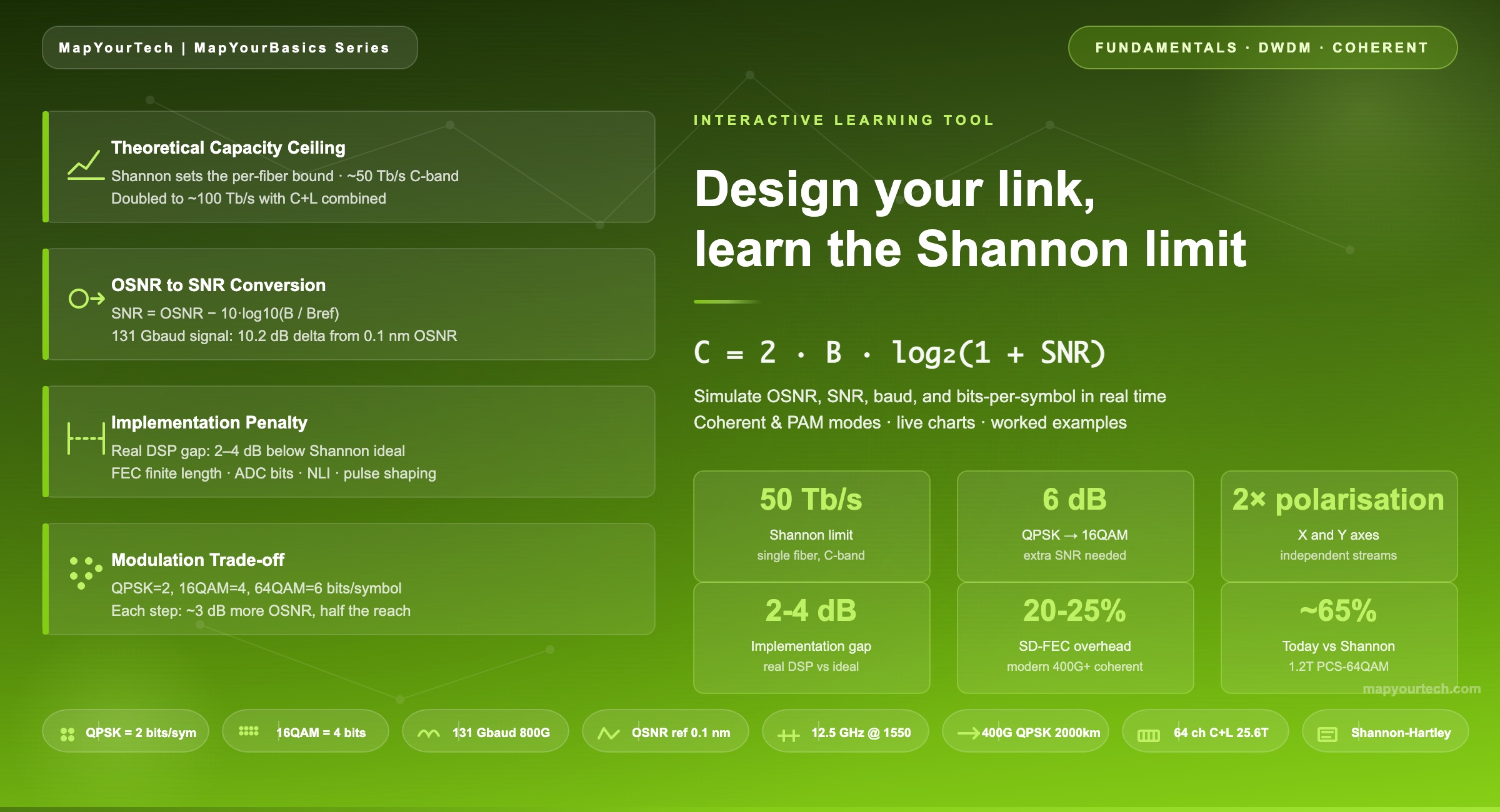
Design your link, learn the Shannon limit
Manipulate bandwidth, SNR, OSNR, baud rate, and bits-per-symbol to see required SNR and achievable capacity in real time. Built-in teaching panels explain the physics, derive the math, and call out the engineering trade-offs on every control. Use it to design real links — or to learn why Shannon caps per-fibre capacity around 50 Tb/s.
01Why Shannon caps every coherent link
Every coherent transceiver decision — which modulation format to run, how many bits per symbol, what OSNR to engineer for, whether 800G fits in a 150 GHz channel — comes back to one equation. The Shannon-Hartley theorem sets the upper bound on how many bits per second you can push through a channel given its bandwidth and signal-to-noise ratio. No DSP, no FEC, no pulse-shaping trick moves this bound. It is a property of the channel, not the equipment.
For a dual-polarisation coherent optical channel, the theorem gives C = 2 · B · log₂(1 + SNR). The factor of 2 is because the two orthogonal polarisations carry independent information streams. Everything engineers do — picking 16QAM over QPSK, raising launch power, adding Raman, switching from 0.2 dB/km G.652D to 0.17 dB/km ULL fiber, moving from 7nm to 5nm to 3nm DSP — is either making B bigger, making SNR bigger, or moving closer to the bound.
As of 2026, the industry has commercial 800G ZR/ZR+ pluggables at 118–131 Gbaud, 1.2T modems on 5nm DSP, and 1.6T single-carrier wavelengths on 3nm DSP at 200 Gbaud. Each generation shaves 0.5–1 dB off the gap to Shannon. Understanding the formula tells you not just where you are today, but what the ceiling looks like when you plan a network for a 10–20 year lifetime. For the full mathematical journey from Shannon's capacity theorem through OSNR and GOSNR, see our complete technical walkthrough for optical networking professionals.
Takeaway: Shannon is not a guideline — it is a ceiling. Real coherent transceivers operate 2 to 4 dB below it because of finite DSP precision, finite FEC code length, and non-ideal pulse shaping. That 2–4 dB gap is the real engineering playground. Closing it by 0.5 dB is a generation of DSP progress.
02Interactive calculator
Inputs
OSNR Reference
Real-world Corrections
Results
Nearest standard modulation format
| Format | bits/sym | Req. SNR (dB) | Req. OSNR (dB) | Line rate @ B | Match |
|---|
03Where the formula comes from
Claude Shannon published A Mathematical Theory of Communication in 1948. The capacity theorem says: for a channel with bandwidth B and additive white Gaussian noise at signal-to-noise ratio SNR, the maximum error-free bit rate is C = B · log₂(1 + SNR) bits per second. This is a single-dimension result — one real-valued signal stream.
Coherent optics uses four real-valued dimensions per channel: in-phase (I) and quadrature (Q) components on each of the two orthogonal polarisations (X and Y). That gives two complex dimensions. The formula scales to C = 2 · B · log₂(1 + SNR) for the dual-polarisation case.
Why the factor of 2?
The two orthogonal polarisation states of light — horizontal and vertical, or X and Y — are physically independent. A polarisation beam splitter at the receiver separates them cleanly. Each carries its own data stream. The 2× is not a bonus — it is the fundamental doubling you get from using both polarisations.
Why log₂?
Bits are base-2 information units. To encode M distinct symbols unambiguously, you need log₂(M) bits per symbol. Shannon showed the channel supports up to 1 + SNR distinguishable signal levels in each dimension. Taking log₂ of that gives bits per symbol; multiplying by symbols per second (B) gives bits per second.
Why baud ≈ bandwidth?
An ideal Nyquist-shaped pulse at baud rate B occupies exactly B Hz of spectrum. Real roll-off factors (0.05 to 0.15 typical) add a few percent. For engineering purposes: a 69 Gbaud signal occupies roughly 70 GHz, fits in a 75 GHz channel, and packs into a 100 GHz flex-grid slot with guard band.
Don't confuse B with channel spacing
B is the signal's baud rate. Channel spacing is the ITU flex-grid slot width you allocate (50, 75, 100, 150 GHz). They are different. A 131 Gbaud signal has B = 131 GHz but can sit in a 150 GHz channel with 19 GHz of guard. Spectral efficiency uses the slot width, not B.
Direct-detect PAM is single-pol, single-quadrature
PAM4/PAM6/PAM8 transceivers (100GBASE-FR1, 400GBASE-DR4, 800GBASE-DR8) use intensity modulation on one polarisation — no I/Q, no dual-pol. The Shannon formula reduces to C = B · log₂(1 + SNR): half the capacity of coherent at the same baud and SNR. That's why a 100 Gb/s PAM4 signal needs ~53 Gbaud, while 100 Gb/s coherent QPSK only needs ~26 Gbaud per polarisation. PAM is cheaper per bit for short reach but wastes spectrum. The calculator's toggle switches the 2× off to model PAM links directly.
Takeaway: the formula has only three knobs — bandwidth, SNR, and the 2× from polarisation. Every capacity decision reduces to one of these. If the customer needs more bits per second, you either widen the channel (more B), lower the noise floor (more SNR), or squeeze closer to Shannon (less implementation penalty). Nothing else changes the ceiling.
04OSNR vs SNR — the thing engineers always confuse
Shannon uses SNR — signal power divided by noise power within the signal bandwidth. Optical engineers measure OSNR — signal power divided by noise power within a fixed reference bandwidth, usually 0.1 nm ≈ 12.5 GHz at 1550 nm. The two numbers are related but different, and mixing them is the single most common error in link budget calculations. For a deeper treatment of OSNR, Q-factor, BER, and why OSNR is the canonical link-quality metric, see OSNR: what does this mean, why do we need it, and how to take care of it.
Why OSNR is measured in 0.1 nm
The 0.1 nm bandwidth was standardised when 10G and 40G signals had ~10–40 GHz bandwidth — a fixed reference let you compare amplifiers and links regardless of signal rate. It stuck even as signals grew to 69 and 131 Gbaud. That's why a 131 Gbaud signal needs ~7 dB more OSNR than SNR for the same channel quality.
High-baud signals look better in OSNR
Moving from 69 Gbaud to 131 Gbaud at the same bit rate per polarisation drops SNR requirement by only 3 dB (since bandwidth doubled, noise doubles at same noise density). But OSNR (fixed 0.1 nm) actually rises by 3 dB for the same quality. The measurement reference hides half the gain. Always compare signals in the same metric.
Rule of thumb: at 1550 nm, 0.1 nm reference = 12.5 GHz. So: OSNR(dB) − SNR(dB) = 10·log₁₀(B_Gbaud / 12.5). A 35 Gbaud signal: add 4.5 dB. A 69 Gbaud signal: add 7.4 dB. A 131 Gbaud signal: add 10.2 dB. These are the corrections between OSA measurements and what the DSP actually experiences.
05Implementation penalty — why real gear falls short
Shannon assumes infinite code length, perfect channel knowledge, and infinite decoding complexity. Real transceivers have none of that. The gap between Shannon's ideal and what a shipping 800G transceiver achieves is the implementation penalty, and it has specific physical contributors that DSP architects work hard to reduce.
Where the 2–4 dB comes from
Finite-length FEC (~0.5–1.0 dB)
Shannon assumes infinite block length. Real LDPC or SD-FEC codes are finite (typically 10k–100k bits per block). Shorter blocks give less coding gain. SD-FEC 25% modern codes close to within 0.7 dB of Shannon at BER 1e-15; older HD-FEC at 7% leaves 2+ dB on the table.
DSP quantisation (~0.5 dB)
ADCs have finite resolution — typically 6–8 effective bits per I/Q sample at 128+ GSps. Every quantisation step adds Gaussian-like noise to the signal before the DSP sees it. Higher ADC resolution closes this gap but burns power and silicon area.
Pulse-shaping loss (~0.3–0.5 dB)
Ideal Nyquist rectangular pulse is unrealisable (infinite impulse response in time). Real transmitters use raised-cosine with finite roll-off (0.05–0.15 typical). The resulting pulse has sidelobes that leak energy outside the ideal rectangular spectrum, costing a fraction of a dB.
Non-Gaussian noise in long-haul (~0.5–1.5 dB)
Shannon assumes additive white Gaussian noise. Fiber nonlinearity (SPM, XPM, FWM) produces noise that is correlated with the signal, non-Gaussian, and worse than AWGN of the same power. The gap grows with launch power and path length — on long-haul it can be 1.5 dB even after NLC (nonlinear compensation). For the analytical framework used to quantify this, see the Gaussian Noise Model for optical transmission.
Takeaway: a 3 dB implementation penalty is a reasonable default for current-generation 5nm coherent DSP on short-reach links (under 500 km). Long-haul and submarine links need 4–5 dB because of NLI. Silicon-node cadence tracks this directly: 28nm enabled 100G circa 2012, 16nm pushed to 200–400G by 2016, 7nm unlocked 600–800G from 2019, 5nm currently supports 800G–1.2T commercial deployments, and 3nm DSP has begun delivering 200 Gbaud and 1.6T single-carrier wavelengths from 2024–2025. Expect another 0.5–1 dB of penalty reduction per silicon generation. Every 1 dB of implementation penalty closed is either 0.33 bits/symbol of extra capacity or roughly a 25% reach extension.
06FEC overhead — line rate vs client rate
Shannon's capacity C is what the channel supports. Real links reserve part of that capacity for forward-error-correction parity bits. The customer pays for client bit rate — the rate after FEC parity is stripped. Confusing line rate with client rate is a common quoting error.
Common FEC schemes
| FEC scheme | Overhead | Coding gain (dB) | Typical use |
|---|---|---|---|
| GFEC (G.709) | 7% | ~6 | Legacy 10G/100G, OTN classical |
| EFEC (G.975.1) | 7% | ~8 | Enhanced 10G/40G |
| OpenROADM | 15% | ~10 | OpenROADM 100G/200G interop |
| SD-FEC (classic) | 20% | ~11.5 | 400G coherent ZR/ZR+ |
| SD-FEC (modern LDPC) | 25–27% | ~11.8 | 800G coherent, current generation |
| OIF oFEC (oFEC-800) | ~15% | ~11 | OIF 800ZR, interoperable |
Design note: higher FEC overhead gives more coding gain (lower SNR required) but reduces client rate at the same line rate. A 400G client at 27% SD-FEC runs 508G on the fiber — that's 508G of bandwidth occupation, even though the customer pays for 400G. When comparing spectral efficiency between vendors, always normalise to client rate, not line rate.
07Modulation formats — from QPSK to 256QAM
Each modulation format packs a fixed number of bits per symbol per polarisation. Moving to a richer constellation doubles bits-per-symbol but roughly doubles the required SNR (quadruples the noise sensitivity). This trade-off — spectral efficiency vs required OSNR — drives every coherent design decision. For the underlying geometry — constellation points, Euclidean distance, symbol energy, and how they set the OSNR threshold — see Basics of Constellation Diagrams in Optical Design.
QPSK (2 bits/symbol)
Four constellation points at equal amplitude, different phase. Published industry OSNR benchmarks for DP-QPSK at 100G–200G line rate with SD-FEC: ~13–15 dB OSNR in 0.1 nm. Workhorse for long-haul and submarine — 400G at 131 Gbaud QPSK reaches 2000+ km on terrestrial and 10,000+ km on submarine.
- Symmetric amplitude — amplifier-friendly
- Large Euclidean distance between symbols — noise-tolerant
- Inefficient in spectrum: 2 bits/symbol × 2 pol = 4 bits/Hz theoretical max
- Most tolerant to fiber nonlinearity — standard choice for long-haul
16QAM (4 bits/symbol)
16 constellation points, 4 amplitude × 4 phase levels. Published industry OSNR benchmarks for DP-16QAM at 400G: ~21–23 dB OSNR in 0.1 nm — about 7 dB more than QPSK. Standard for 400G at 69 Gbaud (metro) and 800G at 118–131 Gbaud (DCI, metro, short-haul regional).
- 2× the bits of QPSK
- Needs ~7 dB more OSNR than QPSK at same baud
- Reach typically 500–1200 km at 800G, depending on span loss and fiber quality
- Industry default for 400G DCI pluggable optics
64QAM (6 bits/symbol)
64-point constellation. Published industry benchmarks for DP-64QAM at 800G: ~28–30 dB OSNR — only achievable on short-reach (< 200 km) with premium fiber and minimal in-line amplification. Used for 1.2T–1.6T short-reach DCI and ultra-dense metro applications.
- 3× QPSK bits per symbol
- Needs ~15 dB more OSNR than QPSK — roughly 32× more signal power
- Extremely noise-sensitive — no margin for degradation
- Only viable at short reach with clean fiber plant
PCS (probabilistic constellation shaping)
Sends low-amplitude constellation points more often than high-amplitude points, matching a Gaussian distribution. Provides fractional bits/symbol (e.g., 3.56, 4.2, 5.35) and closes 0.5–1 dB of the Shannon gap versus uniform M-QAM. Widely adopted in modern 400G and 800G systems — the standard approach for 800G ZR+ interoperable PCS mode.
- Fine-grained rate adaptation — no discrete jumps between formats
- Typical 0.5–1 dB improvement over uniform M-QAM of equivalent average bits/symbol
- Modern 800G and 1.2T coherent designs use PCS natively
- Enables rate/reach optimisation per link without hardware changes
Takeaway: every step up in modulation order costs ~3 dB of OSNR and doubles noise sensitivity. This is why reach shrinks rapidly with higher modulation — 400G QPSK reaches 3000 km, 400G 16QAM 1000 km, 400G 64QAM under 300 km. PCS softens the discrete jumps by letting the transceiver adapt rate in fractional steps to match the available OSNR.
Single-polarisation PAM — the direct-detect cousin
Every modulation format above is dual-polarisation coherent: I/Q on both X and Y polarisations, four real-valued dimensions per channel, detected with a local oscillator and a DSP. Inside data centres the economics flip. Short reach, no optical amplification, no ROADM, no DSP luxury — the design constraint is cost-per-bit at 100 Gb/s to 1.6 Tb/s per port. That is direct-detect PAM territory. For the full application-boundary analysis — where coherent wins, where PAM wins, and where the crossover is moving as coherent-lite and LPO mature — see Coherent vs Direct-Detect Transceivers: Application Boundaries and Technology Selection.
PAM uses only intensity on a single polarisation. A photodiode at the receiver integrates the optical power; no local oscillator, no polarisation tracking, no complex DSP. The Shannon formula loses the 2× factor:
Three things change when you use PAM instead of coherent:
Implementation penalty is higher
PAM has a 4–6 dB implementation penalty versus coherent's 2–4 dB. Direct detection is less tolerant of chromatic dispersion (no DSP-based CD compensation), less tolerant of fibre nonlinearity, and the smaller Euclidean distance between PAM4 levels (compared to QPSK constellation points) makes it more noise-sensitive at the same bit rate.
OSNR is the wrong metric
PAM link budget is measured in dB of optical power, not OSNR in 0.1 nm. A photodiode sees received power; it does not have the frequency resolution of an OSA for unamplified spans. Budgets are built from transmitter launch power, fibre loss, connector loss, and receiver sensitivity — not from noise density.
Half the capacity at the same baud
Compare 100 Gbaud signals: coherent DP-16QAM carries 2 × 100 × 4 = 800 Gb/s; PAM4 at 100 Gbaud carries 1 × 100 × 2 = 200 Gb/s. The 4× gap is why coherent dominates long-haul (where spectrum is scarce) and PAM dominates intra-DC (where fibre is cheap and short).
Coherent is moving into the DC
800G ZR pluggables bring dual-pol coherent into QSFP-DD form factor for DCI links up to 120 km. Meanwhile PAM8 and 200+ Gbaud PAM4 are pushing into reaches where coherent used to be required. The boundary between the two technologies is the current 2026 engineering question for hyperscale optics.
Try the calculator: click the "100G PAM4 (DD)" preset, or toggle "Direct-detect PAM (single polarisation)" on the current scenario to see the formula switch from C = 2·B·log₂(1+SNR) to C = B·log₂(1+SNR). The OSNR result becomes "n/a" because direct-detect doesn't use that metric. Compare the same 100 Gb/s target in both modes to see why PAM needs roughly 2× the bandwidth (Gbaud) that coherent needs.
08What changes when you pick ZR, ZR+, or OTN mode
A modern coherent transceiver exposes multiple operating modes. The same piece of silicon can be provisioned as a short-reach ZR pluggable, an extended-reach ZR+ module, or an OTN line card for carrier-grade transport. The hardware is the same — what changes is the FEC scheme, framing overhead, rate flexibility, and interoperability profile. The distinction is practical: the OSNR a wavelength requires, and the client rate a customer sees, both depend on which mode is running. For a deep dive into the standards, form factors, and deployment economics of 800G pluggable coherent optics, see 800G ZR/ZR+ Coherent Optics.
ZR (OIF standard)
OIF 400ZR / 800ZR — a fixed, interoperable specification for single-span DCI over point-to-point fibre. Designed to plug into a router slot and cross ~80–120 km of fibre without amplification or ROADM.
- FEC: cFEC for 400ZR (~15% overhead), concatenated code for 800ZR
- Modulation: fixed — DP-16QAM at ~60 Gbaud (400ZR) or ~118 Gbaud (800ZR)
- Line rate: fixed at 400G or 800G client
- Reach: 80–120 km single-span typical, unamplified
- Interop: guaranteed across vendors — buy from any vendor, plug into any router
- Client interface: Ethernet only (400GE, 800GE)
ZR+ (OpenZR+ MSA)
Industry MSA extension of ZR. Adds rate flexibility, stronger FEC, PCS, and wavelength tunability. Intended for amplified metro and regional networks — the reach zone ZR cannot serve.
- FEC: oFEC (~15% overhead) — stronger than cFEC, ~2 dB more coding gain
- Modulation: flexible — QPSK, 8QAM, 16QAM, with PCS variants
- Line rate: 100G to 400G (OpenZR+), 200G to 800G (800G ZR+)
- Reach: hundreds to ~2000 km with amplification, depending on rate
- Interop: MSA-defined, cross-vendor at matched modes
- Client interface: Ethernet; some implementations add OTN framing
OTN (vendor-optimised carrier mode)
Full-feature OTN transport mode running the strongest proprietary FEC and the widest rate flexibility in the DSP. Available in both transponder shelves and pluggables (QSFP-DD, OSFP) — OTN framing is a firmware and mapping function, not a form factor. Optimised for maximum reach, minimum OSNR, and carrier-grade OTN performance monitoring.
- FEC: vendor-proprietary SD-FEC, typically 20–27% overhead, the strongest codes available
- Modulation: fully flexible including PCS — dozens of rate modes per transceiver
- Line rate: 100G to 1.6T+ per wavelength, plus sub-rates
- Reach: designed for long-haul — 2000–10,000+ km with Raman, submarine capable
- Form factor: transponder card, QSFP-DD, OSFP, CFP2 — OTN runs on all of them
- Interop: generally single-vendor end-to-end (proprietary FEC and mapping)
- Client interface: multi-service — Ethernet, OTN, Fibre Channel, SONET/SDH, muxponder modes
OpenROADM (open-line-system mode)
A fourth mode worth knowing. MSA targeting multi-vendor open line systems. Sits between ZR+ and OTN — more rate flexibility than ZR+, better interop than proprietary OTN.
- FEC: OpenFEC (~15%) — interoperable SD-FEC
- Modulation: QPSK to 64QAM, PCS in newer revisions
- Line rate: 100G/200G/300G/400G per wavelength, extending to 800G
- Reach: metro to long-haul, depending on rate
- Interop: OpenROADM MSA — open multi-vendor line systems
- Client interface: Ethernet and OTN
What changes in the Shannon math
For the calculator, the mode mostly changes three inputs: FEC overhead, implementation penalty, and whether you can freely pick the modulation. Here is how the defaults shift:
| Mode | Typical FEC OH | Typical penalty | Rate flexibility | Modulation |
|---|---|---|---|---|
| 400ZR | ~15% | 3.0–3.5 dB | Fixed at 400G | DP-16QAM only |
| 800ZR | ~15% | 3.0–3.5 dB | Fixed at 800G | DP-16QAM (118 Gbd) |
| OpenZR+ / 800G ZR+ | ~15% (oFEC) | 2.5–3.0 dB | 100G–400G / 200G–800G | QPSK / 8QAM / 16QAM / PCS |
| OpenROADM | ~15% | 3.0 dB | 100G / 200G / 300G / 400G+ | QPSK to 64QAM, PCS |
| OTN (proprietary) | 20–27% | 2.0–2.5 dB | Full flex, PCS fractional | Any up to 64QAM, fine-step PCS |
Same transceiver, three modes — a worked comparison at 400G client rate
Practical rule: if you have OSNR to spare and need router-integrated optics, ZR is cheapest (pluggable, multi-vendor, Ethernet-native). If the OSNR is tight or you need rate flexibility, ZR+ or OpenROADM gets you another 1–2 dB. If you are running a carrier backbone with sub-rate clients and need the strongest FEC for 3000+ km reach, pick OTN mode — available as a transponder card or as a pluggable, depending on port density and chassis economics. The same DSP silicon serves all three — what changes is the firmware profile, FEC code, and framing.
Takeaway: the mode decision is not about modulation — it is about FEC overhead, coding gain, rate flexibility, and interoperability. For identical client rate and baud, switching from ZR to OTN can save 1–2 dB of OSNR through stronger FEC. That 1–2 dB translates to ~200–400 km of extra reach, or one extra ILA span avoided. Pick the mode to match the business need: pluggable-friendly DCI → ZR; metro with ROADMs → ZR+ or OpenROADM; long-haul carrier → OTN.
09Gap to Shannon — where today's coherent sits
The Shannon limit for a single C-band fiber pair is approximately 50 Tb/s using 16QAM-class modulation at practical OSNR margins. Adding L-band doubles that to ~100 Tb/s. As of 2026, commercial 800G × 64–80 channel C+L deployments reach 25–40 Tb/s per fiber pair — around half of the theoretical Shannon ceiling. The gap is closing by roughly 0.5–1 dB per DSP silicon generation, and industry trials with ultra-wideband C+L+S systems have pushed single-fiber experimental capacity past 100 Tb/s. For the engineering techniques used to close this gap — Nyquist-WDM, higher-order modulation, probabilistic constellation shaping, and advanced FEC — see Spectral Efficiency Maximization Techniques.
| Era | Line rate | Modulation | Baud | Channel (GHz) | b/s/Hz | CMOS node |
|---|---|---|---|---|---|---|
| 2010–2012 | 100G | DP-QPSK | 28–32 | 50 | 2.0 | 40 / 28 nm |
| 2013–2016 | 200G | DP-16QAM | 32–35 | 50 | 4.0 | 28 / 16 nm |
| 2017–2020 | 400G | DP-16QAM | 64–69 | 75 | 5.3 | 16 / 7 nm |
| 2021–2023 | 600G / 800G | 16QAM-PCS | 95–118 | 100–150 | 5.3–6.4 | 7 / 5 nm |
| 2024–2025 | 800G / 1.2T | PCS-16/32QAM | 130–148 | 150 | 6.4–8.0 | 5 nm |
| 2025–2026 | 1.6T | PCS-64QAM | 200 | 200–250 | 8.0–10.0 | 3 nm |
Published industry milestones (2025–2026): first commercial 1.6T single-carrier wavelengths at 200 Gbaud on 3nm CMOS DSP; 800G ZR pluggables in QSFP-DD form factor using 118 Gbaud DP-16QAM for short DCI; 800G ZR+ interoperable PCS mode in 130+ Gbaud for metro/regional reach in 150 GHz channels. Ultra-wideband experiments over C+L+S bands have pushed reported per-fiber capacity beyond 30 Tb/s per band, with commercial C+L deployments reaching 25–30 Tb/s at 400G × 64–80 channels.
Where the next 0.5 dB comes from: (1) 3nm and beyond-3nm DSP with more ADC effective bits — closes ~0.3 dB of quantisation loss, (2) longer LDPC blocks — closes ~0.3 dB of FEC loss, (3) finer-step PCS (probabilistic constellation shaping) with smaller rate increments — closes ~0.3–0.5 dB, (4) machine-learning-assisted nonlinearity compensation — closes ~0.5 dB on long-haul. The cumulative 1–1.5 dB improvement per DSP generation is why 1.2T at 131 Gbaud became practical when earlier DSP generations struggled with 800G at the same symbol rate.
10Current industry benchmarks (2025–2026)
The numbers used in this calculator are grounded in publicly available industry data from standards bodies, MSAs, and published coherent DSP specifications. The values below represent the mainstream of what is commercially deployed or in field trial as of 2026 — across vendors and platforms. Your specific transceiver may differ by ±1 dB from these values; always confirm against the datasheet for the module you are specifying.
Published OSNR requirements (SD-FEC, 0.1 nm reference)
| Line rate | Modulation | Typical baud | OSNR req. (0.1 nm) | Typical reach |
|---|---|---|---|---|
| 100G | DP-QPSK | ~34 Gbd | 13–15 dB | 3000+ km terrestrial, 10,000+ km submarine |
| 200G | DP-QPSK | ~69 Gbd | 14–16 dB | 2000–3000 km terrestrial |
| 200G | DP-16QAM | ~35 Gbd | 17–19 dB | 1000–1500 km |
| 400G | DP-QPSK | ~131 Gbd | 16–18 dB | 1500–2500 km terrestrial |
| 400G | DP-16QAM | ~69 Gbd | 21–23 dB | 500–1000 km metro/regional |
| 800G ZR | DP-16QAM | ~118 Gbd | 24–26 dB | 80–120 km DCI (single span) |
| 800G ZR+ | PCS-16QAM | ~131 Gbd | 22–25 dB | 500–1200 km metro/regional |
| 1.2T | PCS-32/64QAM | ~148 Gbd | 26–28 dB | 200–500 km regional |
| 1.6T | PCS-64QAM | ~200 Gbd | 28–30 dB | 80–300 km metro/DCI |
DSP silicon-generation timeline
| Era | CMOS node | Max baud | Max line rate | Key capability unlocked |
|---|---|---|---|---|
| 2010–2012 | 40 / 28 nm | ~32 Gbd | 100G | First commercial coherent; DP-QPSK with HD-FEC |
| 2013–2016 | 28 / 16 nm | ~35 Gbd | 200G | 16QAM, SD-FEC, CD/PMD compensation |
| 2017–2020 | 16 / 7 nm | ~70 Gbd | 400G | Flex-rate, first PCS, OpenROADM |
| 2021–2023 | 7 / 5 nm | ~130 Gbd | 800G | 800G ZR/ZR+ MSA pluggables, PCS-16QAM |
| 2024–2025 | 5 / 3 nm | 140–200 Gbd | 1.2T / 1.6T | Single-carrier 1.6T, 200 Gbd experimental |
| 2026+ | 3 nm / beyond | 220+ Gbd | 2T+ | ML-assisted NLC, sub-2 dB implementation penalty |
Interpreting these numbers: OSNR values vary by ±1–2 dB across vendor implementations for the same modulation format at the same baud, primarily because of differences in FEC coding gain, PCS shaping step size, and DSP implementation penalty. Use the ranges above for system design budgeting. For production link engineering, always use the specific datasheet OSNR threshold for the exact transceiver model and operating mode. The calculator above lets you dial in implementation penalty from 0 to 10 dB to match any specific datasheet.
Takeaway: the industry has been adding roughly one DSP generation every 3–4 years, each generation delivering either a ~1.5× increase in baud rate or a ~0.5–1 dB reduction in implementation penalty. A 400G wavelength that required 23 dB OSNR in 2018 needs about 21 dB in 2026 — same modulation format, same fiber, different DSP. When planning a network for 10+ years of service, assume OSNR requirements will drop by 2–3 dB over the network lifetime as transceivers refresh. That gives you hidden capacity headroom without touching the line system.
11Examples from real networks
Example 1: 400G ZR over an 80 km unamplified DCI span
Hyperscale data centre interconnect between two buildings on the same campus. Single span, no in-line amplifier, pluggable QSFP-DD directly in the router. Industry-standard OIF 400ZR profile: 16QAM at 60.1 Gbaud with 25% SD-FEC.
Example 2: 200G DP-QPSK over a 600 km regional route
Regional backbone path with 7 EDFA-amplified spans averaging 86 km each. Lower line rate per wavelength trades capacity for reach. Classic long-haul QPSK at 69.4 Gbaud leaves comfortable margin.
Example 3: 800G ZR+ PCS over a 160 km two-span metro link
Metro ring with two amplified spans at 80 km each. PCS-16QAM on 131 Gbaud at 25% FEC. Thin positive margin — the kind of design where vendor datasheet OSNR beats generic benchmarks.
Example 4: 1.2T PCS over a 100 km regional DCI
Two amplified 50 km spans. Leading-edge 5nm DSP at 148 Gbaud. PCS between 32QAM and 64QAM to reach 1.2T client rate. Short spans keep per-span ASE low — the link has enough OSNR to make 1.2T work, but only just.
Example 5: 1.6T PCS over a 150 km metro link
Three amplified spans averaging 50 km each. 3nm DSP operating at 200 Gbaud — the current bleeding edge. Premium fiber (0.17 dB/km) keeps span loss low enough to hit the OSNR the DSP needs for 1.6T.
Example 6: 100G PAM4 over a 10 km single-mode intra-datacenter link
Direct-detect intensity modulation, single polarisation. IEEE 802.3 100GBASE-LR1 profile — 1310 nm, 53.125 Gbaud PAM4 with KP4 RS FEC (~6.25% overhead). No coherent, no dual-pol, no DSP equalisation beyond CTLE/DFE. A different design zone from everything above.
Takeaway: all six examples follow the same recipe — calculate required bits/symbol from target rate and baud, convert to required SNR via 2^(b/s) − 1, add implementation penalty, then compare with what the link delivers. Coherent uses dual-pol (factor of 2) and OSNR in 0.1 nm. PAM uses single-pol (no factor of 2) and electrical SNR at the photodiode. Same physics, different measurement conventions. The calculator's PAM toggle flips the formula so you can model both on the same tool.
12Glossary
Developed by MapYourTech Team
For educational use in optical networking communications technologies
Note: This tool is based on published industry standards (ITU-T, IEEE, OIF, OpenROADM, OpenZR+ MSA), vendor datasheets, and real-world deployment practices. Specific implementations vary by equipment vendor, network topology, and regulatory requirements. Always consult qualified network engineers and vendor documentation for actual deployments.
Feedback welcome: suggestions, corrections, and improvements — [email protected]
Related Articles on MapYourTech