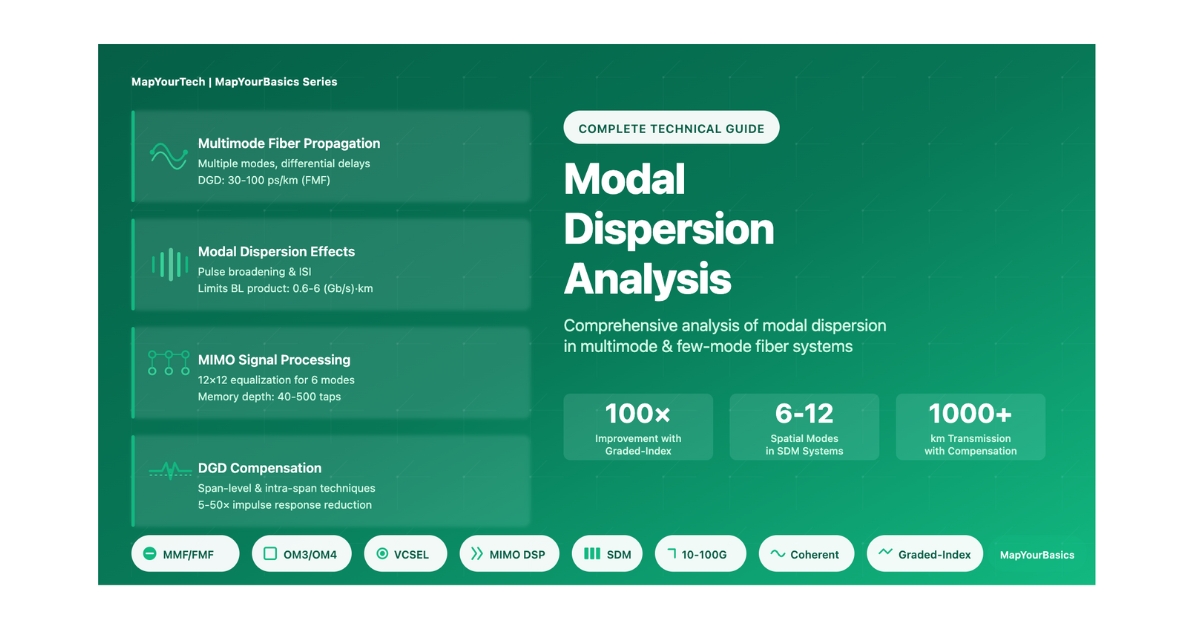

Modal Dispersion Analysis
Comprehensive Guide to Understanding and Managing Modal Dispersion in Optical Fiber Communications
Fundamentals & Core Concepts
What is Modal Dispersion?
Modal dispersion, also known as intermodal dispersion or modal noise, is a fundamental phenomenon that occurs in multimode optical fibers where different modes of light propagate at different velocities. This velocity difference causes an optical pulse to spread out as it travels through the fiber, limiting the maximum transmission distance and data rate.
Key Definition
Modal dispersion is the broadening of optical pulses caused by the different propagation speeds of multiple modes traveling simultaneously through a multimode fiber. Each mode follows a different path length and experiences different propagation delays, causing the pulse to spread temporally at the receiver.
Why Does Modal Dispersion Occur?
Modal dispersion arises from the fundamental physics of light propagation in multimode fibers:
Physical Origin
1. Multiple Propagation Modes: Multimode fibers support multiple spatial modes due to their larger core diameter (typically 50 or 62.5 μm compared to 9 μm for single-mode fibers).
2. Different Path Lengths: Each mode travels through the fiber at a different angle and path length. Lower-order modes travel more directly along the fiber axis, while higher-order modes reflect off the core-cladding interface at steeper angles.
3. Group Velocity Differences: Different modes have different group velocities (β₁,n), causing differential group delay (DGD) between modes. The group velocity for mode n is given by vgr,n = 1/β₁,n.
When Does Modal Dispersion Matter?
Modal dispersion becomes critical in several scenarios:
Critical Scenarios
High-Speed Systems: At bit rates above 100 Mb/s, modal dispersion can limit transmission distance to below 2 km in standard multimode fibers.
Long-Distance Links: For distances exceeding 500 meters, modal dispersion becomes the dominant limiting factor in multimode fiber systems.
Laser-Based Transmitters: Modal noise is particularly problematic when semiconductor lasers are used with multimode fibers, as coherence time effects become significant.
High-Order Mode Systems: Systems utilizing many spatial modes (6+ modes) require MIMO DSP to compensate for modal crosstalk and dispersion.
Why is Modal Dispersion Important?
Practical Significance
System Performance: Modal dispersion directly limits the bit rate-distance (BL) product of multimode fiber systems. For step-index multimode fibers, even at 1 Mb/s, transmission distance is limited to below 10 km.
Network Design: Understanding modal dispersion is essential for proper network design, especially in data centers and local area networks (LANs) where multimode fiber is commonly deployed.
Cost Optimization: While single-mode fiber eliminates modal dispersion, multimode fiber offers cost advantages for short-distance applications when properly managed.
Emerging Technologies: Space-division multiplexing (SDM) and few-mode fibers (FMF) deliberately exploit multiple modes for capacity increase, making modal dispersion management crucial for next-generation systems.
Real-World Analogy
Think of modal dispersion like runners on a track: If multiple runners start together but take different lanes with different path lengths and run at different speeds, they will arrive at the finish line at different times. Similarly, light modes starting together in an optical pulse arrive at different times at the receiver, causing the pulse to spread out.
Mathematical Framework
Core Formulas
Where:
• ΔT = Maximum intermodal delay time (seconds)
• n₁ = Core refractive index (dimensionless, typical value ~1.46)
• Δ = Relative refractive index difference = (n₁ - n₂)/n₁ (typical value ~0.01)
• c = Speed of light in vacuum (3 × 10⁸ m/s)
• L = Fiber length (meters)
Explanation: Graded-index fibers significantly reduce modal dispersion by having a parabolic refractive index profile (α = 2). This causes modes traveling longer paths to move through regions of lower refractive index where they travel faster, partially compensating for the path length difference.
Where:
• DGDn,m = Differential group delay between modes n and m (seconds)
• LF = Fiber length (meters)
• β₁,n = Group delay parameter for mode n (s/m)
• β₁,m = Group delay parameter for mode m (s/m)
Typical Values: Optimized multimode fibers have DGD values around 30-100 ps/km for fibers with 6 or fewer spatial modes.
Where:
• B = Bit rate (bits per second)
• L = Transmission distance (km)
• ΔT = Modal dispersion-induced pulse spreading (seconds)
For step-index fibers: BL ≤ c/(n₁²Δ)
For graded-index fibers: BL ≤ 8c/(n₁Δ²)
Practical Calculation Example
Example: Step-Index Multimode Fiber
Given Parameters:
• Fiber length L = 1 km = 1000 m
• Core refractive index n₁ = 1.46
• Relative index difference Δ = 0.01
• Speed of light c = 3 × 10⁸ m/s
Step 1: Calculate intermodal delay
Step 2: Calculate maximum bit rate
Conclusion: This step-index multimode fiber is severely limited to approximately 14 Mb/s for 1 km transmission distance.
Example: Graded-Index Multimode Fiber
Given Parameters: Same as above
Step 1: Calculate intermodal delay per km
Step 2: For 1 km
Step 3: Calculate maximum bit rate
Conclusion: Graded-index fiber provides over 100× improvement, supporting ~1.64 Gb/s over 1 km compared to 14 Mb/s for step-index fiber.
Group Velocity and Propagation Constant
Terms:
• β₀,n: Phase constant of mode n
• β₁,n: Group delay (inverse group velocity)
• β₂,n: Group velocity dispersion (GVD)
• β₃,n: Third-order dispersion
The group velocity determines how fast optical pulses propagate through the fiber for each mode.
Types & Components
Classification of Multimode Fibers
| Fiber Type | Core Diameter | Modal Dispersion | Bandwidth | Applications |
|---|---|---|---|---|
| Step-Index MMF | 50-100 μm | Very High (~50 ns/km) | Low (< 20 MHz·km) | Legacy systems only |
| Graded-Index MMF | 50, 62.5 μm | Low (~0.5-2 ns/km) | High (200-2000 MHz·km) | LANs, data centers |
| OM1 (62.5/125) | 62.5 μm | Moderate | 200 MHz·km @ 850nm | 1 Gb/s up to 300m |
| OM2 (50/125) | 50 μm | Moderate | 500 MHz·km @ 850nm | 1 Gb/s up to 600m |
| OM3 (Laser-optimized) | 50 μm | Low | 2000 MHz·km @ 850nm | 10 Gb/s up to 300m |
| OM4 (Enhanced) | 50 μm | Very Low | 4700 MHz·km @ 850nm | 10 Gb/s up to 550m |
| OM5 (Wideband) | 50 μm | Very Low | 4700 MHz·km @ 850nm 2470 MHz·km @ 953nm | Multi-wavelength, up to 100 Gb/s |
Mode Group Classification
LP Mode Groups in Graded-Index Fiber
Group 1 (LP₀₁): Fundamental mode, 2 polarization modes
Group 2 (LP₁₁): First higher-order mode, 4 spatial and polarization modes (LP₁₁ₐ and LP₁₁ᵦ)
Group 3 (LP₂₁, LP₀₂): Second-order modes
Group 4 (LP₃₁, LP₁₂): Third-order modes
Higher Groups: LP₄₁, LP₂₂, LP₀₃, and beyond
Each mode group contains nominally degenerate modes with similar propagation constants. The first eight mode groups are commonly utilized in few-mode fiber (FMF) systems for space-division multiplexing.
Coupling Regimes
| Coupling Regime | Characteristics | Distance Range | DSP Requirements |
|---|---|---|---|
| No Coupling | Modes propagate independently Impulse response shows distinct peaks separated by DGD | < 10 km | Independent detection possible Simple MIMO (2×2 or 4×4) |
| Weak Coupling | Random uniform crosstalk plateau Requires DGD compensation Linear impulse response growth | 10-500 km | Full MIMO DSP required Memory depth = DGD |
| Strong Coupling | Continuous mode mixing Bell-shaped impulse response √distance growth of response width | > 500 km | MIMO with reduced memory MDL tolerance improved |
Few-Mode Fiber (FMF) Types
Optimized FMF Designs
Depressed Cladding (DC) Design: Uses modified cladding structure to control DGD. Provides good mode confinement and low loss.
Ring-Core (RC) Fiber: Features a ring-shaped high-index region in the core. Excellent for mode-group separation and low DGD.
Graded-Index (GI) Profile: Most common design, similar to conventional multimode fiber but optimized for minimal DGD. Theoretical DGD can be < 1 ps/km with precise profile control.
Step-Index Modified: Simple design supporting 2-6 modes, but typically has DGD > 1 ns/km, limiting practical transmission to < 50 km without compensation.
Mode Coupling Components
| Component | Function | Key Parameters |
|---|---|---|
| Photonic Lantern | Adiabatically converts spatially separated SMF modes to overlapping MMF modes | Insertion loss < 1 dB Mode selectivity Taper length |
| Phase Mask SMUX | Spatial mode multiplexing using diffractive elements | Modal crosstalk Insertion loss Wavelength dependence |
| DGD Compensator | Reverses differential group delay between modes | Compensation range Residual DGD Bandwidth |
| Mode Coupler | Selectively couples specific modes | Coupling efficiency Modal selectivity Loss |
Effects & Impacts
System-Level Effects
1. Pulse Broadening
Mechanism: Different modes arrive at different times, causing temporal spreading of optical pulses.
Impact: Adjacent pulses begin to overlap, leading to intersymbol interference (ISI).
Severity: For step-index MMF, pulse spreading can be 50-100 ns/km, completely destroying signals over long distances.
2. Modal Noise
Origin: Interference among various modes creates a speckle pattern at the photodetector. Temporal fluctuations in this pattern (due to vibrations, microbends, or temperature changes) produce power fluctuations.
Conditions: Occurs when coherence time (Tc ≈ 1/Δν) is longer than intermodal delay time ΔT.
Impact: Severely degrades SNR in laser-based MMF systems. LED sources avoid this due to large spectral width (Δν ~ 5 THz).
Power Penalty: Can reach 3-6 dB depending on mode-selective coupling loss and number of laser longitudinal modes.
3. Bandwidth Limitation
3-dB Bandwidth: The frequency at which the fiber's transfer function drops by 3 dB.
Typical Values:
• Step-index MMF: < 20 MHz·km
• Graded-index MMF (OM1/OM2): 200-500 MHz·km
• Laser-optimized MMF (OM3/OM4): 2000-4700 MHz·km
Impact: Directly limits the maximum data rate that can be transmitted over a given distance.
Performance Implications
| Parameter | Without Modal Dispersion (SMF) | With Modal Dispersion (MMF) | Impact Ratio |
|---|---|---|---|
| Maximum Distance (10 Gb/s) | 80 km (limited by chromatic dispersion) | 300-550 m (OM3/OM4) | ~100-200× reduction |
| Pulse Spreading (1 km) | ~17 ps (chromatic dispersion) | 0.5-50 ns (modal dispersion) | 30-3000× worse |
| Required SNR | Baseline | +3 to +10 dB (due to ISI and modal noise) | Power penalty |
| Equalizer Complexity | Simple or none | Complex MIMO DSP required | High computational cost |
Quantitative Impact Assessment
Bit Error Rate (BER) Degradation
ISI-Induced Errors: When pulse spreading exceeds the bit period, ISI causes increased BER. A typical requirement is that pulse spreading should be < 70% of bit period for NRZ format.
Modal Noise Contribution: Adds to receiver noise, effectively reducing optical signal-to-noise ratio (OSNR).
Example: At BER = 10⁻¹², a 1.3-μm system at 140 Mb/s with 146-mode fiber can experience 2-5 dB power penalty due to modal effects.
Tolerance Levels and Thresholds
| Application | Maximum Tolerable DGD | Distance Limit | Mitigation Strategy |
|---|---|---|---|
| Data Center (10 Gb/s) | < 0.1 ns | 300-550 m | Use OM3/OM4 fiber |
| Campus Network (1 Gb/s) | < 1 ns | Up to 2 km | Graded-index fiber |
| SDM Systems (6 modes) | 30-100 ps/km | 40-100 km without compensation | DGD compensation + MIMO |
| Long-Haul SDM (> 1000 km) | < 10 ps/km (compensated) | > 1000 km | DGD comp. every span + strong coupling |
Mitigation Strategies Overview
Immediate Mitigation Approaches
1. Fiber Selection: Use graded-index instead of step-index fiber (100× improvement)
2. Source Selection: LEDs for short distances (no modal noise), single-mode lasers for higher speeds
3. Distance Reduction: Limit transmission distance to stay within bandwidth limits
4. Lower Bit Rates: Reduce data rate to accommodate larger pulse spreading
5. Digital Compensation: Implement MIMO DSP for advanced systems
Techniques & Solutions
1. Optimized Fiber Design
Graded-Index Profile Optimization
Principle: Design refractive index profile n(ρ) = n₁[1 - Δ(ρ/a)^α] with α ≈ 2(1-Δ) to minimize modal dispersion.
Advantages:
- Reduces modal dispersion by factor of 100-1000× compared to step-index
- All modes arrive nearly simultaneously
- Achieves bandwidth > 2000 MHz·km
Disadvantages:
- Requires precise manufacturing control
- Profile accuracy must be better than 1% for optimal performance
- Wavelength-dependent optimization
Applications: OM3, OM4, OM5 fibers for data centers and LANs
Few-Mode Fiber (FMF) with Low DGD
Design Approaches:
• Depressed Cladding: Modified cladding reduces mode coupling and controls DGD to 30-50 ps/km
• Ring-Core Design: Ring-shaped index profile provides excellent mode separation, DGD < 20 ps/km
• Optimized Graded-Index: Precision profile control achieves theoretical DGD < 1 ps/km (practically 5-10 ps/km)
Challenge: Maintaining DGD < 1 ppm relative group velocity error requires extremely precise fabrication
Best Use: Space-division multiplexing systems for capacity scaling
2. Differential Group Delay (DGD) Compensation
Span-Level DGD Compensation
Method: Cascade fiber with compensating element having inverse DGD characteristics.
Implementation:
• Use fiber section with negative DGD to reverse delay accumulation
• Modes separate in first section, then overlap at span end
• Typical residual DGD: 100-200 ps after compensation
Benefits:
- Reduces impulse response spread by 5-50×
- Enables transmission distances > 1000 km in FMF systems
- Reduces MIMO DSP memory requirements
Experimental Results: 3-mode FMF with 30 km spans demonstrated impulse response containment over 900 km with span-level compensation.
Intra-Span DGD Compensation
Concept: Perform DGD compensation within spans (e.g., every 1 km) rather than only at span boundaries.
Performance: Additional 50× reduction in impulse response spread compared to span-level compensation.
Trade-off: Increased complexity and cost vs. significantly improved performance.
3. MIMO Digital Signal Processing
MIMO Equalization Techniques
Purpose: Compensate for modal crosstalk and dispersion in multi-mode systems.
Channel Model:
• Time-domain: r(t) = H * s(t), where H is the MIMO channel matrix
• Frequency-domain: r̃(ω) = H̃(ω) · s̃(ω)
Equalizer Configurations:
• 2×2 MIMO: For LP₀₁ mode transmission (2 polarizations)
• 4×4 MIMO: For LP₁₁ modes (2 spatial modes × 2 polarizations)
• 12×12 MIMO: For 6 spatial modes × 2 polarizations
Memory Depth: Must match maximum DGD (typically 100-500 taps for long-distance systems)
Algorithms: Adaptive equalization, decision-feedback equalization, maximum likelihood sequence estimation
4. Mode Coupling Management
| Technique | Method | Benefit | Application |
|---|---|---|---|
| Weak Coupling Control | Minimize fiber perturbations, control splice quality | Predictable channel, reduced crosstalk | Short-reach systems (< 100 km) |
| Strong Coupling Enhancement | Intentionally introduce controlled perturbations | √distance impulse response growth, improved MDL tolerance | Long-haul systems (> 500 km) |
| Mode Scrambling | Mode mixers at regular intervals | Averages modal properties, reduces speckle variations | Modal noise reduction |
| Mode-Selective Launch | Photonic lanterns, phase masks | Independent mode transmission without DSP | Short-distance SDM (< 10 km) |
5. Source Optimization
LED Sources for Modal Noise Suppression
Advantage: Large spectral width (Δν ~ 5 THz) makes coherence time Tc << intermodal delay ΔT, eliminating modal noise.
Limitation: Limited to lower bit rates (< 622 Mb/s) due to broader spectrum and chromatic dispersion.
Best Use: Cost-sensitive applications with moderate speed requirements.
Single-Longitudinal-Mode Lasers
Advantage: Narrow spectral width reduces chromatic dispersion effects while maintaining high coherence.
Challenge: Can exacerbate modal noise in MMF systems.
Solution: Combine with mode-selective launching or use with FMF and MIMO DSP.
Comparison of Techniques
| Technique | Complexity | Cost | Performance Gain | Practicality |
|---|---|---|---|---|
| Graded-Index Fiber | Low (manufacturing) | Moderate | 100× improvement | ⭐⭐⭐⭐⭐ Widely deployed |
| DGD Compensation | Moderate | Moderate-High | 5-50× improvement | ⭐⭐⭐⭐ Proven for SDM |
| MIMO DSP | High (computational) | Moderate (hardware) | Enables long-distance SDM | ⭐⭐⭐⭐ Standard for advanced systems |
| LED Sources | Low | Low | Eliminates modal noise | ⭐⭐⭐ Limited to low speeds |
| Strong Coupling | High (requires long distance) | None (natural phenomenon) | √distance scaling | ⭐⭐⭐ Emerges naturally > 500 km |
Best Practices
Implementation Recommendations
For Data Centers (< 500 m): Use OM3/OM4 graded-index fiber with VCSEL sources. Simple, cost-effective, supports 10-100 Gb/s.
For Campus Networks (< 2 km): Use OM2/OM3 fiber with LED or laser sources at moderate bit rates (1-10 Gb/s).
For SDM Systems (< 100 km): Use optimized FMF with mode-selective multiplexing and 2×2 or 4×4 MIMO DSP.
For Long-Haul SDM (> 100 km): Implement DGD compensation at span level, full MIMO DSP with adequate memory depth, consider strong coupling regime for ultra-long distances.
For Modal Noise Sensitive Systems: Use LED sources or implement mode scrambling; avoid coherent laser sources with multimode fiber.
Design Guidelines & Methodology
Step-by-Step Design Process
Phase 1: Requirements Analysis
Step 1.1 - Define System Parameters:
- Target bit rate (B): e.g., 1 Gb/s, 10 Gb/s, 100 Gb/s
- Required transmission distance (L): e.g., 300 m, 2 km, 100 km
- Acceptable BER: typically 10⁻¹² to 10⁻¹⁵
- Budget constraints: cost per port, total system cost
Step 1.2 - Calculate BL Product:
Example: For 10 Gb/s over 550 m: BL = 10 × 0.55 = 5.5 (Gb/s)·km
Phase 2: Fiber Selection
Step 2.1 - Determine Fiber Type Based on BL Product:
| BL Product Range | Recommended Fiber | Typical Application |
|---|---|---|
| < 0.1 (Gb/s)·km | Any MMF | Very short reach |
| 0.1 - 0.6 (Gb/s)·km | OM1/OM2 MMF | Legacy LANs |
| 0.6 - 3 (Gb/s)·km | OM3 MMF | Modern data centers |
| 3 - 6 (Gb/s)·km | OM4/OM5 MMF | High-speed data centers |
| > 6 (Gb/s)·km | Single-mode fiber | Long-haul, metro |
Step 2.2 - Verify Modal Dispersion Budget:
Phase 3: Source Selection
Decision Framework:
IF B < 622 Mb/s AND distance < 2 km:
→ USE LED source (low cost, no modal noise)
ELSE IF B ≥ 1 Gb/s AND using graded-index MMF:
→ USE VCSEL laser (850 nm or 1310 nm)
ELSE IF long distance OR high speed:
→ USE single-mode fiber with DFB laser
Phase 4: Link Budget Calculation
Step 4.1 - Calculate Total System Rise Time:
Where:
- Ttr = Transmitter rise time (typically 0.1-2 ns)
- Tfiber = √(T²modal + T²GVD)
- Trec = Receiver rise time (typically 0.35/BW_receiver)
Step 4.2 - Verify Rise Time Requirement:
Practical Design Examples
Example 1: 10 Gb/s Data Center Link
Requirements:
- Bit rate: 10 Gb/s
- Distance: 400 m
- BER: 10⁻¹²
Design Steps:
1. Calculate BL product: 10 × 0.4 = 4 (Gb/s)·km
2. Select fiber: OM4 (supports 10 Gb/s up to 550 m)
3. Select source: 850 nm VCSEL (optimized for OM4)
4. Verify modal dispersion:
5. Check rise time requirement: 0.70/10 Gb/s = 0.07 ns
Since 0.085 ns > 0.07 ns, we need to account for this in system margin or consider OM5.
Conclusion: OM4 with 850 nm VCSEL is adequate with proper system margin.
Example 2: SDM System with 6 Spatial Modes
Requirements:
- Total capacity: 60 Gb/s (6 modes × 10 Gb/s per mode)
- Distance: 80 km
- Fiber: Optimized graded-index FMF with DGD = 50 ps/km
Design Steps:
1. Calculate total DGD: 50 ps/km × 80 km = 4000 ps = 4 ns
2. Required MIMO memory: 4 ns × 10 GHz symbol rate ≈ 40 symbols
3. DGD compensation strategy: Implement span-level compensation every 80 km to reduce residual DGD to ~200 ps
4. MIMO configuration: 12×12 MIMO (6 spatial modes × 2 polarizations)
5. Modulation format: QPSK or 16-QAM with coherent detection
Conclusion: System is feasible with DGD compensation and MIMO DSP
Design Checklist
Pre-Deployment Verification
✓ BL product within fiber capability
✓ Modal dispersion < 70% of bit period
✓ Source spectral width compatible with fiber type
✓ Rise time budget satisfied: Tr ≤ 0.7/B
✓ Link power budget includes modal noise penalty (if applicable)
✓ Splice and connector losses accounted for
✓ MIMO DSP memory depth adequate for DGD
✓ Temperature and aging margins included
✓ Compliance with relevant standards (IEEE, ITU-T)
Common Pitfalls to Avoid
| Pitfall | Consequence | Prevention |
|---|---|---|
| Using step-index MMF for high-speed | Severe modal dispersion, system failure | Always use graded-index fiber |
| Coherent laser with MMF without mode control | Modal noise, high BER | Use LED or implement mode scrambling |
| Ignoring mode-selective coupling at splices | Increased modal noise, unpredictable performance | Use high-quality fusion splicing |
| Insufficient MIMO memory depth | Incomplete crosstalk cancellation | Size memory to maximum DGD + margin |
| Neglecting fiber bends and microbends | Increased mode coupling, loss | Follow minimum bend radius specifications |
| No DGD compensation for long FMF links | Excessive impulse response spread | Implement span-level or intra-span compensation |
Practical Applications & Case Studies
Real-World Deployment Scenarios
1. Data Center Interconnects
Application: High-speed connections between servers, switches, and storage within data centers.
Typical Requirements: 10-100 Gb/s over 50-500 meters
Modal Dispersion Solution:
- OM3/OM4 graded-index multimode fiber
- 850 nm VCSEL sources (low cost, high performance)
- Bandwidth: 2000-4700 MHz·km
- Maximum distances: 300 m @ 10 Gb/s (OM3), 550 m @ 10 Gb/s (OM4)
Key Benefit: Multimode fiber offers significant cost savings compared to single-mode for short distances while providing adequate bandwidth.
2. Campus/Enterprise Networks
Application: Building-to-building links in university campuses or corporate environments.
Typical Requirements: 1-10 Gb/s over 500 m to 2 km
Modal Dispersion Solution:
- OM2/OM3 fiber for moderate distances
- Transition to single-mode fiber for distances > 2 km
- LED sources for lower speeds (< 1 Gb/s) to avoid modal noise
- Laser sources for higher speeds with proper mode conditioning
3. Space-Division Multiplexing (SDM) Systems
Application: Next-generation capacity scaling for metro and long-haul networks.
Typical Requirements: 60-600 Gb/s total capacity over 80-4000 km
Modal Dispersion Solution:
- Few-mode fibers (3-12 spatial modes) with optimized DGD < 50 ps/km
- DGD compensation at span or intra-span level
- Full MIMO DSP with memory depth matching residual DGD
- Coherent detection with advanced modulation (QPSK, 16-QAM)
Achievement: Experimental systems have demonstrated 4200 km transmission in coupled-core MCF with strong coupling regime.
Detailed Case Studies
Case Study 1: 10 Gb/s Data Center Upgrade
Challenge:
A large enterprise data center needed to upgrade from 1 Gb/s to 10 Gb/s Ethernet connections for 400 server racks. Existing infrastructure used OM1 fiber (62.5/125 μm) with maximum link lengths of 450 meters. The company wanted to minimize infrastructure changes while achieving 10 Gb/s performance.
Initial Assessment:
- OM1 fiber bandwidth: 200 MHz·km @ 850 nm
- BL product for 10 Gb/s × 0.3 km = 3.0 (Gb/s)·km
- OM1 capability: 200 MHz·km / 0.3 km ≈ 667 Mb/s (insufficient)
Solution Approach:
- Option 1: Complete fiber replacement with OM4 - High cost, maximum downtime
- Option 2: Replace only critical links > 100 m with OM4 - Moderate cost
- Option 3 (Selected): Hybrid approach with distance-based fiber selection
Implementation Details:
- Links < 33 m: Kept existing OM1 fiber (supports 10 Gb/s up to 33 m)
- Links 33-300 m: Upgraded to OM3 fiber (supports 10 Gb/s up to 300 m)
- Links 300-450 m: Installed OM4 fiber (supports 10 Gb/s up to 550 m)
- Used 850 nm VCSEL transceivers optimized for laser-optimized MMF
- Implemented proper cable management to minimize microbends
Results and Benefits:
- 65% of links reused existing OM1 fiber (< 33 m)
- Cost savings: 40% compared to full fiber replacement
- Achieved 10 Gb/s performance across all links
- BER < 10⁻¹² on all links
- Project completed in 6 weeks with minimal downtime
- Infrastructure ready for future 40 Gb/s upgrade (OM4 links)
Case Study 2: SDM Transmission over 1180 km
Challenge:
Research team aimed to demonstrate long-distance MIMO transmission using few-mode fiber to validate SDM technology for next-generation optical networks. Target: 6-mode transmission over > 1000 km with acceptable OSNR and BER.
System Parameters:
- Fiber: 59 km graded-index FMF supporting 6 spatial modes (LP₀₁, LP₁₁, LP₂₁, LP₀₂)
- DGD: ~50 ps/km (uncompensated)
- Wavelength: 1550 nm (C-band)
- Modulation: QPSK with coherent detection
- Symbol rate: 10 GBaud per mode
- Total capacity: 12 × 10 Gb/s = 120 Gb/s (6 modes × 2 polarizations × 10 Gb/s)
Solution Approach:
- DGD Compensation: Implemented span-level compensation after each 59 km section
- Residual DGD: Reduced to ~200 ps per span through careful design
- MIMO DSP: 12×12 MIMO equalizer with 40-tap memory depth
- Amplification: EDFA after each span to compensate for fiber loss
- Mode Multiplexing: Photonic lanterns with mode-selective operation
Experimental Results:
- Successfully transmitted over 1180 km (20 × 59 km spans)
- BER < 10⁻³ (pre-FEC) on all modes
- Impulse response width contained within DGD compensation window
- OSNR penalty: ~3 dB compared to single-mode fiber
- Mode-dependent loss (MDL) < 2 dB across all modes
Key Insights:
- DGD compensation is essential for long-distance FMF transmission
- MIMO DSP successfully mitigates modal crosstalk
- System demonstrates 6× capacity increase over SMF
- Path forward for commercial SDM systems in metro/regional networks
Case Study 3: Modal Noise Mitigation in Legacy Network
Challenge:
A telecommunications provider experienced intermittent high BER on several 1.3 μm laser-based links using existing multimode fiber infrastructure. Investigation revealed modal noise as the primary cause, particularly affecting links with multiple splices and connectors.
Problem Analysis:
- Fiber: Graded-index MMF, 146 supported modes
- Sources: Fabry-Pérot lasers with 3-5 longitudinal modes
- Coherence time: Tc ≈ 200 ps
- Intermodal delay: ΔT ≈ 500 ps (longer than Tc → modal noise present)
- Splices/connectors acting as mode-selective filters
- Environmental vibrations causing temporal speckle fluctuations
- Power penalty: 3-6 dB depending on splice quality
Solution Options Evaluated:
- Option 1: Replace lasers with LEDs - Low cost but limited to < 622 Mb/s
- Option 2: Upgrade to single-mode fiber - High cost, extensive deployment
- Option 3: Implement mode scrambling - Moderate cost, proven technology
- Option 4: Use single-mode lasers with mode filtering - Higher laser cost
Implemented Solution:
- Installed mode scramblers at strategic points (every 3 splices)
- Improved splice quality through technician retraining
- Replaced worst-case fibers with high splice loss (> 0.5 dB)
- Added mechanical vibration isolation in equipment rooms
- Upgraded to DFB lasers on most critical links
Results and Benefits:
- BER improved from 10⁻⁶ to 10⁻¹² on affected links
- Power penalty reduced from 5-6 dB to < 1 dB
- System reliability increased: MTBF improved by 300%
- Cost: 30% of full fiber replacement
- Lessons learned applied to new installations to prevent modal noise
Troubleshooting Guide
| Problem | Symptoms | Root Cause | Solution |
|---|---|---|---|
| High BER | Error rate > 10⁻⁹ Frequent link flapping | Excessive pulse spreading from modal dispersion | • Reduce distance or bit rate • Upgrade to lower-dispersion fiber • Check for excessive bends |
| Intermittent Errors | Periodic BER spikes Temperature-dependent | Modal noise from coherent source + MMF | • Install mode scramblers • Switch to LED or SMF • Improve splice quality |
| Limited Distance | Cannot meet spec distance Eye diagram closure | Modal dispersion limiting BL product | • Upgrade fiber type (OM1→OM3→OM4) • Reduce bit rate • Use SMF for long links |
| MIMO Convergence Failure | Equalizer cannot converge Residual crosstalk | Insufficient DSP memory depth Excessive DGD | • Increase equalizer taps • Implement DGD compensation • Reduce span length |
| Mode-Dependent Loss | Some modes have high loss Uneven OSNR across modes | Poor mode multiplexing Fiber design issues | • Improve photonic lantern design • Check fiber profile • Use mode equalizers |
Quick Reference Tables
Fiber Selection Guide
| Application | Distance | Bit Rate | Recommended Fiber | Source Type |
|---|---|---|---|---|
| Desktop to switch | < 100 m | 1 Gb/s | OM1/OM2 | LED or VCSEL |
| Server to TOR switch | < 300 m | 10 Gb/s | OM3 | 850 nm VCSEL |
| Data center spine | < 550 m | 10-40 Gb/s | OM4/OM5 | VCSEL |
| Campus backbone | 0.5-2 km | 1-10 Gb/s | OM3 or SMF | Laser |
| Metro SDM | 40-100 km | 100+ Gb/s total | FMF (3-6 modes) | Coherent |
| Long-haul SDM | > 100 km | 100+ Gb/s total | FMF with DGD comp. | Coherent |
Maximum Transmission Distances
| Fiber Type | 1 Gb/s | 10 Gb/s | 40 Gb/s | 100 Gb/s |
|---|---|---|---|---|
| OM1 (62.5/125) | 300 m | 33 m | N/A | N/A |
| OM2 (50/125) | 600 m | 82 m | N/A | N/A |
| OM3 | 1000 m | 300 m | 100 m | 70 m |
| OM4 | 1000 m | 550 m | 150 m | 100 m |
| OM5 | 1000 m | 550 m | 150 m | 150 m |
| SMF (G.652) | 100+ km | 80 km | 40 km | 40 km |
Professional Recommendations
Design Best Practices
- Always verify BL product: Calculate bit rate × distance and ensure it's within fiber capability
- Use graded-index fiber: Never use step-index MMF for data communications (unless legacy support required)
- Plan for future growth: Specify OM4/OM5 for new installations to support future speed upgrades
- Minimize modal noise: Use LEDs for < 1 Gb/s or mode conditioning for laser sources
- Control splice quality: Maintain fusion splice loss < 0.1 dB to minimize mode-selective coupling
- Follow bend radius specs: Prevent microbends that increase mode coupling and loss
- Consider SMF transition: For distances > 2 km or bit rates > 40 Gb/s, evaluate SMF economics
- Test before deployment: Measure modal bandwidth and verify link budgets on representative links
- Document fiber types: Maintain accurate records of fiber types and patch panel layouts
- Plan DGD compensation: For SDM systems, budget for span-level compensators