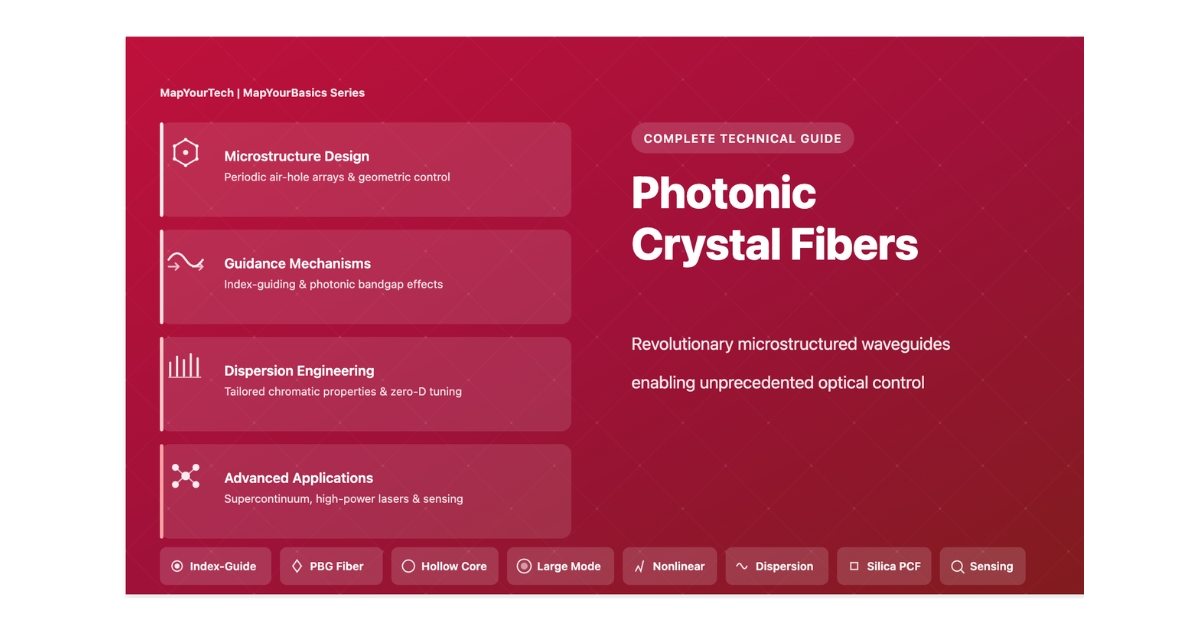
Photonic Crystal Fibers: Guiding Light by Geometry, and Where the Microstructure Pays Off
A solid or hollow core wrapped in a lattice of air holes lets a fiber do what step-index glass cannot — stay single-mode at every wavelength, push the zero-dispersion point into the visible, raise nonlinearity a hundredfold or suppress it a thousandfold, and now guide light through air at lower loss than silica itself.
Introduction
A step-index fiber has two knobs: the refractive index of the core and the index of the cladding. Everything it does — mode size, cutoff wavelength, dispersion, numerical aperture — follows from that small index step and the core diameter. A photonic crystal fiber adds a third dimension of control by replacing the uniform cladding with a periodic array of air holes running the length of the glass. The hole spacing Λ and the hole-size ratio d/Λ become design variables, and they reach properties that index contrast alone cannot: single-mode operation at every wavelength, an effective mode area engineered from one square micron to a thousand, a zero-dispersion wavelength dragged anywhere from the visible to the mid-infrared, and a guided mode that sits in air rather than glass.
The first such fiber was drawn at the University of Bath in 1996, and the field has run from laboratory curiosity to commercial product across supercontinuum sources, kilowatt fiber lasers, gas sensors, and — most consequentially for transmission — hollow-core fiber whose loss has now fallen below that of solid silica. This guide works from the guiding physics outward: the two mechanisms that confine light, the handful of parameters and formulas that set every property, the trade-offs against conventional fiber, and the design choices that turn a target specification into a drawable preform. Four calculators let you move the geometry and watch mode area, nonlinearity, and dispersion respond.
Two ways to trap light
Photonic crystal fibers split into two families by how they hold the mode in the core, and the split decides almost everything else about the fiber.
Modified total internal reflection
In a solid-core PCF the centre is unbroken silica and the surrounding holes lower the average index of the cladding. The core therefore sits at a higher index than its surroundings and guides by total internal reflection, the same principle as ordinary fiber — but the effective cladding index is now wavelength dependent. Short wavelengths stay concentrated in the silica between holes and see a high effective index; long wavelengths spread into the holes and see a lower one. That wavelength tracking is what produces the most distinctive PCF behaviour.
Endlessly single-modeBecause the cladding index falls as wavelength falls, the normalized frequency of a solid-core PCF stays below the second-mode cutoff at every wavelength when the holes are small enough. The effective-index analysis of Birks, Knight and Russell puts the boundary at d/Λ ≈ 0.42 for a single missing-hole core: below it the fiber carries only the fundamental mode from the ultraviolet to the infrared, with no cutoff — a property no step-index fiber can have.
Photonic bandgap guidance
The second mechanism abandons index guiding entirely. Arrange the holes so the cladding has a photonic bandgap — a band of frequencies it forbids from propagating, exactly analogous to the electronic bandgap of a semiconductor — and light at those frequencies cannot enter the cladding. It is then trapped in whatever defect sits at the centre, and that defect can be a hollow air channel. Light guides in air because the surrounding lattice reflects it, not because the core has the higher index. This is the only way to make a fiber that confines a guided mode in a vacuum-like core, and it is the basis of hollow-core fiber.
The two mechanisms set opposite design priorities. Index guiding wants the broadest possible transparency and tolerates large air holes only when high nonlinearity is the goal; bandgap guidance needs a high air-filling fraction and a precise lattice to open and hold the gap, which is why hollow-core fibers are harder to draw and historically guided over a narrower band.
The design parameters and their formulas
Four geometric quantities and a short set of relations describe almost any solid-core PCF: the pitch Λ (centre-to-centre hole spacing), the hole diameter d, their ratio d/Λ, and the number of hole rings around the core. From these follow the effective cladding index, the air-filling fraction, the mode area, the nonlinearity, and the dispersion.
Geometric packing fraction of circular holes on a hexagonal lattice. At d/Λ = 0.8, f ≈ 0.58; at d/Λ = 0.4, f ≈ 0.15.
A first cut at the cladding index treats the air-silica mix as a weighted average, nclad ≈ (1−f)nsilica + f·nair. With f ≈ 0.58 the cladding index drops to about 1.19 against a silica core near 1.45 — a far larger step than the ~0.005 of standard fiber, which is why tightly-holed PCFs confine so strongly. The averaging is a teaching approximation; an accurate effective index needs the wavelength-dependent fundamental-space-filling-mode calculation.
A geometric estimate in which the mode radius shrinks as the holes grow. It reproduces the demonstrated landmarks — a large-mode-area design at Λ = 20 µm, d/Λ = 0.4 gives ≈ 600 µm², and a highly nonlinear design at Λ = 2 µm, d/Λ = 0.85 gives ≈ 2.8 µm². Exact values require numerical mode solving.
n2 ≈ 2.6×10⁻²⁰ m²/W for silica (measured). Because γ scales as 1/Aeff, the same glass spans γ ≈ 0.1 W−1km−1 in a large-mode fiber to > 50 W−1km−1 in a small-core one.
The effective area is the single most consequential number a PCF designer sets, because it pulls nonlinearity and power handling in opposite directions. Shrink the core and γ rises, which is exactly what supercontinuum generation and parametric mixing want; enlarge it and γ falls toward the value of standard fiber, which is what a kilowatt laser needs to avoid self-focusing and stimulated scattering. The same trade governs ordinary transmission fiber, where large-effective-area designs raise the nonlinear threshold.
Material dispersion of silica is fixed by the Sellmeier relation and crosses zero near 1270 nm. Waveguide dispersion is set by the microstructure and, in a small-core PCF, is strongly anomalous — enough to pull the total zero-dispersion wavelength into the visible.
Dispersion is where PCF design is least like ordinary fiber. In standard glass the waveguide term is a small negative correction that nudges the zero-dispersion point from 1270 nm out to 1310 nm. In a tightly-confined PCF the waveguide term is large and anomalous, able to drag the zero-dispersion wavelength below 1100 nm or below 800 nm. That is what lets a fiber present anomalous dispersion at a visible pump wavelength — the condition for soliton dynamics and broadband supercontinuum — which bulk silica can never do. The dispersion calculator below shows the exact material curve and how the geometry shifts the crossing.
Take Λ = 2 µm and d/Λ = 0.85 at 1550 nm. The estimate gives a mode radius w ≈ 2(0.9 − 0.425) = 0.95 µm, so Aeff ≈ π(0.95)2 ≈ 2.8 µm². Then γ = 2π(2.6×10⁻²⁰) / (1.55×10−6 × 2.8×10−12) ≈ 37 W−1km−1 — about thirty times the ~1.1 W−1km−1 of standard single-mode fiber. A few metres of this fiber pumped near its zero-dispersion wavelength is enough to generate an octave of supercontinuum.
The PCF family
One fabrication platform produces a spread of fibers that share nothing in their application but the air-hole lattice. The guiding mechanism and the d/Λ ratio sort them.
| Type | Core | d/Λ | Defining property | Where it is used |
|---|---|---|---|---|
| Endlessly single-mode | Solid, one missing hole | < 0.42 | No higher-order-mode cutoff at any wavelength | Broadband instruments, fiber lasers |
| Large mode area | Solid, large core 20–50 µm | < 0.45 | Aeff from hundreds to ~1000 µm², low γ | High-power lasers and amplifiers |
| Highly nonlinear | Solid, small core < 2 µm | 0.7–0.95 | Aeff of 1–3 µm², γ > 50 W−1km−1 | Supercontinuum, parametric amplification |
| Dispersion-tailored | Solid, optimized geometry | variable | Large or flat dispersion at a chosen band | Pulse shaping, compensation |
| Polarization-maintaining | Solid, asymmetric holes | variable | High birefringence Δn > 10−3 | Sensors, coherent sources |
| Hollow-core bandgap | Air, 10–20 µm | 0.9+ | Most of the field in air; low latency and nonlinearity | Low-latency links, gas cells, power delivery |
| Antiresonant / nodeless (NANF, DNANF) | Air, thin-wall tubes | n/a | Broadband low loss without a full bandgap | Lowest-loss transmission, high-power delivery |
The newest family member, the antiresonant nodeless fiber, does not rely on a true photonic bandgap at all: thin curved glass walls reflect by antiresonance across an octave-wide window, which is how hollow-core loss finally fell below silica. It is treated in its own section below and in more depth in the full account of hollow-core fiber types and physics.
Where PCF beats step-index glass, and where it does not
A microstructured fiber buys design freedom at the cost of fabrication difficulty, splice loss, and price. The honest comparison against standard single-mode fiber separates the parameters PCF transforms from the ones where it pays a penalty.
| Parameter | Standard SMF | Index-guiding PCF | Hollow-core PCF |
|---|---|---|---|
| Loss at 1550 nm | ~0.18 dB/km | ~0.3–1 dB/km | < 0.1 dB/km (record 0.08–0.09) |
| Nonlinear coeff. γ | ~1.1 W−1km−1 | 0.1–100+ W−1km−1 | ~1000× lower than silica |
| Dispersion at 1550 nm | ~+17 ps/(nm·km) | −500 to +200 ps/(nm·km) | low, near-flat |
| Effective area | ~80 µm² | 1–1000 µm² | large (mode in air) |
| Splice loss to SMF | ~0.05 dB | 0.5–2 dB | ~0.15–0.5 dB achievable |
| Group velocity | ~0.68c (n ≈ 1.47) | ~0.68c | ~0.997c (mode in air) |
| Relative cost | baseline | several× | ~50–100× |
The shared failure modeAir holes are an open door. Liquid solvent wicks into them by capillary action and never fully leaves, and atmospheric moisture degrades a hollow core over time. Both ruin the fiber. PCF ends are cleaned dry — compressed gas or plasma, never solvent — and hollow-core terminations are hermetically sealed. This is a class of fault that solid glass simply does not have.
The splice penalty deserves emphasis because it sets the system architecture. A mode-field mismatch of two-to-one against standard fiber, plus the risk of collapsing the holes under fusion heat, turns a routine 0.05 dB joint into 0.5–2 dB unless a tapered transition or a mode-field adapter is used. The same accounting that governs insertion loss and reflectance at every interface applies, but with larger per-joint numbers, which is why most systems use PCF only where its property is essential and standard fiber everywhere else.
Hollow core: the loss floor just moved
For most of the field’s history the hollow-core trade was simple: accept higher loss and narrower bandwidth in exchange for light that travels in air. That trade has been overturned. Antiresonant nodeless designs — nested and double-nested tube structures rather than a full triangular bandgap lattice — have driven loss below the silica floor. A double-nested antiresonant nodeless fiber reached 0.08 ± 0.03 dB/km at 1550 nm (reported at OFC 2024), and a 2025 result published in Nature Photonics measured 0.091 dB/km, the first broadband fiber under 0.1 dB/km and below the ~0.14 dB/km practical loss floor of solid silica that had stood for four decades. Sub-0.05 dB/km fibers have since been reported. The detailed mechanism and its system consequences are laid out in the analysis of hollow-core fiber as a transmission medium.
Guiding the mode in air changes three numbers at once. The group velocity rises to roughly 99.7% of c against 68% in silica, which cuts propagation latency by about 31% — the property that justified the first commercial hollow-core links between financial exchanges. The nonlinear coefficient drops by about three orders of magnitude because the field barely touches glass, so launch power is no longer bounded by self-phase modulation, four-wave mixing, or stimulated Raman scattering. And because Rayleigh scattering in air is negligible, the usable band is far wider than the C+L window silica favours. The latency, power, and bandwidth case is developed further in the primer on ultra-low-latency hollow-core transmission.
What the air core costsThe advantages come with a roughly 50–100× cost premium, demanding fabrication, splicing that is still harder than solid fiber, an immature vendor ecosystem, and no settled standards. Distributed Raman and erbium amplification both assume a glass nonlinearity the air core does not provide, so amplifier architecture has to be rethought. These constraints are surveyed in the review of hollow-core advantages and open challenges.
Takeaway: Hollow-core fiber is no longer the high-loss option. With antiresonant designs now below silica’s loss floor while cutting latency ~31% and nonlinearity ~1000×, the open questions are cost, splicing, amplification, and standards — not whether the physics works.
Drawing and splicing the microstructure
The dominant method is stack-and-draw: hundreds of silica capillaries and solid rods are stacked by hand into the target pattern around a core element, fused into a centimetre-scale cane, and drawn down to a 125 µm fiber, sometimes through an intermediate cane stage for complex lattices. The geometry is set in the stack and preserved through the draw, which is why the method reaches such intricate structures — and why it is slow and skilled work. Soft glasses and polymers can instead be extruded through a patterned die in one step, and additive manufacturing is emerging for chalcogenide preforms that stack-and-draw cannot easily build.
The draw itself is a pressure-control problem. Surface tension wants to collapse the holes as the glass softens, so the holes are held open — or deliberately expanded or shrunk — by regulating internal pressure, typically tens to a couple of hundred millibar relative to atmosphere. Different pressures in different holes produce the asymmetric lattices that make polarization-maintaining fiber. Lose pressure control and the holes collapse or balloon, and the optical properties drift out of specification.
| Method | Typical loss | Best for |
|---|---|---|
| Tapered splice | 0.2–0.8 dB | PCF-to-SMF, critical links; gradually matches the mode field |
| Mode-field adapter | 0.15–1 dB | Hollow-core terminations and high-performance joints |
| Direct fusion (modified) | 0.5–2 dB | PCF-to-PCF at moderate air-fill; lower current, shorter arc |
| Mechanical / connector | 0.8–3 dB | Field work, temporary or modular connections |
Every fusion recipe is a compromise against hole collapse: too much heat seals the microstructure and destroys guidance, too little leaves a weak joint. The standard diagnostic after the fact is a reflectometer trace, the same OTDR method used to locate loss and reflections on any fiber route, read here for the signature of a partially collapsed splice.
Designing a fiber to a target
PCF design runs from the application backward to the geometry. The first fork is the guiding mechanism: index guiding for the broadest band, the lowest solid-core loss, and the easiest splicing; bandgap or antiresonant hollow core for minimal latency and nonlinearity, accepting a narrower band and harder fabrication. After that, the pitch and d/Λ follow from the property in demand.
Set the pitch near the operating wavelength, Λ ≈ λ to 3λ, then choose d/Λ for the regime: below about 0.42 keeps the fiber endlessly single-mode and the mode large, which is what large-mode-area lasers need; 0.5–0.7 is the balanced middle; above 0.7 confines tightly for high nonlinearity. A large-mode-area laser fiber inverts the usual instinct — it wants a big pitch and small holes so the mode stays single and wide, then relies on coiling to a controlled diameter to strip any higher-order mode by differential bend loss. A supercontinuum fiber does the opposite: small pitch, large holes, zero-dispersion wavelength placed at the pump.
Where the simple recipe breaksDesigning for a perfect property at one wavelength usually spoils performance elsewhere, and the geometry that looks ideal on paper may be undrawable. Account for a ±5% hole-size and ±2% pitch tolerance from the start, budget at least 2–3 dB per PCF-to-SMF splice in the link budget, and confirm single-mode operation by calculation rather than assuming it — large holes support higher-order modes that a careless design will excite.
Target a single-mode 1080 nm fiber with Aeff above 1000 µm² to keep nonlinearity and damage in check at kilowatt power. Endlessly-single-mode operation fixes d/Λ below 0.42, so choose 0.40 and set the pitch large at Λ = 20 µm, giving a hole diameter of 8 µm. The first-order estimate then gives a mode radius near 14 µm and Aeff ≈ 600 µm² per the single-core estimate, rising further for a multi-cell core — in the right range, with γ well under 1 W−1km−1. Coiling to about 30 cm diameter then suppresses the higher-order content. The comparison and core-parameter calculators below reproduce these numbers.
Interactive toolkit
Four calculators built on the relations above. The core-parameter and comparison tools use the first-order geometric mode-area estimate; the dispersion tool computes the exact silica material dispersion from the Sellmeier relation and adds an illustrative waveguide term so the zero-dispersion wavelength moves with the geometry. Treat the outputs as design intuition, not a substitute for numerical mode solving.
Mode area is a first-order geometric estimate anchored to demonstrated fibers; the waveguide-dispersion term is illustrative. Exact effective area, dispersion, and confinement loss require a full vectorial mode solver (finite element or multipole) — the tools are here to show the direction and rough scale of each trade.
In the field
Multi-modal microscopy wanted a single broadband source from roughly 450 to 1800 nm to replace a bulky solid-state laser. A highly nonlinear silica PCF with Λ = 1.7 µm and d/Λ = 0.85 — Aeff near 2.8 µm², γ about 37 W−1km−1 — was designed with its zero-dispersion wavelength at the 1064 nm pump so the pump sat in anomalous dispersion. About 15 m of fiber, tapered-spliced to the delivery fiber, produced a flat octave-spanning output. The two lessons that mattered were thermal: a couple of degrees of drift shifted the spectrum visibly, so the fiber was held in a stabilized mount, and direct fusion failed until replaced by tapered splices. The physics is sound; the engineering was in the packaging.
An industrial cutting laser needed multi-kilowatt output in a near-single-mode beam while suppressing stimulated Raman and Brillouin scattering. The gain fiber was a Yb-doped large-mode-area PCF, ~40 µm core, six hole rings, Λ = 25 µm and d/Λ ≈ 0.38 for endlessly single-mode operation, with Aeff above 1000 µm² holding γ near 0.08 W−1km−1. The large area suppressed nonlinear scattering at full power; the limiting engineering problems were thermal — quantum-defect heating required active cooling despite the low nonlinearity — and the output end-cap, which took several iterations to survive the power. Coil diameter set the beam quality: too tight and the mode degraded, too loose and higher-order content survived.
A trading route on the order of 750 km between two financial centres was rebuilt on hollow-core fiber to cut latency. With the mode in air at ~99.7% of c, one-way latency fell from about 3.7 ms on standard fiber toward 2.5 ms — close to a third less — because group velocity, not loss, was the figure being bought. The build needed mode-field adapters at every amplifier site, hermetic sealing against moisture ingress into the core, and careful wavelength planning within the guided band. Early failures traced to moisture in the core confirmed that sealing, not loss, was the operational risk. The latency advantage carried the project despite installation far more involved than splicing solid fiber on a long repeatered route.
The thread across all three is that the PCF physics behaves as designed; the deployment risk lives in temperature, splicing, and contamination. That maps onto the broader system-design discipline of budgeting every loss and environmental factor, and onto the same link-design parameters that govern any DWDM route.
Main Points
- A PCF adds the air-hole lattice — pitch Λ and ratio d/Λ — as design variables, reaching properties that core-cladding index contrast alone cannot.
- Two mechanisms guide light: modified total internal reflection in solid cores, and photonic bandgap or antiresonance in hollow cores; the choice sets band, loss, and fabrication difficulty.
- A solid-core PCF is endlessly single-mode below d/Λ ≈ 0.42 (effective-index analysis), carrying only the fundamental mode at every wavelength — impossible in step-index fiber.
- Nonlinearity follows γ = 2πn2/(λAeff); the same silica spans γ from ~0.1 to >50 W−1km−1 purely by setting the effective area.
- The air-filling fraction of a triangular lattice is f ≈ 0.907(d/Λ)2; large holes give the high fill needed for a bandgap.
- Waveguide dispersion in a small-core PCF is strongly anomalous and can pull the zero-dispersion wavelength into the visible, enabling supercontinuum that bulk silica cannot support.
- Hollow-core antiresonant fibers have fallen below 0.1 dB/km (record 0.08–0.09 at 1550 nm), under silica’s ~0.14 dB/km floor, while cutting latency ~31% and nonlinearity ~1000×.
- PCF pays in splice loss (0.5–2 dB to SMF), fabrication difficulty, and cost (hollow core ~50–100×); most systems use PCF only where its property is essential.
- Air holes must never meet liquid solvent and hollow cores must be sealed against moisture — a failure class solid glass does not have.
- Design backward from the property: large pitch and small holes for kilowatt single-mode lasers, small pitch and large holes for supercontinuum, and always budget tolerances and splice loss.
References
- T. A. Birks, J. C. Knight and P. St. J. Russell — Endlessly Single-Mode Photonic Crystal Fibre, Optics Letters.
- J. C. Knight, T. A. Birks, P. St. J. Russell and D. M. Atkin — All-Silica Single-Mode Optical Fibre with Photonic Crystal Cladding, Optics Letters.
- N. A. Mortensen — Effective Area of Photonic Crystal Fibers, Optics Express.
- I. H. Malitson — Interspecimen Comparison of the Refractive Index of Fused Silica, Journal of the Optical Society of America.
Sanjay Yadav, "Optical Network Communications: An Engineer's Perspective" — Bridge the Gap Between Theory and Practice in Optical Networking.
Developed by MapYourTech Team
For educational purposes in Optical Networking Communications Technologies
Note: This guide is based on industry standards, best practices, and real-world implementation experiences. Specific implementations may vary based on equipment vendors, network topology, and regulatory requirements. Always consult with qualified network engineers and follow vendor documentation for actual deployments.
Feedback Welcome: If you have any suggestions, corrections, or improvements to propose, please feel free to write to us at [email protected]
Related Articles on MapYourTech