
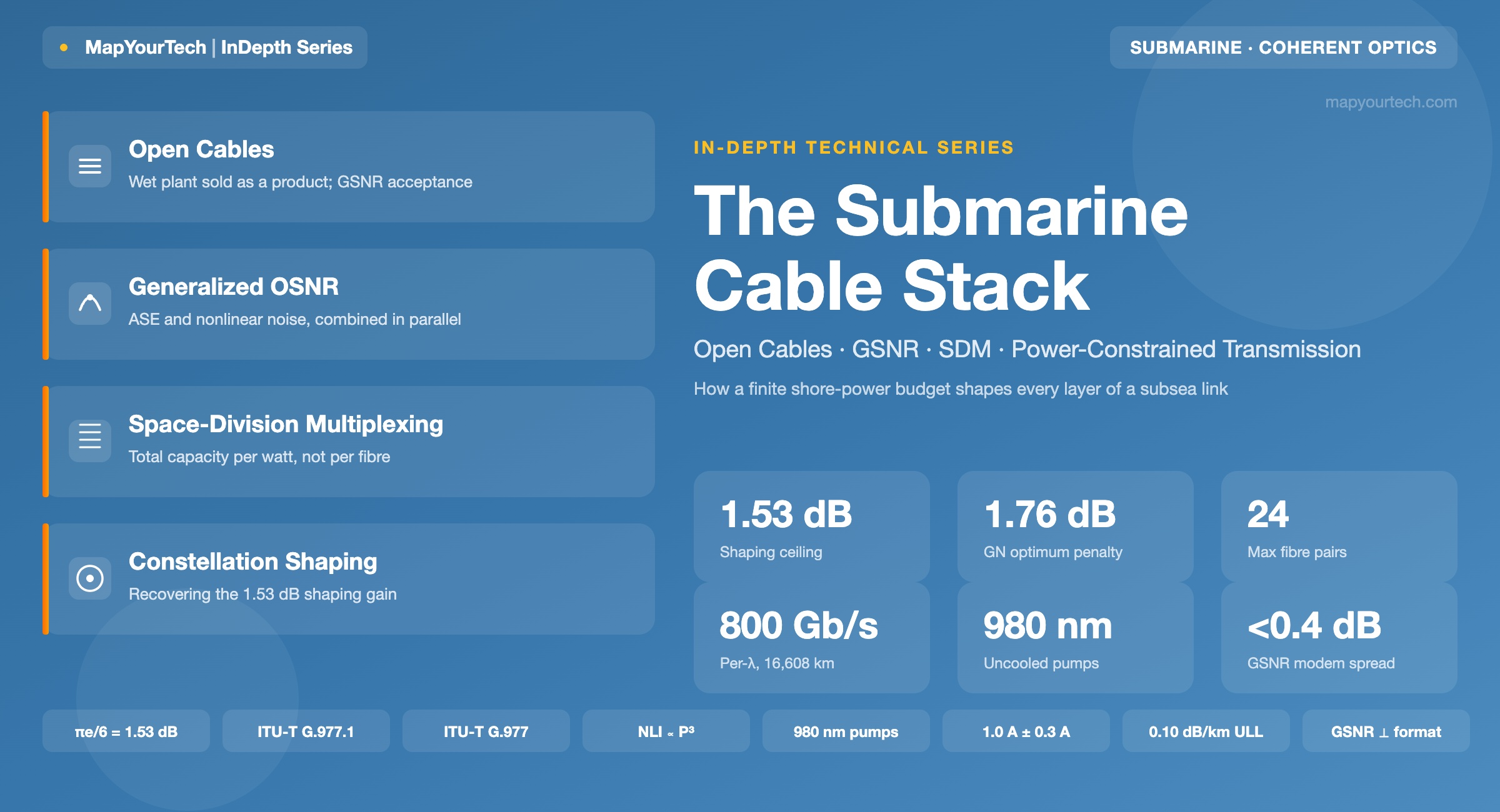
The Submarine Cable Stack: Open Cables, Generalized OSNR, SDM and Power-Constrained Transmission
Wet-plant engineering, generalized OSNR acceptance, space-division multiplexing for power efficiency, and coded-modulation capacity inside a fixed electrical-power budget — the four levers that set how much data crosses an ocean.
1. Introduction
A transoceanic cable carries a fixed budget of electrical power from the shore. Every optical amplifier submerged along the route — one erbium-doped amplifier per fibre direction, packed into pressure vessels every 60 to 80 km — draws its pump energy from a copper conductor fed at up to 18 kV of direct current from a beach in, say, Virginia, with the circuit closed through a sea earth thousands of kilometres away. That single constraint, watts delivered from land, sits underneath almost every design decision in a modern subsea system. It decides how many fibre pairs the cable can carry, how much power each amplifier can put out, what optical signal-to-noise ratio each channel sees, and therefore how many bits per second cross the ocean.
For three decades the industry treated that budget as a joint optimisation between the wet plant (cable, repeaters, branching units) and the dry plant (the terminal transponders). A supplier delivered both, guaranteed a Q-factor, and the buyer accepted the system against it. That model has come apart. Buyers — increasingly Google, Meta, Amazon and Microsoft rather than telco consortia — now want to buy the wet plant once, on a 25-year design life, and refresh the transponders every 18 to 24 months as coherent silicon advances. To make that split work, the industry had to invent a way to specify and accept a cable that has no transponders attached yet. The answer is the open cable, and its currency is a transponder-independent figure of merit called the generalized signal-to-noise ratio (GSNR).
This article follows the stack from the seabed up. It starts with why the wet plant became a product you can specify on its own, then builds the physics: the two kinds of noise a coherent channel accumulates, how they combine into GSNR, and how GSNR is measured on a cable with no traffic on it. From there it turns to the two levers that turn a fixed power budget into capacity. The first is space-division multiplexing (SDM), which counter-intuitively lowers the signal-to-noise ratio on each fibre to raise the total capacity of the cable. The second is coded modulation with constellation shaping, which extracts more bits per symbol from whatever GSNR the wet plant delivers. The two levers are complementary: SDM sets how much GSNR each fibre gets, and shaping decides how efficiently the transponder spends it.
The audience here is anyone who has to reason about a subsea link end to end — the newcomer meeting GSNR for the first time, and the architect deciding whether the next cable runs 16 or 24 fibre pairs. Foundations are explained as they arrive, but the depth is aimed at the person who will have to defend a number in a design review.
Takeaway: A subsea cable is a power-limited system before it is a bandwidth-limited one. Open cables, GSNR, SDM and constellation shaping are four responses to the same underlying fact: the watts arriving from shore are finite, and every design lever is really a decision about how to spend them.
2. Context: why the wet plant became a product
Start with the object itself. A repeatered submarine cable is a series electrical circuit dressed as an optical one. Power feeding equipment (PFE) on shore injects a stabilised constant current — typically around 1.0 A ± 0.3 A in optically amplified systems, up from roughly 1.6 A ± 0.2 A in the older regenerated 3R designs (measured, typical values from operational systems) — down a central copper conductor whose resistance runs about 0.7 to 1.5 Ω per km (measured, cable design range). Each repeater in the chain drops a fixed voltage, so the accumulated voltage the PFE must supply grows with the number of repeaters and the number of fibre pairs it feeds. The return path is the ocean itself, through electrodes buried near the landing beach. Because active components live under kilometres of water and are expected to run for 25 years with essentially no maintenance, every part is redundant, over-specified, and conservative. You do not get to service a repeater at 5,000 m; you design so you never have to.
That reliability requirement is exactly why the wet plant and the transponders age on different clocks. Cable, repeaters and branching units are qualified for a 25-year life (standard design target), while coherent modem technology now moves on an 18-to-24-month generational cadence (industry practice). Buying both together forces the buyer to commit to a transponder generation two or three years before the cable is even in the water — and to accept that generation for the cable's whole life. For a hyperscaler whose traffic doubles on a short cycle, that is the wrong trade. The separation of wet plant and dry plant lets the buyer install the cable first and choose the terminal equipment later, close to the acceptance date, picking the most current coherent silicon and aligning it with the terrestrial network for operational and volume-pricing reasons.
The open cable also unlocks business models the turnkey system could not. Recent cables are frequently built on a per-fibre-pair ownership model: several owners run different terminal equipment, and different management systems, over their own pairs of the same physical cable. Two or more owners can even share the spectrum of a single fibre pair, subject to careful treatment of privacy, monitoring and fault isolation. Each owner upgrades independently. None of this is possible if one vendor's transponders are welded to the acceptance criteria.
Read the Full Analysis with Premium
The remaining 87% of this article — the design numbers, trade-offs and field guidance — is part of MapYourTech Premium, along with the full premium library, courses and professional tools.
You May Also Like
-
Free
-
September 4, 2026
-
Premium
-
September 4, 2026
-
Premium
-
September 4, 2026