
Raman Tilt in DWDM Systems
Summary
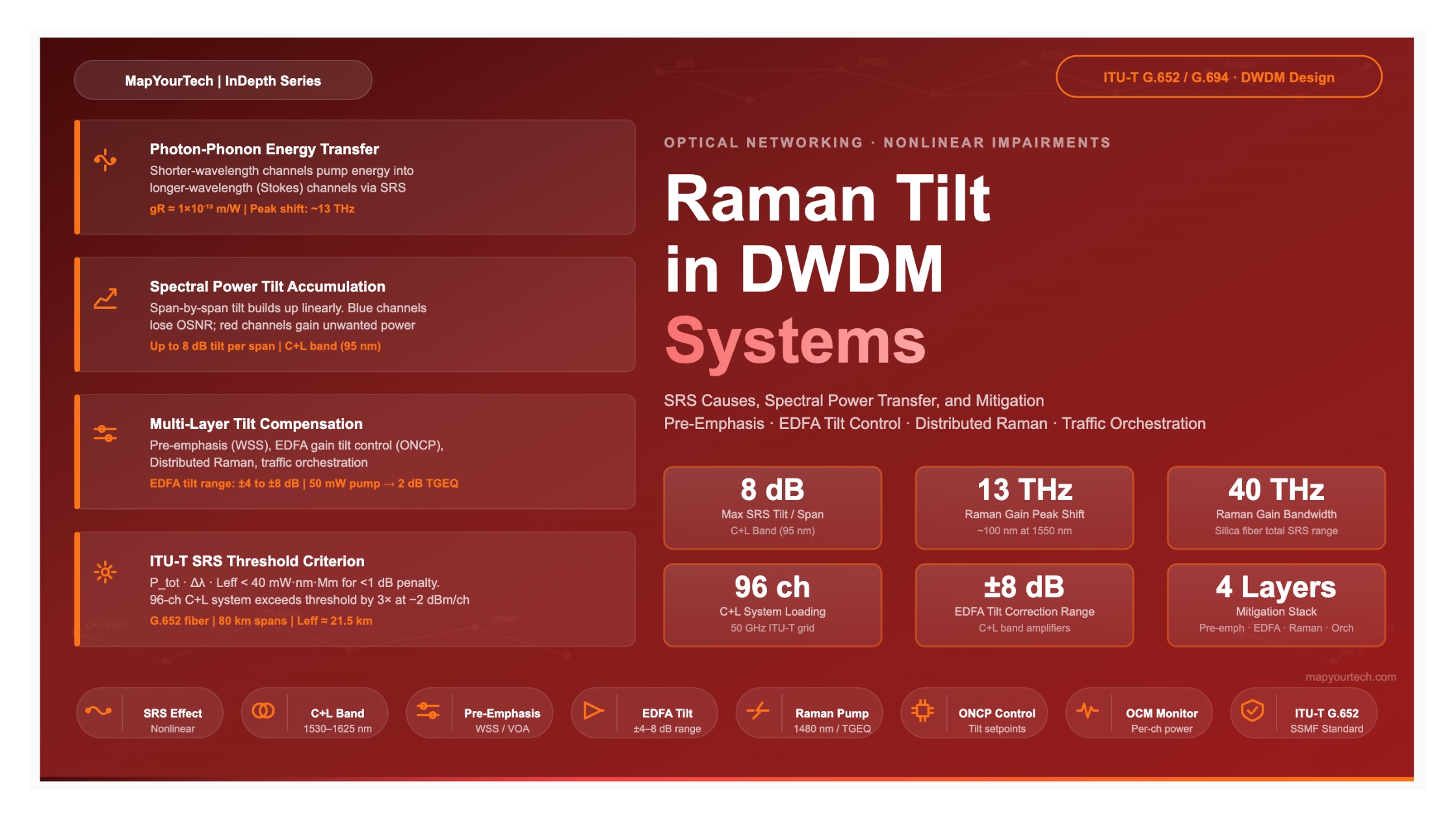
Stimulated Raman Scattering (SRS) is one of the most operationally significant nonlinear impairments in Dense Wavelength Division Multiplexing (DWDM) networks. When multiple optical channels propagate simultaneously through a silica fiber, SRS transfers optical energy from shorter-wavelength (higher-frequency) channels to longer-wavelength (lower-frequency) channels. The result is a progressive spectral tilt across the signal band, where blue-side channels lose power and red-side channels gain power. In C+L band systems this tilt can reach 8 dB or more per span. Left unmanaged, SRS tilt degrades optical signal-to-noise ratio (OSNR), increases bit-error rate (BER), and can render some channels unable to close the link budget. This article explains the physical mechanism, quantitative models, impact on OSNR, and the full toolkit of mitigation strategies including pre-emphasis, tilt-aware EDFA gain control, and distributed Raman amplification.
1. Introduction
The context and engineering significance of Raman-induced spectral tilt in DWDM systems
Dense Wavelength Division Multiplexing has become the foundational technology for long-haul and ultra-long-haul fiber-optic transport. Modern DWDM systems pack tens to hundreds of optical channels onto the same fiber, with 50 GHz and 100 GHz ITU-T grid spacings representing the most common deployments. As spectral occupancy increases — particularly with the expansion into C+L band architectures that span from approximately 1530 nm to 1625 nm — nonlinear fiber effects grow proportionally more important.
Among these effects, Stimulated Raman Scattering (SRS) occupies a distinctive position. Unlike Four-Wave Mixing (FWM) or Cross-Phase Modulation (XPM), which degrade signal phase coherence, SRS directly transfers optical power between channels. This creates a power imbalance — commonly called spectral tilt or SRS tilt — that accumulates over the length of each fiber span and then repeats span after span. The total tilt across a multi-span link can become large enough to push short-wavelength channels below the noise floor of their amplifiers while simultaneously over-driving long-wavelength channels into excessive nonlinear penalties.
The problem is loading-dependent: SRS tilt scales with the total optical power in the fiber and the spectral range over which channels are distributed. A partially loaded DWDM system behaves differently from a fully loaded one, and a system whose traffic changes dynamically — as channels are provisioned and de-provisioned — experiences transient SRS tilt events that must be handled without causing service impact. This article addresses all of these dimensions.
Tilt per Span (C+L Band)
Power imbalance between C-band and L-band channels caused by SRS in a typical DWDM span.
Up to 8 dBRaman Gain Peak Separation
Frequency offset between pump (donor) and Stokes (acceptor) signals at peak Raman gain in silica fiber.
~13 THzSRS Threshold (Single-Span)
Approximate single-channel launch power at which SRS becomes measurable in a 100 km SSMF span.
500 mW – 1 WRaman Gain Coefficient (gR)
Characteristic SRS coefficient for standard single-mode silica fiber (ITU-T G.652).
~1 × 10⁻¹³ m/W2. The Physical Mechanism of Stimulated Raman Scattering
Molecular vibrations, photon-phonon interaction, and the origin of power transfer in silica fiber
2.1 Spontaneous vs. Stimulated Raman Scattering
The Raman effect, discovered by C.V. Raman in 1928, describes the inelastic scattering of photons by molecular vibrations in a medium. When a photon interacts with a silica (SiO2) molecule in an optical fiber, it can excite a vibrational mode (an optical phonon) and lose some of its energy in the process. The scattered photon emerges at a lower frequency — the so-called Stokes frequency — with the frequency difference corresponding to the vibrational mode of the molecule, typically around 13 THz for silica.
At low power levels this process is spontaneous: scattered photons emerge at random phases and directions and have negligible impact on propagation. However, when an optical field is sufficiently intense, the scattered Stokes photons can stimulate further scattering in phase with themselves, creating a coherent amplification process. This is Stimulated Raman Scattering. The threshold for this transition is much lower in multi-channel WDM systems than in single-channel systems, because the existing long-wavelength channels serve as Stokes seeds, dramatically lowering the effective threshold.
In a DWDM fiber link, this means the shorter-wavelength channels (C-band edge, ~1530 nm) act as Raman pumps for the longer-wavelength channels (L-band edge, ~1625 nm). Energy flows continuously from pump to Stokes as signals propagate, depleting blue-side channels and amplifying red-side channels.
2.2 Forward and Backward SRS
SRS occurs in both directions relative to signal propagation. Forward SRS produces scattered light propagating in the same direction as the pump signal, while backward SRS produces light propagating in the opposite direction. In a co-propagating WDM system where all channels travel in the same direction, forward SRS is the dominant mechanism driving inter-channel power transfer and spectral tilt. Backward SRS, though present, contributes to noise generation rather than to the directional spectral tilt that determines system-level power balance.
Read the Full Analysis with Premium
The remaining 89% of this article — the design numbers, trade-offs and field guidance — is part of MapYourTech Premium, along with the full premium library, courses and professional tools.