
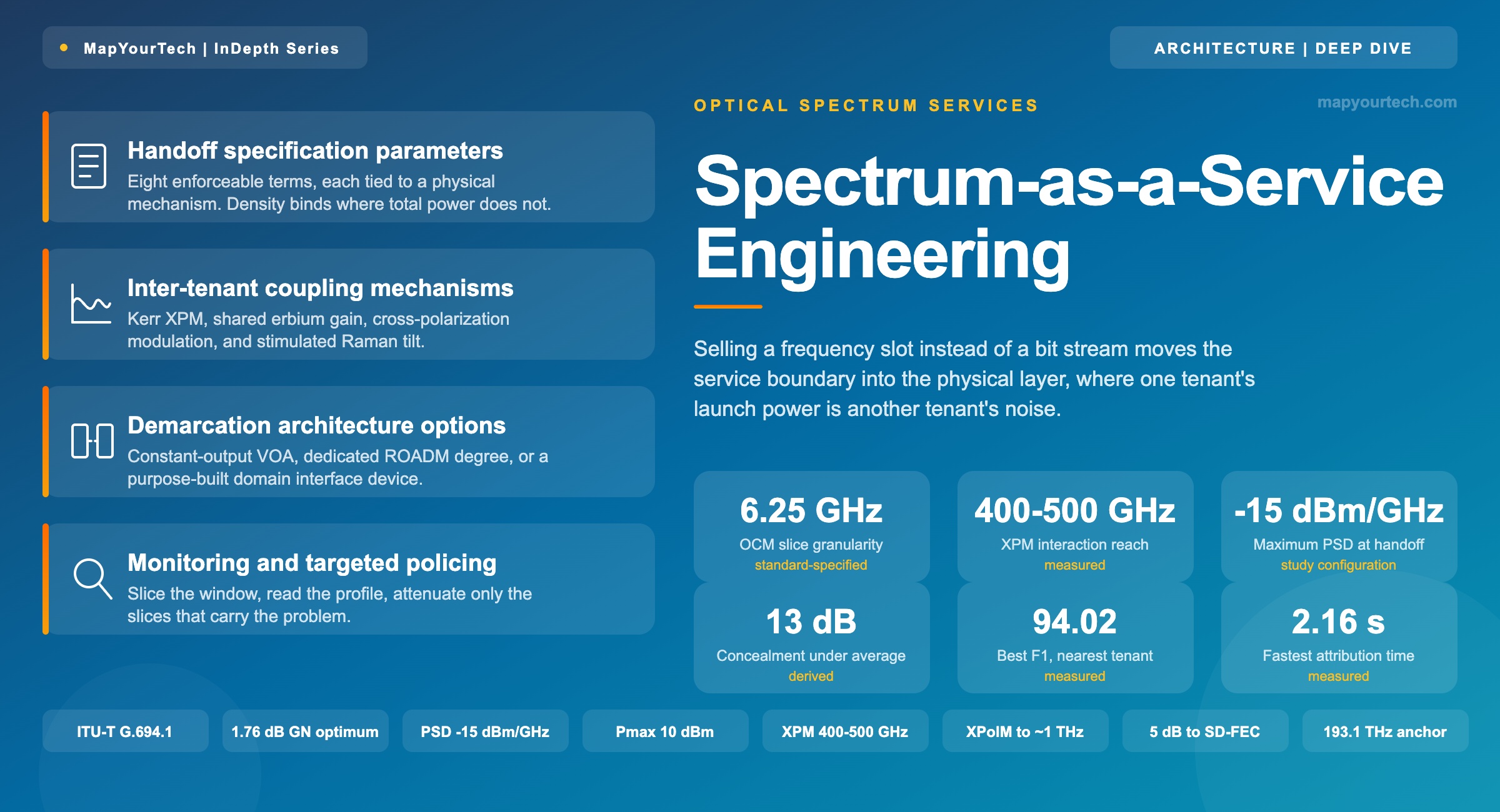
Spectrum-as-a-Service Engineering: Demarcation, Monitoring, and Interference Policing
Selling a frequency slot instead of a bit stream moves the service boundary into the physical layer, where one tenant's launch power is another tenant's noise. This is the engineering that keeps that boundary honest.
1. Introduction
A wavelength service ends at a client port. A spectrum service ends at a frequency slot, and everything downstream of that slot is someone else's equipment operating inside your fiber. That single change of boundary is what makes optical spectrum as a service (OSaaS) a different engineering problem from every other transport product an operator sells. The line system still amplifies, still equalises, still carries the tenant's light through the same erbium and the same silica as its own channels, but it no longer knows how many carriers are in the slot, what their modulation format is, or what happens when the tenant's network operations centre decides to drop six of eight channels at two in the morning.
The commercial pull is obvious enough. A regional operator with a lit C-band route and forty percent spectral occupancy has an asset it cannot monetise as wavelengths, because the buyer wants control of its own transceiver refresh cycle and does not want to renegotiate every time it moves from 400G to 800G. Selling 400 GHz of contiguous spectrum on a fifteen-year term converts idle bandwidth into revenue while leaving the transponder economics with the party that cares about them. Research and education networks got there first, for the same reason they got to alien wavelengths first: their traffic growth outruns their capital budgets, and their peers are trusted counterparties.
The engineering pushback is equally concrete, and it has a number attached. In a survey of twenty-five network operators reported in doctoral work at Tallinn University of Technology, sixty percent named power and power spectral density management inside the leased window as their primary concern, and others specifically named the risk of a customer injecting intensity-modulated on-off keyed (OOK) signals into a line system engineered for coherent channels. Both concerns describe the same failure: a tenant does something entirely reasonable inside its own slot, and a channel three hundred gigahertz away, belonging to somebody else, drops below its forward error correction (FEC) threshold.
That coupling is not a bug in anyone's implementation. Erbium-doped fiber amplifiers (EDFAs) share gain across the whole band. The Kerr nonlinearity in the transmission fiber couples intensity in one channel to phase in its neighbours. Stimulated Raman scattering tilts power from short wavelengths to long ones across the entire occupied spectrum. None of these mechanisms respects the frequency boundaries drawn on a commercial contract, and all of them are the reason a spectrum service needs a demarcation architecture rather than a spreadsheet of allocated slots.
This article works through that architecture in four parts. First, what a handoff specification has to contain to be enforceable — the parameters, their reference points, and why power spectral density rather than total power is the term that actually binds. Second, where the demarcation physically lives and what the three practical interconnect options give up. Third, how per-tenant monitoring works when the operator is deliberately blind to the tenant's internal channel plan, including the optical channel monitor (OCM) technique that recovers 6.25 GHz resolution inside an opaque window without adding a filtering penalty. Fourth, the policing mechanisms — detection, attribution, and action — along with published measurements of how accurate and how fast they are.
The treatment assumes working familiarity with coherent DWDM engineering. Readers who want the underlying noise accounting first should start with the OSNR fundamentals primer, and those who want the architectural context for open line systems should read how open line systems carry multi-vendor coherent wavelengths before continuing here.
Takeaway: A wavelength service hands over a bit stream and keeps the physics. A spectrum service hands over the physics and keeps the liability. Every mechanism in this article exists to close that gap — to give the operator enough observability and enough authority at the boundary that a tenant's freedom inside its slot stops at the edge of its neighbour's.
2. Spectrum Service Definition and Scope
2.1 Service Tiers and Responsibility Boundaries
Transport products differ in one variable: how far down the stack the demarcation sits. Dark fiber puts it at the fiber connector; the buyer owns the amplifiers, the ROADMs, the channel plan, and every decibel of the loss budget. A managed wavelength puts it at a client-side Ethernet or OTN port; the buyer owns nothing optical. Spectrum sits between them, and a managed optical fiber network (MOFN) sits between spectrum and dark fiber, with the seller running the line system as a service on the buyer's behalf.
The distinction that matters for engineering is not who pays for what — it is which party's decisions can change the physical layer. On dark fiber, the buyer's decisions change only the buyer's fiber. On a wavelength, the buyer has no physical-layer decisions to make. On spectrum, the buyer's decisions change a shared fiber that other parties are also using, which is the only one of the four cases where a purely commercial boundary sits inside a coupled physical medium.
2.2 Frequency Slot Definition per ITU-T G.694.1
A spectrum service delivers a frequency slot as defined by ITU-T G.694.1 — a nominal central frequency and a slot width, anchored to 193.1 THz. Under the flexible grid, the nominal central frequency granularity is 6.25 GHz and the slot width granularity is 12.5 GHz, so a slot is described as 193.1 THz plus n times 6.25 GHz, with a width of 12.5 times m gigahertz (standard-specified, ITU-T G.694.1). A 400 GHz allocation is m = 32. The tenant may place any carriers it likes inside that slot, at any baud rate and any modulation format, provided the composite signal stays inside the slot edges and inside the agreed power envelope. Everything about the grid mechanics is covered in more depth in the G.694.1 channel-grid walkthrough.
What the tenant does not buy is a guarantee of quality of transmission that is independent of its own behaviour. This is the point most commercial teams get wrong on the first contract. The generalised signal-to-noise ratio (GSNR) delivered at the far end is a function of the launch power the tenant chose, the channel count the tenant configured, and the modulation formats the tenant selected — none of which the operator controls. A spectrum service-level agreement that promises a delivered OSNR without constraining the tenant's launch conditions is unenforceable in both directions.
Write the spectrum SLA as a conditional. The operator warrants a minimum delivered GSNR provided the tenant operates within a stated power spectral density envelope, a stated per-carrier bandwidth floor, and a stated modulation class. Outside that envelope the warranty lapses and the policing rules apply. Anything else asks the operator to guarantee an outcome it cannot observe and cannot influence.
2.3 Technology Enablers for Commercial Adoption
Three things changed. Coherent transceivers became commodity pluggables, so a tenant can light a slot with a router line card instead of a transport shelf. Flexible-grid wavelength selective switches (WSS) became ubiquitous, so an operator can carve a contiguous 300 or 400 GHz block without wasting a fixed-grid channel plan. And streaming telemetry over gNMI replaced polling, so per-second visibility into a probe channel's performance became a normal operational capability rather than a lab exercise — the pattern described in the network-as-code approach to optical automation.
What has not changed is the trust model. Spectrum services today are still overwhelmingly sold to counterparties the operator already trusts — peer carriers, national research and education networks, large enterprises with their own transport teams. The technical work described in the rest of this article is what would be needed to widen that circle, and the fact that it is still an active research subject rather than a settled product feature tells you where the model actually stands.
Takeaway: Spectrum is the only transport tier where a commercial boundary is drawn inside a coupled physical medium. Every other tier either isolates the buyer on its own fiber or keeps the physical layer entirely with the seller. That is why spectrum needs a demarcation function and the others do not.
3. From Alien Wavelength to Alien Spectrum
3.1 Alien Wavelength Operation and Control
An alien wavelength is a single channel from a third-party transponder carried across another vendor's line system. The technique is old — European research networks were running production alien wavelengths years before the phrase "open line system" was in vendor marketing — and it works because the line system retains complete authority over the channel. The multiplexer add port constrains the channel to its assigned centre frequency and bandwidth through hard optical filtering, and the line system monitors and attenuates the channel's power as part of its normal per-channel levelling loop. Ribbon describes exactly this in its open line system documentation: the third-party transponder is registered as an unmanaged element and the channel is defined as a virtual transceiver on the port, with declared transmit power, chromatic dispersion tolerance and polarisation-mode dispersion tolerance, after which it receives the same optical performance monitoring and restoration treatment as a native channel (vendor description, Ribbon).
Read the Full Analysis with Premium
The remaining 89% of this article — the design numbers, trade-offs and field guidance — is part of MapYourTech Premium, along with the full premium library, courses and professional tools.
You May Also Like
-
Premium
-
September 1, 2026
-
Premium
-
September 1, 2026
-
Free
-
August 31, 2026