What Does an Optical Network Engineer Do?
An engineering-grade look at the role — the daily work, the technical scope, the tools, the skills that distinguish a less experienced engineer from a senior one, and the standards that anchor the whole discipline.
Introduction
An optical network engineer owns the physical layer that moves data through fiber. That single sentence covers more ground than it looks. The role spans fiber physics, coherent modulation, optical amplifiers, ROADM switching, OTN framing, multi-vendor integration, and the planning and operations software that ties all of it together. An engineer who understands one of these domains and not the others is part of an optical engineering team, not a complete one.
This article describes what the role contains: the work an optical network engineer actually does, the technical domains they need to know, the tools they use, the education and certifications that open doors, the compensation the market pays, and the directions the discipline is moving. It is written for a working audience — final-year engineering students choosing a specialisation, early-career engineers calibrating their next step, and senior engineers checking that their picture of the field is current.
1. What the Role Actually Looks Like
An optical network engineer's week splits unevenly across four buckets: design, validation, commissioning, and operations. The proportion depends on the employer. A service provider engineer spends more time on commissioning and operations. A hyperscaler engineer spends more time on design and automation. A vendor-side systems engineer spends more time on customer-facing validation.
Across all three contexts the deliverables look similar:
- Design — a wavelength plan, a span loss budget, an OSNR budget, an amplifier configuration, and a topology diagram showing every ROADM degree, every booster and pre-amplifier, every transponder port, and every patch panel.
- Validation — physical-layer simulation results (typically from a GNPy-based planning tool or a vendor planning suite) showing that the proposed plan meets OSNR targets at every receiver, with at least 3 dB of margin.
- Commissioning — fiber-plant characterization with an OTDR, splice and connector loss verification, amplifier gain and noise figure measurement, per-channel power equalization, and BER and Q-margin verification at every receiver.
- Operations — alarm correlation across an EMS or controller, ticket triage, scheduled fiber maintenance windows, capacity expansions, software upgrades, and post-mortem analysis on every outage.
The unifying thread is that nothing about the work is abstract. Every decision the engineer makes is tied to a measured number — span loss, gain, OSNR, BER, dispersion accumulation, polarization-mode dispersion, channel power deviation — and to a physical constraint somewhere in the plant.
It is not configuring a router. It is not running a CLI session against a firewall. The optical network engineer owns the optical physical layer (Layer 1 in OSI terms) and its supporting OTN frame structure. The IP and Ethernet layers above it belong to a different team in most organisations, though the boundary has blurred with IP-over-DWDM and pluggable coherent optics.
2. The Technical Domain — What You Actually Need to Know
The optical network engineer's technical scope spans six domains. None of them is optional. An engineer strong in three and weak in three is not yet a complete optical network engineer.
Fiber Physics and Impairments
Attenuation profiles across the C and L bands, chromatic dispersion, polarization-mode dispersion (PMD), four-wave mixing (FWM), self-phase modulation (SPM), cross-phase modulation (XPM), and stimulated Raman scattering (SRS) — and how each interacts with the modulation format and baud rate in use.
Coherent Modulation and DSP
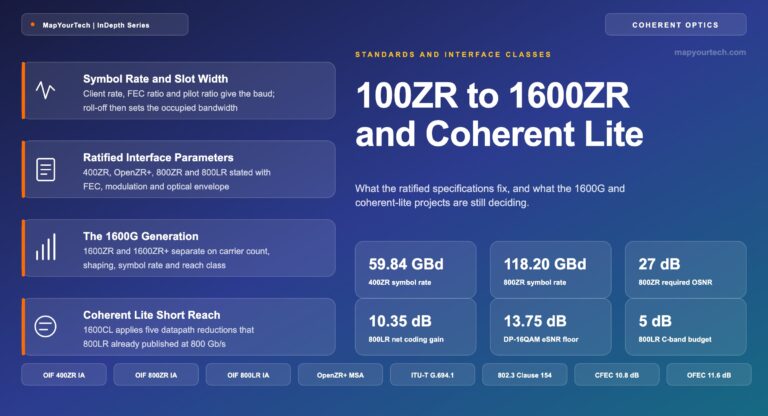
DP-QPSK, DP-16QAM, DP-64QAM and probabilistic constellation shaping; symbol rates from 32 GBaud (100G) through 60 GBaud (400ZR) up to 120+ GBaud at 800G and beyond; how the DSP performs chromatic and polarization dispersion compensation in the electrical domain.
Optical Amplifiers
EDFA gain profile (typically 20-35 dB), noise figure (4-6 dB), and per-channel power flattening; Raman amplification for spans exceeding 100 km; combined Raman+EDFA hybrids for routes beyond 1,500 km; pump-sharing and multi-rail architectures in modern ILA sites.
ROADM and WSS Architecture
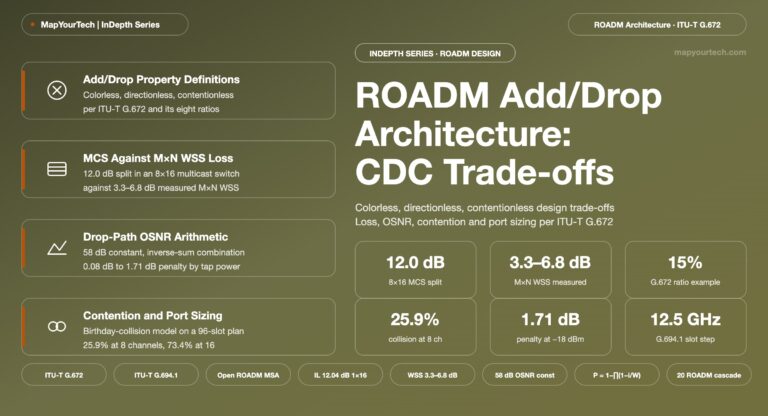
Colorless, directionless, and contentionless (CDC) add/drop; LCoS-based WSS technology with 6.25 GHz or 12.5 GHz grid steps; flex-grid spectrum allocation per ITU-T G.694.1; broadcast-and-select versus route-and-select architectures; protection switching times under 20 ms.
OTN and Client Mapping
ODUk frame structure and overhead, mapping hierarchies for 100GbE/400GbE/800GbE clients into ODUflex containers, FEC schemes (HD-FEC, SD-FEC, oFEC, CFEC), and the trade-off between FEC overhead and net coding gain.
Standards and Specifications
ITU-T G-series (G.652, G.654.E, G.694.1, G.872, G.709); OIF 400ZR, 800ZR, and emerging 1600ZR Implementation Agreements; OpenROADM and OpenZR+ MSAs; IEEE 802.3 series for client interfaces; OpenConfig and TAPI for the management plane.
An erbium-doped fiber amplifier (EDFA) example shows why depth matters here. The engineer needs to know that EDFAs provide approximately 20-35 dB of gain with a 4-6 dB noise figure, that this is enough to compensate a typical 80-140 km span, and that the cumulative noise figure across a cascaded chain follows the ASE accumulation equation. They also need to know that placing a variable optical attenuator before an EDFA increases the effective noise figure and degrades OSNR, while placing it after preserves OSNR — a single design choice that decides whether the receiver gets enough margin or fails to lock.
The ROADM and WSS architecture domain is where most modern multi-vendor design work happens. A CDC ROADM with 8 line degrees and 96 channels per degree on the C-band grid is a standard metro building block. The engineer needs to understand how the WSS attenuation profile interacts with cascaded ROADM filtering penalties — a wavelength that traverses eight ROADM nodes accumulates filter narrowing that can cost 1-2 dB of OSNR margin, which has to be budgeted upfront, not discovered at turn-up.
The coherent shift
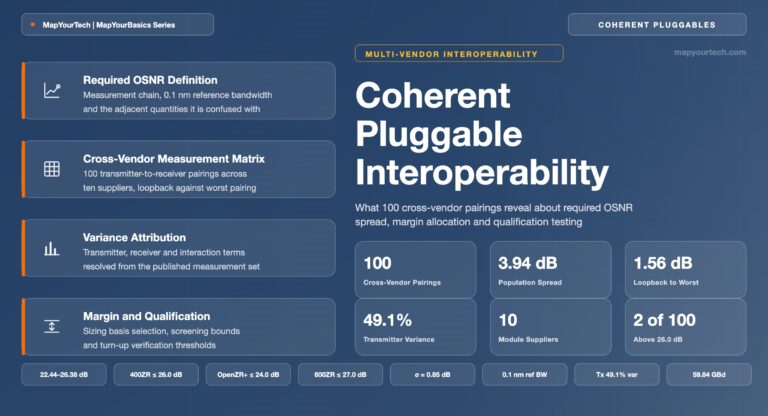
OIF released the 400ZR Implementation Agreement in 2020, defining a 400G coherent pluggable in QSFP-DD or OSFP form factor for single-span DCI links up to roughly 120 km. By 2024, more than 70% of coherent bandwidth deployed was in pluggable form (Cignal AI data, cited across industry coverage). The 800ZR Implementation Agreement followed in late 2024, doubling per-wavelength capacity through ~118 GBaud operation on 4-nanometer CMOS DSPs. The 1600ZR specification is in active development.
For the engineer this means three concrete things: every metro DCI design now starts with a pluggable-versus-embedded decision, every long-haul design has to account for the gap between embedded high-performance modules and merchant-DSP pluggables (10-20% behind in reach and spectral efficiency), and every multi-vendor plan has to reconcile the OIF, OpenZR+, and OpenROADM coherent variants that may all appear in the same network. The coherent versus direct-detect boundary at 800G is one of the most active design questions in the field.
3. Tools of the Trade
An optical network engineer's toolkit has expanded from physical test gear to a hybrid stack of hardware, planning software, and automation frameworks.
Test and measurement hardware
- Optical Time Domain Reflectometer (OTDR) — single-port instrument that maps fiber attenuation, splice loss, connector loss, and Fresnel reflections out to roughly 250 km using Rayleigh backscatter. ITU-T G.650.3 and IEC 61280-4-2 govern the methodology. The OTDR is the single most important field instrument an optical engineer learns to drive.
- Optical Power Meter (OPM) and Optical Spectrum Analyzer (OSA) — for per-channel power and OSNR measurement in the field. A modern OSA resolves 0.05 nm and gives per-channel OSNR to within ±0.5 dB.
- Coherent receiver test sets — for BER, Q-margin, pre-FEC and post-FEC error counting, and constellation diagram capture.
- Variable optical attenuators, polarization scramblers, ASE noise loaders — for receiver sensitivity and OSNR margin testing.
Planning and simulation software
The planning-tool category splits into two camps. Vendor-specific tools (Ciena's WaveLogic Planner, Nokia's WaveSuite Planning, Cisco's Optical Network Planner) model their own equipment with high fidelity but cannot model a competitor's hardware. Open-source GNPy, developed under the Telecom Infra Project's Open Optical and Packet Transport (OOPT) group, models multi-vendor topologies through a published equipment JSON schema and the Gaussian Noise (GN) model. GNPy has been validated against measured GSNR in production networks by operators including Meta, Orange, Telia, and Microsoft, with prediction accuracy within 1 dB for more than 90% of measurements across diverse scenarios.
An operator-grade in-house multivendor planning tool typically wraps GNPy with a network model, an equipment library curated against measured vendor data, a workflow engine, and an SDN-controller interface. The engineer who can both use such a tool and contribute to its equipment library is in short supply.
Automation and software tooling
- Python — the dominant language for optical network automation. Libraries that matter: pyangbind for YANG models, ncclient for NETCONF, paramiko for legacy SSH/CLI, requests for REST APIs, and scapy for low-level packet work.
- NETCONF/YANG and gNMI/gNOI — model-driven configuration and telemetry interfaces, standardised through OpenConfig and IETF.
- TAPI (Transport API) — the ONF-standardised northbound API for transport network controllers.
- Git, Jenkins, Ansible — the configuration management and CI/CD pipeline that the optical engineer increasingly inherits from the IP-networking world.
The optical network automation shift is not optional. Major equipment vendors and hyperscalers actively recruit optical engineers who can read a YANG model and write a NETCONF client. An engineer who can only operate a vendor's GUI is now competing for a shrinking pool of roles.
4. Skills That Distinguish a Less Experienced Engineer from a Senior One
Skills divide into three layers. The first two are table stakes; the third is what gets engineers promoted.
Foundational technical skills
- Fiber-optic physics — attenuation, dispersion, nonlinearities, polarization effects
- DWDM and OTN protocol stack, frame structure, and overhead
- Link budget calculation — power, OSNR, and dispersion budgets
- Coherent modulation and FEC fundamentals
- ROADM/WSS architecture and CDC operation
- OTDR trace interpretation and field test methods
Software and automation skills
- Python proficiency — scripting, data parsing, API consumption
- YANG data modeling and NETCONF/RESTCONF client work
- Linux command-line fluency
- Git version control
- JSON and YAML manipulation
- Basic knowledge of REST API design
The differentiators
A senior optical engineer reads a vendor datasheet and can immediately identify what is published, what is measured, and what is implied. They can also identify what is missing. The differentiating skills are not on any certification syllabus:
- Spec-reading discipline — knowing the difference between an OIF Implementation Agreement, an ITU-T Recommendation, an IEEE Standard, and an MSA — and what each one actually obligates a vendor to deliver.
- Multi-vendor integration judgement — knowing when an "interoperable" claim is real and when it depends on a specific software release on both sides.
- Failure-mode intuition — knowing where a design is fragile before it fails. A senior engineer reading a plan will spot the single shared pump laser whose failure takes down four rails of an ILA hut before anyone runs an FMEA.
- Comfort with uncertainty — knowing how to make a design decision with incomplete data and document the assumption clearly enough that the next engineer can verify it later.
Takeaway: Engineering certifications and software fluency get the engineer through the door. Spec-reading discipline, multi-vendor integration judgement, and failure-mode intuition decide who runs the project and who works on it.
5. Education and Certifications
A Bachelor's degree in Electrical Engineering, Electronics & Communications Engineering, Photonics, or Applied Physics is the standard entry credential. Roughly 60% of optical engineers hold a Bachelor's, around 22% hold a Master's, and roughly 11% hold a PhD. The distribution shifts toward Master's and PhD for vendor R&D roles (DSP architecture, photonic IC design), and stays at Bachelor's for service-provider operations and hyperscaler deployment roles.
Certifications matter less than they did a decade ago, but they still help with first-job filtering. Three categories of credential are worth investing in:
| Category | Examples | Best fit for |
|---|---|---|
| Vendor-neutral optical | Certified Optical Network Associate (CONA), Certified Optical Network Engineer (CONE), Certified Optical Network Specialist (CONS) | Engineers entering the field or moving between vendors |
| Fiber Optic Association | FOA CFOT, CFOS variants for testing, splicing, and design | Field engineers, installation specialists |
| Vendor-specific | Ciena certifications, Nokia ONC, Cisco CCNP Service Provider, Juniper JNCIP | Engineers committed to a specific vendor ecosystem |
| Cross-domain | AWS Certified Advanced Networking, Python Institute PCEP/PCAP | Engineers moving toward hyperscaler or automation roles |
A more durable investment than any specific certification is conference participation. OFC (Optical Fiber Communication Conference, North America) and ECOC (European Conference on Optical Communication) are where the standards work happens and where the engineer can see what the industry will be deploying 18-24 months ahead of public product announcements.
6. Where Optical Engineers Work
Optical engineers work for one of four employer categories. Each has a distinct work pattern and compensation profile.
| Employer type | Typical employers | Work focus |
|---|---|---|
| Hyperscalers and cloud providers | Google, Meta, Microsoft, AWS, Oracle | DCI design, scale-across networks, automation, custom optical platforms |
| Telecom service providers | AT&T, Verizon, Deutsche Telekom, NTT, Reliance Jio | Long-haul and metro DWDM design, operations, capacity planning |
| Equipment vendors | Ciena, Nokia, Cisco/Acacia, Ribbon, ADTRAN, ZTE, Huawei, SmartOptics, PacketLight | Product design, customer-facing systems engineering, R&D, standards work |
| Submarine cable and consortium operators | SubCom, ASN, NEC, Google subsea team, Meta subsea team | Submarine line system design, branching unit configuration, repeater specifications |
The fastest-growing segment is the hyperscaler bucket. The inter-DC and intra-DC optical disciplines have collapsed into one role at hyperscalers, where the same engineer may design a 40-meter intra-rack LPO link in the morning and a 4,000 km submarine-to-onshore DCI extension in the afternoon. North American long-haul spending has surged in recent years, driven primarily by hyperscaler data center interconnection.
7. Compensation and Job Outlook
Compensation varies sharply by employer category and geography. Hyperscaler senior optical engineers in San Jose or Seattle can earn 2-3x a service-provider engineer in a tier-2 US city, almost entirely through equity grants tied to AI-infrastructure expansion. The following data points illustrate the spread for the US market.
| Reference | Median / average | 25th-75th percentile | Source |
|---|---|---|---|
| Optical Network Engineer | $129,378 | $100K - $169K | Glassdoor, Jan 2026 |
| Optical Network Engineer | $130,736 | $111K - $147K | ZipRecruiter, Feb 2026 |
| Electrical Engineer (parent) | $111,910 | $74K - $175K | BLS OEWS, May 2024 |
| Electronics Engineer (parent) | $127,590 | $79K - $199K | BLS OEWS, May 2024 |
| Equipment vendor senior optical engineer | $150K - $200K | $220K+ at senior level | Industry compensation surveys |
| Hyperscaler / IT sector top end | ~$280,747 (including RSUs) | 350K+ | Glassdoor, Jan 2026 |
The US Bureau of Labor Statistics reports overall employment of electrical and electronics engineers is projected to grow 7% between 2024 and 2034 — much faster than the average for all US occupations — translating to about 17,500 openings per year across the parent category. The optical-specific subset benefits disproportionately because the headline growth drivers (cloud, AI training fabrics, 5G/6G transport, submarine capacity expansion) all consume optical infrastructure.
Compensation patterns differ outside North America. UK base salaries cluster between £55K-£95K for mid-career roles. Continental Europe (Germany, France, Netherlands) ranges €65K-€110K. India sees ₹15-50 lakh per annum spreads for vendor and hyperscaler roles, with multinationals like Reliance Jio, Ciena India, and Nokia India driving the upper band. APAC hyperscaler hubs in Singapore and Tokyo pay 1.5-2x the regional service-provider average for engineers with automation skills.
8. How the Role Is Evolving
Three structural shifts are rewriting the day-to-day work of optical engineers.
AI workloads have changed what gets designed
Training a large language model across geographically distributed GPU clusters generates "scale-across" traffic patterns that earlier DCI designs were never asked to carry. A single 576-GPU cluster can require roughly 18,432 single-ended 800G optical modules. Scaled to a million-GPU deployment, transceivers alone can consume on the order of 180 MW. The pattern of traffic — bursty all-reduce gradient synchronisation between distant GPUs — also breaks the assumptions baked into legacy carrier-grade SLA engineering. Optical engineers designing for AI fabrics now plan around peak burst capacity, sub-millisecond latency tolerance, and per-port power budgets that pluggable optics struggle to meet at scale. Co-packaged optics (CPO) has moved from lab demonstration to production, with multiple vendors including Nvidia, Broadcom, and AMD shipping CPO-enabled switch platforms for AI scale-up applications.
Automation has changed how the work gets done
The optical engineer now writes code. Not application code — the engineer who tries to compete with full-time software developers loses — but glue code: scripts that pull telemetry from an SDN controller, parse it, identify anomalies, generate a configuration change, and push it back through NETCONF or a REST API. Python is dominant for this work because the ecosystem matches the engineer's actual needs. An engineer who can write 200 lines of Python that automate a previously two-hour manual workflow is more valuable to most employers than one who can recite the OTN frame structure from memory.
AI is being applied to optical operations
The third shift is bidirectional: AI is also being applied to the operation of optical networks. The proven AI use cases in optical NOC operations — alarm clustering, OSNR anomaly detection, and predictive fault management — are now in production at major operators. The engineer's role here is not to build the AI — that is the vendor's job — but to understand its limits well enough to know when its recommendations are reliable and when they are not.
Takeaway: The optical engineer's job is still an optical engineer's job. The fiber physics has not changed. What has changed is the surrounding stack — the AI workloads driving demand, the automation expected of every deliverable, and the software-defined control plane that increasingly mediates every operational action. Engineers who treat any one of these as someone else's problem find their career options narrowing.
9. Common Career Pitfalls
Five mistakes appear repeatedly in optical engineering careers. They are listed here because they are avoidable.
- Single-vendor lock-in too early. An engineer who spends the first five years exclusively on one vendor's platform finds it hard to move. Two vendors by year five is a healthier baseline.
- Ignoring the software shift. The engineer who refuses to learn Python past the third reminder is the engineer the next round of layoffs targets first.
- Confusing certifications with skill. A wall of certifications without a portfolio of designed-and-deployed networks looks like compensation for shallow experience. Build the portfolio first.
- Treating standards as optional reading. The senior engineers everyone defers to are the ones who have actually read OIF 400ZR, ITU-T G.872, and the relevant IEEE 802.3 clauses end to end. There is no substitute.
- Underinvesting in writing. Optical engineers who can write a clear design document, a clean root-cause analysis, or a defensible technology recommendation get promoted faster than those who cannot. The most valuable senior engineers are the ones who can translate physics into a decision that a non-engineer executive can sign off on.
Conclusion
The optical network engineer sits inside the bandwidth supply chain that AI training, cloud computing, and the next generation of consumer connectivity all depend on. The role pays well, has strong growth fundamentals, and is technically richer than the job description suggests. It also demands more — more breadth across hardware and software, more comfort with multi-vendor integration, more discipline around standards and measurement.
For engineers entering the field: build foundations in fiber physics and DWDM architecture, layer Python and YANG modeling on top, get a portfolio of designed networks, and stay current with the OIF and ITU-T standards roadmap. For mid-career engineers: invest in the AI-era technologies redefining the role — LPO, CPO, scale-across networks, and AI-assisted operations — before they become entry requirements rather than differentiators. For senior engineers: the value you bring is judgement under uncertainty, and the way to keep that value compounding is to keep reading the new specs and keep your hands on at least one live network.
The discipline keeps changing. The engineers who treat that as the most interesting feature of the job are the ones who do well in it.
Continue Learning on MapYourTech
Everything covered in this article — fiber physics, coherent DSP, ROADM architecture, OTN framing, OSNR engineering, automation, AI-era optical fabrics — is available in depth on the MapYourTech platform. The library has grown since 2011 into the most-referenced optical networking resource for working engineers.
Free beginner-tier courses cover fiber fundamentals and DWDM. Premium tiers add the OSNR simulator, link budget calculator, OTDR trace analyzer, channel plan generator, GnPy-aligned planning tools, and the full course catalog on coherent optics, OTN, ROADM design, submarine systems, and network automation. The platform is built by optical engineers, for optical engineers — vendor-neutral, standards-anchored, written from real field experience.
Explore MapYourTechDeveloped by MapYourTech Team
For educational purposes in Optical Networking Communications Technologies
Note: This guide is based on industry standards, best practices, and real-world implementation experiences. Specific implementations may vary based on equipment vendors, network topology, and regulatory requirements. Always consult with qualified network engineers and follow vendor documentation for actual deployments.
Feedback Welcome: If you have any suggestions, corrections, or improvements to propose, please feel free to write to us at [email protected]
Related Articles on MapYourTech