Capacity Planning Trigger Points: When to Upgrade vs When to Build a New Route
The utilization band that should trigger a capacity decision, the three upgrade paths available once a route crosses it, how their CAPEX profiles compare, and why deciding late turns a routine upgrade into an emergency build.
1. Introduction
A DWDM (Dense Wavelength Division Multiplexing) route does not fail when it runs out of capacity — it fails when the operator runs out of time to react. Traffic on a fiber route rarely grows in a straight line to 100% and stops there; it accelerates, and the window between "we should look at this" and "we are out of channels" is set by whichever upgrade path takes the longest to execute. Capacity planning is the discipline of watching utilization against that lead time, not against the raw fill percentage alone.
This article sets out the utilization band that experienced planning teams treat as a decision trigger, the three paths available once a route crosses it — a modulation refresh, spectrum expansion into the L-band, or a new fiber build — and how their capital cost and lead time profiles differ enough to change the decision depending on how much runway remains. It closes with a comparison table and a decision framework an engineer can apply directly to a route under review.
2. The Utilization Threshold: Why 60–70%
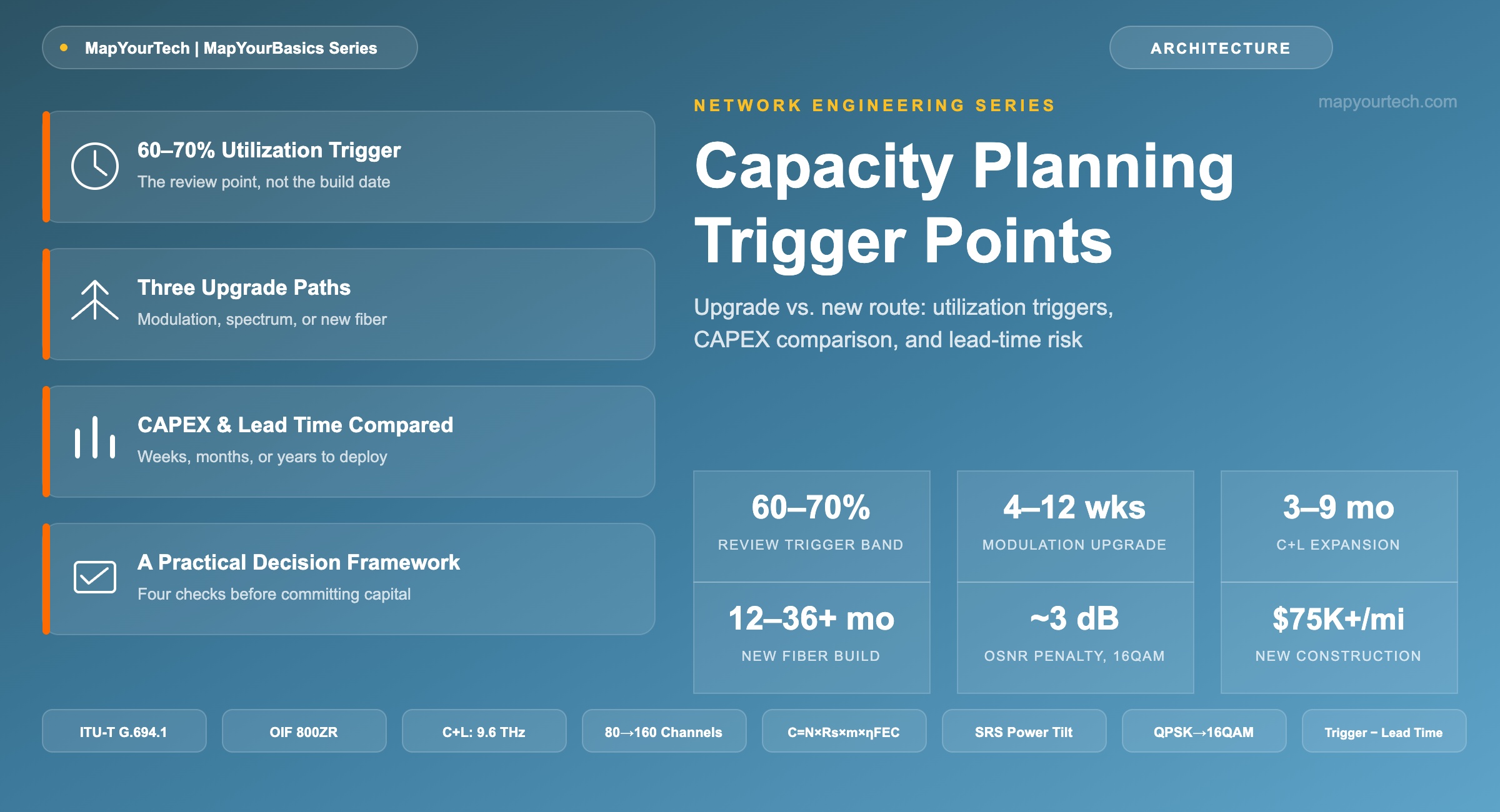
Most operational capacity-management practices treat 60–70% of a route's lit capacity as the point where a formal upgrade evaluation starts, not the point where the upgrade itself must be complete. This is a planning heuristic drawn from operating experience rather than a formal standard, and it exists because of three separate margins that stack on top of each other: forecast error in the traffic model, the time needed to design, procure, and turn up whichever upgrade path is chosen, and the operational buffer needed to absorb a traffic spike or a competing project without an emergency change.
Waiting until a route is near full is the most common planning failure, because the last 20–30% of capacity on a DWDM system is consumed disproportionately fast. Traffic growth driven by cloud on-ramps, 5G backhaul densification, and AI training-cluster interconnect has been running well above single-digit percentages year over year on many metro and long-haul routes, and a route sitting at 55% utilization with 12 months of historical growth data can cross 90% well inside the lead time of a fiber build that has not yet started.
The 60–70% trigger is a review point, not a construction start date. A route that enters the trigger band with 30 months of fiber-build lead time ahead of it needs the build decision made almost immediately; the same route with a same-quarter modulation refresh available has considerably more room to confirm the forecast before committing capital.
Takeaway: Treat the 60–70% band as the moment to start the evaluation in Section 3, not the moment to start construction. The correct trigger point for any single route is the threshold minus the lead time of the slowest viable upgrade path.
3. Upgrade Path Options
Once a route crosses its trigger point, an operator generally has three ways to add capacity without abandoning the existing right-of-way. Each works by increasing a different term in the DWDM capacity equation.
3.1 Higher Modulation Format
Moving a route's transponders from DP-QPSK (dual-polarization quadrature phase-shift keying, 2 bits per symbol) to DP-16QAM (4 bits per symbol) roughly doubles the bits carried per channel at a fixed symbol rate — a theoretical relationship (Shannon capacity, C = B log&sub2;(1+SNR)) that measured DWDM deployments approximate closely when optical signal-to-noise ratio (OSNR) headroom is sufficient. The cost is reach: 16QAM requires roughly 3 dB more OSNR than QPSK for the same bit error rate, which measured link-engineering data shows typically halves the achievable unregenerated distance. This path is attractive because it reuses the existing fiber, amplifiers, and ROADM (Reconfigurable Optical Add/Drop Multiplexer) nodes; the change is confined to the transponder card or pluggable, making it the fastest of the three options to execute.
3.2 Spectrum Expansion: C+L Band
A C-band-only DWDM system uses roughly 4.8 THz of the erbium gain window (approximately 1530–1565 nm). Adding the L-band (approximately 1565–1625 nm) makes another 4.8 THz available on the same fiber pair, which at matched channel counts and modulation can effectively double total capacity — for example, from 80 channels at 50 GHz spacing in C-band alone to 160 channels across C+L. This requires L-band EDFAs (erbium-doped fiber amplifiers), C/L band splitting and combining optics, and ROADM line cards or WSS (wavelength selective switch) modules rated for the extended spectrum, so it is a line-system upgrade rather than a transponder-only change, but it does not require new outside-plant construction.
Activating L-band channels on a fiber that is already carrying lit C-band traffic introduces a power-tilt risk from stimulated Raman scattering (SRS): power transfers from the shorter C-band wavelengths to the longer L-band wavelengths as total launched power rises, and an unmanaged tilt across a multi-span link can reach several dB before automatic gain equalization or Raman-assisted tilt correction is applied. This makes C+L activation a planned line-system change with power-management steps, not a simple channel add.
3.3 New Fiber Route
When a corridor's existing fiber is already running C+L band at its highest supportable modulation, or when duct capacity along the route is exhausted, the remaining path is a new physical route: new duct or aerial construction, new fiber strands, and a new DWDM line system end to end. This path adds capacity that is independent of whatever happens to the existing route, and it is the only option that also adds physical route diversity, which matters for protection switching and disaster recovery. It is also the most capital-intensive and slowest of the three, for reasons covered in Section 4.
The two in-place paths (3.1 and 3.2) are the reason many capacity decisions never reach the new-build stage: C+L band expansion alone can triple original C-band capacity on some routes when combined with a modest modulation change, and modern open line systems let an operator add a third-party transponder generation without replacing the amplifier chain.
4. CAPEX Comparison Across Paths
The three paths sit on a cost curve that tracks their lead time closely: the fastest path is also the cheapest per route, and the slowest is the most expensive but delivers the only capacity gain that is fully independent of the original fiber. A modulation upgrade is a transponder-level capital expense, typically the cost of new coherent pluggables or line cards across the route's terminal sites, with no outside-plant work. A C+L expansion adds L-band amplifier modules, band-splitting optics, and ROADM line cards at every site the new spectrum will pass through, which scales with node count rather than distance. A new fiber build's cost structure is dominated by outside-plant construction: industry pricing surveys report that new fiber construction in areas without existing duct commonly exceeds 75,000 USD per mile, a figure that swings sharply with terrain, permitting, and whether the route crosses urban rights-of-way or open corridor — on top of the DWDM terminal and amplifier equipment needed to light the new strands.
| Upgrade Path | Typical Capacity Gain | Relative CAPEX Class | Typical Lead Time | Primary Constraint | Route Diversity Added |
|---|---|---|---|---|---|
| Modulation upgrade (e.g., QPSK → 16QAM) | Up to ~2× per channel | Low — transponder-only | 4–12 weeks | OSNR headroom / reach reduction | None |
| Spectrum expansion (C+L band) | Up to ~2× total fiber capacity | Medium — line-system upgrade | 3–9 months | SRS power tilt, C+L ROADM readiness | None |
| New fiber route build | New capacity block, independent of existing route | High — outside-plant construction | 12–36+ months | Permitting, right-of-way, construction season | Yes — physical path diversity |
Because a new build is the only path that adds independent route diversity, it is sometimes justified on protection and disaster-recovery grounds even when the existing route still has spectrum available — a decision driver separate from raw capacity that a purely utilization-based trigger will miss. Where a new build is not immediately justified, leasing an existing operator's managed optical fiber network capacity can bridge the gap while a proprietary build proceeds in parallel, trading a portion of long-term cost advantage for a materially shorter lead time.
5. Lead Time Risk of a Late Decision
The financial risk in capacity planning is asymmetric: deciding early costs a few months of amplifier or transponder capital sitting unused, while deciding late forces the operator into whichever path has capacity available at any cost, often the most expensive and slowest option executed under schedule pressure. A route that reaches 85–90% utilization before a decision is made has, in practice, already lost the option to use a measured modulation upgrade or C+L expansion as the primary response, because the headroom those paths add will be consumed before the equipment can be procured and turned up — leaving an emergency new-build, a temporary lease, or in the worst case a managed traffic restriction as the only remaining options.
View chart data as a table
| Quarter | Projected Utilization | 60% Threshold | 70% Threshold |
|---|---|---|---|
| Q1 | 42% | 60% | 70% |
| Q2 | 48% | 60% | 70% |
| Q3 | 54% | 60% | 70% |
| Q4 | 59% | 60% | 70% |
| Q5 | 64% | 60% | 70% |
| Q6 | 69% | 60% | 70% |
| Q7 | 75% | 60% | 70% |
| Q8 | 82% | 60% | 70% |
In this illustrative trend, utilization crosses the lower edge of the trigger band around quarter five. A modulation upgrade started at that point (4–12 weeks lead time) comfortably lands before the route reaches the upper edge of the band in quarter six or seven. The same trend started at quarter seven leaves a C+L expansion (3–9 months) landing after the route has likely reached practical exhaustion, and a new fiber build (12–36+ months) started at quarter seven would not complete until well past the point the route ran out of capacity under continued growth — the gap between when capacity runs out and when the build finishes has to be covered by an interim measure such as traffic engineering, temporary leased capacity, or accepted congestion.
Takeaway: Compare the trigger date to each path's lead time, not to the exhaustion date. If a new fiber build might plausibly be needed within its own lead time window, that decision has to start at or before the 60% edge of the trigger band, while a modulation refresh can safely wait closer to 70%.
6. A Practical Decision Framework
A workable framework applies four checks in sequence once a route enters the trigger band, rather than defaulting to whichever path was used last time.
- Confirm the growth rate, not just the current fill. A route at 62% growing 8% year over year has a very different runway than one at 62% growing 35% year over year; the trigger band is a starting point for this calculation, not a substitute for it.
- Check OSNR margin before committing to a modulation upgrade. If the route is already running a higher-order format near its OSNR limit, or the span loss budget leaves little headroom, a modulation upgrade may not be available at all, which pushes the decision directly to spectrum expansion.
- Confirm C+L readiness across every node on the route. Spectrum expansion only works if every ROADM and amplifier site along the path supports the extended band; a single legacy site can force a partial line-system refresh that changes the CAPEX and lead time assumptions in Table 1.
- Evaluate route diversity needs independently of capacity. If the route lacks physical protection diversity, a new build may be justified on resilience grounds well before capacity alone would trigger it, in which case the build timeline should be set by risk tolerance rather than by the utilization curve.
Running this sequence at the first trigger-band review, rather than after the route is already tight, keeps every option in Table 1 open and lets the lead time of the chosen path — not the shrinking runway — set the schedule.
7. Summary
A DWDM route's utilization curve is not the risk; the mismatch between that curve and the lead time of the available upgrade paths is. Treating 60–70% utilization as a review trigger, checking OSNR margin and node readiness before committing to a path, and matching the chosen path's lead time against the actual growth rate keeps a capacity decision a planned engineering exercise instead of a reactive one. Modulation upgrades and C+L band expansion cover the overwhelming majority of capacity events on routes with existing fiber; a new build remains reserved for routes that are already fully expanded, or where physical route diversity is the deciding factor rather than raw capacity.
Takeaway: Set the trigger point for each route at (60–70% utilization) minus (lead time of the slowest viable upgrade path), and re-evaluate against actual traffic growth at every planning cycle rather than waiting for a fixed calendar date.
| Parameter | Typical Value | Evidence Class |
|---|---|---|
| Capacity review trigger band | 60–70% | Operating heuristic |
| OSNR penalty, QPSK → 16QAM | ~3 dB | Measured (link engineering) |
| Modulation upgrade lead time | 4–12 weeks | Typical (industry practice) |
| C+L expansion lead time | 3–9 months | Typical (industry practice) |
| New fiber build lead time | 12–36+ months | Typical (industry practice) |
| New fiber construction cost | 75,000+ USD/mile | Vendor / market survey, 2026 |
For background on the spectrum-side option covered in Section 3.2, see the companion guide to C+L band DWDM systems, the ITU-T G.694.1 frequency grid that governs channel placement across both bands, and Shannon's limits for fiber optics for the theoretical ceiling behind the modulation-upgrade path. For the line-system side of a spectrum or modulation upgrade, OpenROADM basics and open line systems cover how disaggregated ROADM and transponder choices affect what a given node can support. Engineers sizing the transponder-level path should also review 800G ZR/ZR+ coherent optics and spectral efficiency maximization techniques, and teams evaluating mixed 400G/800G/1.2T deployments during an upgrade should see mixed channel rate planning on DWDM line systems. Full link-budget parameters for any of the three paths are covered in important parameters in DWDM link design.
References
- ITU-T G.694.1 — Spectral grids for WDM applications: DWDM frequency grid, ITU-T Study Group 15.
- Optical Internetworking Forum — 800ZR Implementation Agreement, OIF.
- ITU-T G.652 — Characteristics of a single-mode optical fibre and cable, ITU-T Study Group 15.
Sanjay Yadav, "Optical Network Communications: An Engineer's Perspective" – Bridge the Gap Between Theory and Practice in Optical Networking.
Related Articles on MapYourTech