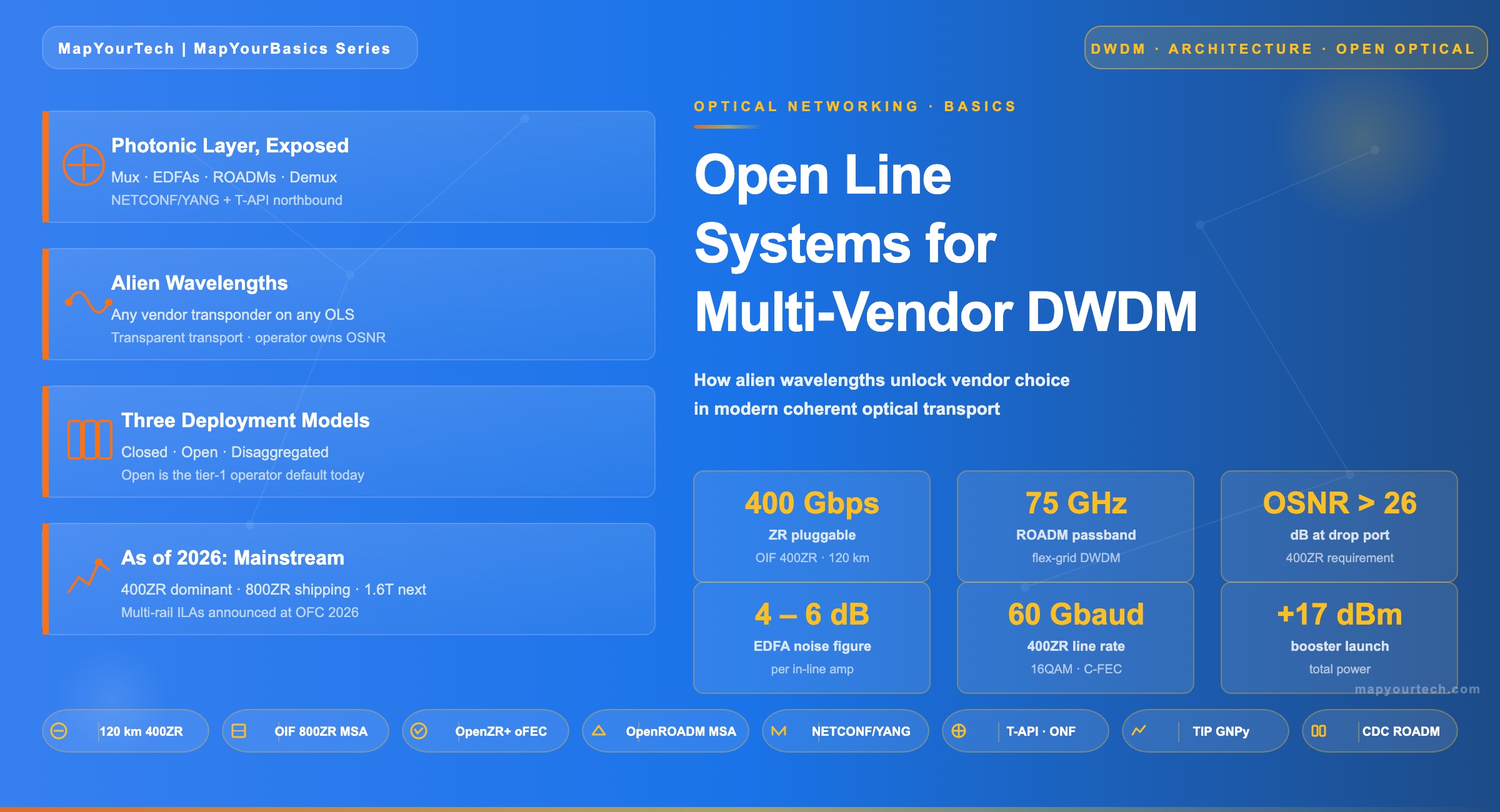
MapYourTech · MapYourBasics Series
Open Line Systems: Multi-Vendor Coherent Wavelengths
How open DWDM line systems carry alien wavelengths from different transponder vendors across the same photonic layer, and why that single architectural shift unlocked the last decade of optical innovation.
1. Introduction
For most of DWDM's history, the transponder and the line system came from the same vendor and had to stay that way. Buying a wavelength meant buying everything attached to it. The amplifiers, the Reconfigurable Optical Add-Drop Multiplexers (ROADMs), the management software, and the transponder were welded together into a closed appliance. Adding a second vendor's transponder to the same fiber was, in practice, impossible.
The Open Line System (OLS) broke that model. It separates the photonic transport layer from the transponder layer with clean, documented interfaces so any vendor's coherent transponder — a traditional line card, a 400ZR QSFP-DD in a router, or an 800ZR+ pluggable — can ride the same fiber, amplifiers, and ROADMs as any other vendor's transponder. The channel a third-party transponder produces is called an alien wavelength.
This guide explains what an open line system is, what makes a wavelength "alien," the three architectural models in the field today, the standards that make interoperability work, and where the industry sits in 2026.
2. The Closed DWDM Legacy
Traditional DWDM systems bundled the transponders, multiplexers, amplifiers, and ROADMs inside a single vendor's chassis under a single management system. The vendor controlled every optical parameter — launch power, gain tilt, per-channel equalization, ROADM attenuation — and tuned them to work only with its own transponder types. Any deviation was out of specification.
This closed design made optical performance easy for the vendor to guarantee and hard for the operator to share. Capacity upgrades meant buying a new transponder from the same vendor at the same price point, even when competitors offered better economics. When the vendor discontinued a product line, the operator had no migration path except a forklift of the entire line system.
Definition
Closed Line System: a DWDM network where transponders, amplifiers, and ROADMs are designed, validated, and managed as one integrated product from a single vendor. Third-party wavelengths are either not supported or require explicit per-channel engineering.
Hyperscalers and tier-1 service providers reached a breaking point around the mid-2010s. Traffic growth demanded far more wavelengths than closed procurement cycles could deliver. The Telecom Infra Project (TIP) launched its Open Optical & Packet Transport (OOPT) working group in 2016 with backing from Facebook, Deutsche Telekom, Telefonica, and others. OpenROADM, driven by AT&T, followed with a Multi-Source Agreement (MSA) targeting metro and regional disaggregated optical networks. Both aimed at the same goal: let operators pick a transponder from one vendor and a line system from another, and have them work together.
3. What an Open Line System Actually Is
An open line system is the photonic transport layer — everything that moves light but does not originate or terminate it. At minimum it contains four element types.
3.1 The four OLS building blocks
- Optical multiplexer and demultiplexer: combines multiple wavelengths onto one fiber at the transmit side and separates them at the receive side. Passive or active, fixed-grid or flex-grid.
- Erbium-Doped Fiber Amplifier (EDFA): boosts optical power after the mux (booster) and before the demux (pre-amp), plus in-line amplifiers every 80–100 km on long spans. Raman amplification is added on ultra-long spans.
- ROADM: software-controlled node that selects which wavelengths pass through, add, or drop at each site. Modern ROADMs use Wavelength Selective Switches (WSS) with colorless, directionless, and contentionless (CDC) flexibility.
- Open management interface: a northbound API — typically NETCONF with YANG models or T-API (Transport-API) — that lets an external controller configure the line system without vendor-specific GUIs.
The critical word in the definition is open. An OLS exposes its photonic parameters and accepts optical channels whose transponder sits outside the OLS vendor's product line. It publishes the spectrum it will carry, the launch power window it expects at each add port, the OSNR it delivers at each drop port, and the ROADM attenuation budget. Any transponder that meets those specifications works.
4. Alien Wavelengths Explained
An alien wavelength is any optical channel whose transponder is not part of the line system vendor's product family. If Vendor D sells the OLS and Vendor A's 400ZR pluggable feeds a channel into it, that channel is alien to Vendor D's management system.
The word alien is precise. Vendor D's management plane does not originate the signal, does not configure the modulation format, and cannot read the pre-FEC bit error rate from the transponder. Vendor D's OLS only knows the channel's spectral footprint (center frequency, bandwidth, power) and whatever performance the drop-port OSNR monitor reports. The transponder is a black box to the line system, which is exactly the point.
Key insight: alien wavelength support is a property of the line system, not the transponder. Any coherent transponder is automatically an "alien" to every line system except its own vendor's. What makes a channel usable is whether the OLS accepts and carries it.
4.1 What the OLS must do for an alien to work
Carrying a third-party wavelength requires the open line system to perform four engineering functions correctly without direct control of the transponder.
- Accept the launch power: the mux/add port must tolerate the transponder's output power (typically −10 to +1 dBm for ZR pluggables, up to +7 dBm for line-card transponders) without saturating or distorting.
- Pass the spectral footprint transparently: the mux, ROADMs, and filters along the path must not clip the channel bandwidth (75 GHz for 400ZR, 100–150 GHz for 800G+) or add in-band ripple that the transponder's DSP cannot handle.
- Deliver predictable OSNR at the drop port: the transponder needs the OSNR stated in its datasheet for its chosen modulation format. The OLS must engineer amplifier gain and channel power to hit that number over the path.
- Report accurate telemetry: per-channel power and OSNR measurements must be visible to the external controller so the transponder's performance can be correlated with line-system behaviour.
5. Three Architectural Models
Optical networks today deploy along a spectrum from fully closed to fully disaggregated. Cisco describes three canonical points on that spectrum, and the industry has largely adopted the same framing.
5.1 Closed
One vendor supplies both the transponders and the line system. Management is single-pane. Optical performance is guaranteed by the vendor end-to-end. Operators pay for that guarantee in price, upgrade cycles, and vendor lock-in.
5.2 Open
A single vendor supplies the line system (the amplifiers, ROADMs, and mux/demux), but transponders come from multiple vendors. The line system is open — it accepts alien wavelengths. This is the most common model for tier-1 operators deploying 400ZR pluggables in routers while keeping an existing OLS from a different optical vendor.
5.3 Disaggregated
Every element in the line system — amplifiers, ROADMs, mux/demux — can come from a different vendor, bolted together under an operator's own controller. Sometimes called "disaggregation soup" because the operator takes on full integration responsibility. More common in greenfield hyperscaler and open-source research deployments (TIP MANTRA, OpenROADM reference designs) than in mainstream service provider networks.
Takeaway: most operators deploy "Open" (middle row) rather than fully disaggregated. The OLS vendor still owns the photonic engineering, but the transponder market opens up. This keeps operations manageable while eliminating transponder lock-in, which is where most of the upgrade spending lives anyway.
6. The Standards That Make It Work
Multi-vendor interoperability needs published specifications that every vendor can build to. Four bodies of work matter for open line systems and the transponders they carry.
6.1 OIF 400ZR and 800ZR
The Optical Internetworking Forum (OIF) defines ZR pluggables for shorter-reach inter-datacenter links. OIF 400ZR targets up to 120 km of amplified fiber at 400 Gbps using 16QAM at 60 Gbaud with concatenated FEC (C-FEC). OIF 800ZR extends the same philosophy to 800 Gbps at around 118 Gbaud. Both emphasize simplicity, low power, and interoperability between any two compliant modules.
6.2 OpenZR+ MSA
A vendor-led Multi-Source Agreement that extends ZR with multi-haul reach using open FEC (oFEC) and flexible client mapping (100/200/300/400G on the line side, 100/200/400 GbE client muxing). OpenZR+ 400G has become the dominant 400G coherent pluggable, running on router hosts with alien wavelength support across third-party line systems. 800G OpenZR+ adds interoperable Probabilistic Constellation Shaping (PCS) for metro and regional reaches.
6.3 OpenROADM MSA
Driven by AT&T with participation from many industry members, OpenROADM targets metro and edge applications. It standardises both the transponder line-side interface (100G–800G) and the ROADM management interface through YANG data models. OpenROADM specifies interoperable modulation formats including 400G QPSK, 800G 16QAM, and 600G/800G PCS on the optical line side.
6.4 TIP OOPT and GNPy
The Telecom Infra Project's Open Optical & Packet Transport group publishes point-to-point OLS specifications and operates MANTRA, a multi-vendor integration testbed. Its open-source optical simulation tool, GNPy, computes end-to-end performance for any topology using published amplifier and fibre models — giving operators a vendor-neutral way to verify a proposed wavelength will meet its OSNR target before turn-up.
7. How Multi-Vendor Provisioning Actually Happens
The mechanical question is simple: when the operator wants a new wavelength from site A to site B, which system tells which device what? In a closed network the vendor's NMS does everything. In an open network, two domains cooperate through a standard interface.
Modern deployments use a two-controller model. An IP controller manages the routers hosting the ZR pluggables. An optical domain controller manages the line system. Both publish their state and accept commands through T-API, the ONF Transport-API, which uses NETCONF with YANG data models. A higher-level orchestrator asks the IP controller for a new 400ZR link; the IP controller asks the optical domain controller for an acceptable channel and launch parameters; the optical controller responds with a wavelength and power level; both sides provision their ends.
Standard interfaces let the same orchestrator manage a line system from one vendor and routers from another — something that was not feasible before.
Worth noting: in open deployments the operator — not the OLS vendor — is responsible for end-to-end performance verification. Most tier-1 operators build this capability using GNPy (for pre-deployment simulation) plus vendor-supplied telemetry (for post-deployment assurance).
8. Benefits and What They Cost
Operators choose open line systems because the economics and agility advantages are real. They also take on integration work that closed systems avoid. Both sides of the ledger matter.
| Dimension | Open line system advantage | What it costs the operator |
|---|---|---|
| Transponder economics | Competitive bidding per wavelength refresh cycle; pluggable ZR optics at commodity prices | Operator owns the interop testing burden |
| Innovation pace | Adopt 400ZR → 800ZR → 1.6T as soon as they ship; no line-system forklift required | Must validate each new transponder against existing OLS specs |
| Network agility | IPoDWDM converges router and transport layers; fewer boxes, lower power | IP and optical teams must share provisioning workflows |
| Vendor flexibility | No single-vendor lock-in; negotiate from multiple suppliers each cycle | Spare-parts pools fragment across vendors |
| Management | Single multi-vendor controller; open data models for automation | Correlating alien-wavelength faults across domains needs investment |
| Performance | Same optical performance as native wavelengths when engineered correctly | Operator — not vendor — is responsible for OSNR delivery |
Industry analyst data reinforces this trade-off picture. ACG Research has found that Routed Optical Networking built on open line systems delivers substantial CapEx, OpEx, and total cost savings compared with traditional multi-layer transport, plus significantly lower power per bit compared with dedicated transponder chassis. The benefits are not marketing numbers — they accrue directly from collapsing layers and letting cheaper, denser pluggable optics replace purpose-built boxes.
9. The Challenges Nobody Should Hide
Open line systems are not a free lunch. Four categories of challenge recur across every serious deployment.
9.1 Optical engineering at the boundaries
A new alien transponder changes the per-channel spectrum, power density, and gain loading on every amplifier it passes. If launch power is miscalibrated the adjacent wavelengths from legacy transponders can be degraded. Some line systems handle this automatically through their power-management control loops; others need manual engineering per channel. Independent multi-vendor interoperability testing exists precisely because the interactions are subtle.
9.2 Fault isolation across domains
When a lightpath fails, who owns the ticket? The router team sees a link down; the optical team sees all wavelengths healthy; the transponder vendor sees a host-layer alarm. Without correlated multi-domain telemetry the operator burns hours bouncing tickets between teams. Open deployments solve this with unified assurance tools that pull data from IP, transport, and pluggable layers simultaneously.
9.3 Management consistency
Every OLS vendor implements the YANG models slightly differently, and the models themselves evolve. An operator's SDN controller must track multiple OLS vendors' quirks. Adapters exist — notably Nokia's NSP, Ribbon's Muse, and several open-source controllers under TIP — but the burden is non-trivial.
9.4 Security of alien wavelengths
An alien wavelength is transparent to the OLS, which means the OLS cannot inspect or filter its payload. Layer-1 optical encryption at the transponder is the standard answer. Most tier-1 pluggable coherent optics now support MACsec or AES-256 at the line side precisely to address this concern.
10. Where the Industry Sits as of 2026
The shift to open line systems has moved from early-adopter phase into mainstream deployment. Five observable trends define the 2026 market.
400ZR pluggables are the default for new DCI and metro builds. They have become the fastest-adopted coherent technology in the industry's history, with 400G ZRx making up the majority of total deployed 400G coherent interfaces. Open line systems are the reason — they enable 400G Digital Coherent Optics (DCO) to be plugged into third-party photonic infrastructure as alien wavelengths without reengineering.
800G pluggable coherent is shipping in volume. OIF 800ZR targets up to 120 km, OpenZR+ at 800G uses interoperable PCS for metro/regional reaches. OFC 2026 announcements included 1.6 Tbps ZR/ZR+ OSFP modules in development, signalling the next capacity jump is near.
100G ZR/ZR+ now has multiple DSP suppliers. For most of the technology's life the 100 Gbps ZR/ZR+ DSP was a single-source product. During OFC 2026, Cisco Acacia and Arrcus Technologies both announced in-house DSPs shipping mid-2026 — bringing three independent DSP suppliers to the market and giving operators genuine choice at the 100G tier.
Multi-rail line systems are coming. Coherent Corp., Ciena, Cisco, and Nokia all announced multi-rail ILA products at OFC 2026, with Ribbon, Molex, and Smartoptics evaluating similar solutions. The aim is to scale optical transport density by increasing the number of transponders and in-line amplifiers per rack unit. Commercial shipments are expected around 2027.
Optical spectrum as a service is emerging but not yet mainstream. Most operators that offer wavelength services to third parties still do so as alien wavelengths (operator controls the OLS, customer brings the transponder) rather than raw spectrum leasing. The reason is control: keeping launch power management inside the OLS avoids service-level headaches.
Takeaway: the architectural question has been answered. Open line systems with alien wavelengths won. The remaining work is integration maturity — better multi-vendor controllers, better cross-domain telemetry, better GNPy-style planning tools, and better operational playbooks. The underlying physics and protocols are settled.
11. Main Points
- An Open Line System (OLS) is the photonic transport layer — mux, amplifiers, ROADMs, demux — exposed through standardised management interfaces so transponders from other vendors can ride it.
- An alien wavelength is any channel whose transponder is not part of the OLS vendor's product family. The OLS treats it transparently; the transponder owns all bit-level behaviour.
- Three architectural models span the industry: closed (single vendor end-to-end), open (single OLS, multi-vendor transponders — dominant today), and fully disaggregated (every element can differ — mainly hyperscaler and research).
- Four standards bodies provide the interop foundation: OIF (400ZR/800ZR), OpenZR+ MSA (multi-haul pluggables), OpenROADM MSA (metro TXP and ROADM), and TIP OOPT (line systems and GNPy simulation).
- Benefits are real but not free. Operators gain vendor choice, lower cost per bit, and faster innovation cycles, in exchange for owning interop testing, fault correlation, and end-to-end performance verification.
- As of 2026 the model is mainstream for metro/regional and DCI. 400ZR pluggables dominate; 800G is deploying; 1.6T is on the roadmap.
12. Glossary
- Alien wavelength: an optical channel whose transponder is outside the line system vendor's product family.
- CDC ROADM: Colorless, Directionless, Contentionless ROADM — any wavelength can be added or dropped on any port in any direction.
- C-FEC: Concatenated Forward Error Correction — the FEC used in OIF 400ZR and 800ZR pluggables.
- DCO: Digital Coherent Optics — coherent transponders with integrated DSP in pluggable form factors.
- DWDM: Dense Wavelength Division Multiplexing — carrying many wavelengths on one fibre pair at narrow channel spacing.
- EDFA: Erbium-Doped Fiber Amplifier — the workhorse amplifier for DWDM systems, typically 4–6 dB noise figure.
- GNPy: Gaussian Noise model in Python — open-source optical transmission simulator from TIP OOPT.
- MSA: Multi-Source Agreement — a vendor-led specification for interoperable products.
- oFEC: Open Forward Error Correction — the higher-performance FEC used in OpenZR+ and OpenROADM.
- OLS: Open Line System — the DWDM photonic layer exposed through open management interfaces.
- OSNR: Optical Signal-to-Noise Ratio — the key performance metric for coherent links, measured in dB in a 0.1 nm reference bandwidth.
- PCS: Probabilistic Constellation Shaping — a modulation technique that tunes symbol probabilities for extra reach.
- ROADM: Reconfigurable Optical Add-Drop Multiplexer — software-controlled wavelength switching node.
- T-API: Transport API — the ONF-defined northbound interface for transport domain controllers.
- WSS: Wavelength Selective Switch — the optical switching fabric inside modern ROADMs.
- YANG: Yet Another Next Generation — the data modelling language used with NETCONF for configuration.
13. References
- OIF, "400ZR Implementation Agreement," Optical Internetworking Forum.
- OIF, "800ZR Implementation Agreement," Optical Internetworking Forum.
- OpenZR+ MSA, "OpenZR+ Multi-Source Agreement Specification."
- OpenROADM MSA, "Open ROADM Multi-Source Agreement Specifications and YANG Data Models."
- Telecom Infra Project, "Open Optical and Packet Transport (OOPT) Reference Documents and MANTRA Integration Program."
- Telecom Infra Project, "GNPy — Gaussian Noise Model in Python (open-source optical route planning library)."
- Nokia, "Using IP-Optical Automation to Make Peace with Alien Wavelengths," Nokia Blog.
- Cisco, "Embrace the Future with Open Optical Networking," Cisco Blogs.
- LightRiver Software, "Open Optical Transport Networks — A Framework to Success," White Paper.
- Dell'Oro Group, "OFC 2026 — Scaling Up Optical Network Density," Industry Analysis.
- ITU-T Recommendation G.694.1, "Spectral grids for WDM applications: DWDM frequency grid."
- ITU-T Recommendation G.872, "Architecture of optical transport networks."
- Sanjay Yadav, "Optical Network Communications: An Engineer's Perspective" — Bridge the Gap Between Theory and Practice in Optical Networking.
Developed by MapYourTech Team
For educational purposes in Optical Networking Communications Technologies
Note: This guide is based on industry standards, best practices, and real-world implementation experiences. Specific implementations may vary based on equipment vendors, network topology, and regulatory requirements. Always consult with qualified network engineers and follow vendor documentation for actual deployments.
Feedback Welcome: If you have any suggestions, corrections, or improvements to propose, please feel free to write to us at [email protected]

Optical Communications & Network Automation Expert | Author of 3 Books for Optical Engineers | Founder, MapYourTech
Optical networking engineer with nearly two decades of experience across DWDM, OTN, coherent optics, submarine systems, and cloud infrastructure. Founder of MapYourTech. Read full bio →
Follow on LinkedInRelated Articles on MapYourTech