Compact Modular Optical Hardware: Why Hyperscalers Changed the Game
How pizza-box transponders and small-chassis optical line systems, engineered first for hyperscaler data-center interconnect, now carry a growing share of optical transport revenue and are moving into traditional carrier networks.
1. Introduction
A 2-rack-unit chassis shipping today carries a vendor-stated 25.6 Tbps of line-side optical capacity — a job that needed a full equipment bay of chassis-based transponders and reconfigurable optical add-drop multiplexer (ROADM) shelves a decade ago. That shift, from multi-slot, chassis-based optical transport systems toward small, fixed or sled-based platforms that pack a transponder, an optical line system, or both into one or two rack units, is what the industry calls compact modular hardware. Dell'Oro Group tracks this category under the label Disaggregated WDM, split into three parts: transponder units, optical line systems (OLS), and IPoDWDM ZR/ZR+ pluggables that move the coherent optic directly into a router or switch port.
Hyperscale cloud providers forced this category into existence around the mid-2010s, driven by data-center power budgets that had become a harder constraint than compute capacity itself. A decade later, the same compact modular platforms account for a substantial and growing share of total optical transport revenue, and vendors are now marketing them explicitly to traditional communication service providers (CSPs), not only webscale operators. This article covers what distinguishes a compact modular platform from a chassis-based system, the rack-density and cost math behind the shift, and where the category is — and is not — replacing the multi-degree ROADM chassis in carrier networks.
2. What Counts as Compact Modular Hardware
A compact modular platform fits an entire optical transport function — sometimes a transponder, sometimes an optical line system, occasionally both — into one to four rack units, using a fixed shelf or a small number of sled-based line cards rather than the 16- to 32-slot bays that chassis-based systems use. The distinction is architectural, not just physical size. A chassis-based system separates functions across dedicated card types: transponder or muxponder cards in one chassis, ROADM degree cards and amplifier modules in another, each drawing from a shared backplane and needing its own fan tray, power shelf, and controller card. A compact modular platform collapses those functions into a single field-replaceable unit or a small set of sleds sharing one chassis shell — a subject MapYourTech has covered in more depth in its guide to compact modular hardware and the disaggregation of optical transport.
Dell'Oro Group's taxonomy for this category, Disaggregated WDM, defines three subcategories that map directly onto the compact modular form factor: transponder units, a compact form factor housing embedded or pluggable WDM transponders for long-haul and metro deployment; optical line systems, small chassis that mainly house the amplifier — erbium-doped fiber amplifier (EDFA) and/or Raman — plus the optical add/drop multiplexer and mux/demux; and IPoDWDM ZR/ZR+, where the WDM transceiver moves out of any standalone box entirely and into a router or Ethernet switch port (Dell'Oro Group, industry taxonomy). Compact modular hardware and disaggregation are related but distinct ideas — disaggregation means the transponder and the line system are sold, and can be sourced, independently; compact modular describes what each of those independent pieces looks like on the rack.
Cisco's NCS 1001 illustrates the pattern on the line-system side: a 1RU platform built around EDFA, polarization-mode dispersion/PSM, and OTDR modules that supports current ZR pluggable variants, positioned against Cisco's own chassis-based NCS 2000 family, which spreads amplification and add/drop functions across multiple ROADM service cards in a larger shelf (Cisco, vendor documentation). Cisco has taken the concept further with a pluggable EDFA in a QSFP-DD form factor — the ONS-QDD-OLS module, rated at 17.5 dBm output with 7 to 25 dB of pre-amplifier gain and 3 to 25 dB of booster gain — small enough to plug directly into a router faceplate slot rather than occupy a rack unit at all (Cisco, vendor datasheet). On the transponder side, Ribbon Communications' Apollo 9408 and 9458 platforms pack a stated 25.6 Tbps of line capacity into 2RU, marketed explicitly toward "large communication service providers and webscale operators" (Ribbon Communications, vendor claim), while Nokia's GX Series — acquired from Infinera when that deal closed on February 28, 2025 — uses a sled-based compact modular chassis that reaches up to 1.2 Tbps per wavelength with its ICE7 optical engine (Nokia/Infinera, vendor specification). Ciena markets its Waveserver line the same way: a compact, modular interconnect platform built to cut power draw and rack footprint for high-growth, bandwidth-intensive links (Ciena, vendor description). None of these platforms eliminate ROADM chassis entirely — they replace the transponder or amplifier tier, and, in point-to-point and low-degree topologies, the ROADM tier too.
3. Architecture: Removing Boxes, Not Just Shrinking Them
The traditional data path for a single wavelength can run through five physical stages: the router's grey (non-DWDM) client port, a multi-source agreement (MSA) pluggable, fiber jumpers, a transponder or muxponder card inside its own chassis, and a ROADM chassis with its own degree cards before the signal reaches outside-plant fiber. Compact modular architecture collapses that path in one of two ways. In an IPoDWDM design — covered step by step in MapYourTech's complete architecture walkthrough of IP over DWDM — a coherent digital coherent optics (DCO) pluggable such as 400ZR, 400ZR+, or the newer 800ZR+ variants sits directly in the router's own QSFP-DD or OSFP cage, generating the DWDM wavelength at the router faceplate and removing the transponder chassis outright; the wavelength then reaches a compact modular optical line system for amplification and add/drop before it hits the fiber. In a transponder-based design, the compact modular platform still exists as a separate box, but it integrates the muxponder and OLS functions that used to occupy two chassis into one.
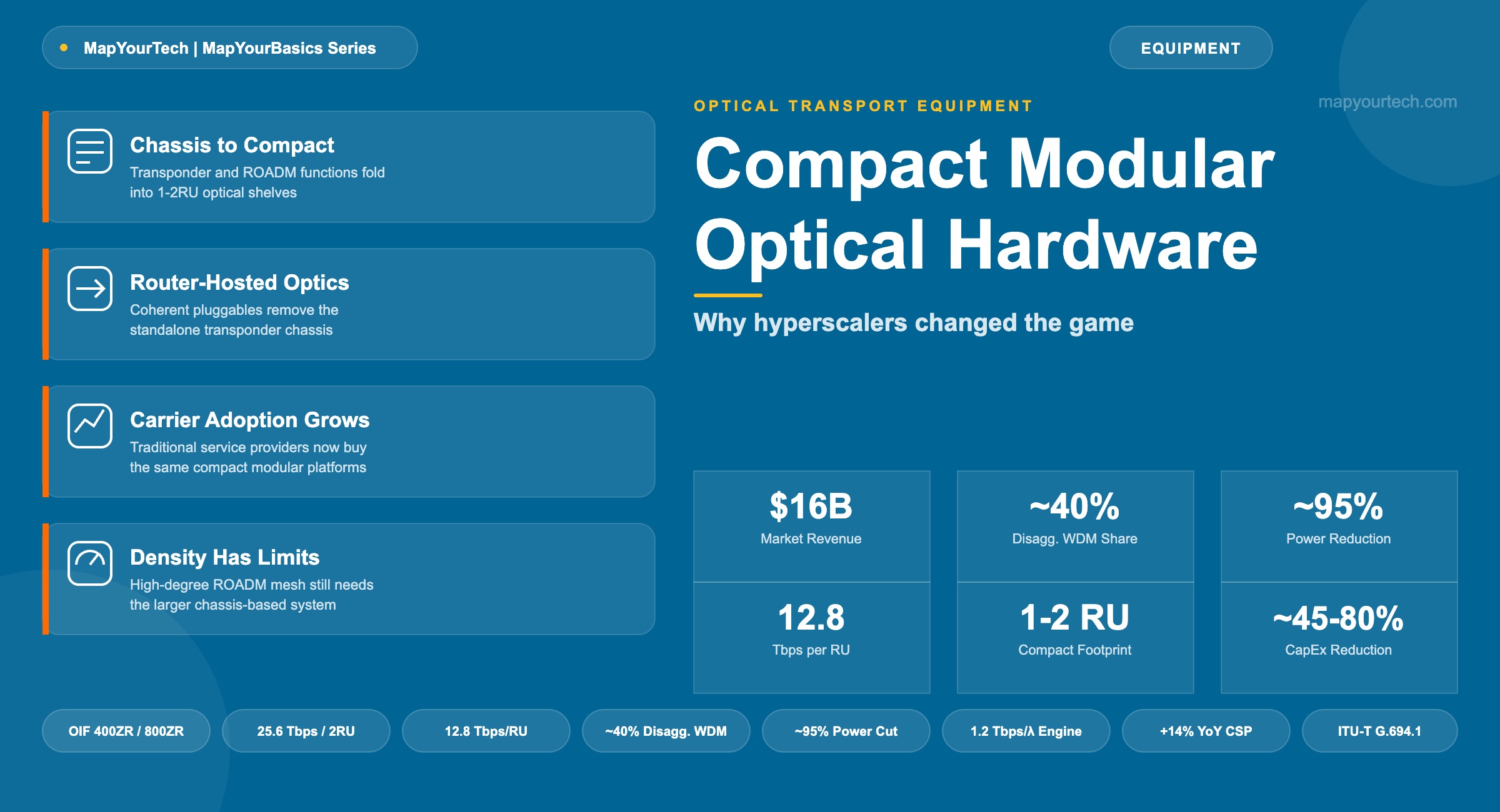
Cisco quantifies the router-hosted path in its own comparison of DCO-based Routed Optical Networking against a router-plus-muxponder-plus-ROADM baseline: roughly 45 to 80 percent lower capital cost, close to 95 percent lower power draw, and complete elimination of dedicated transponder/muxponder rack space (Cisco, vendor claim — the comparison basis is Cisco's own and results vary by deployment). The economics behind that power figure, and where they start to break down at higher line rates, are worked through in MapYourTech's power-per-bit case for router optics.
Rack Density (Tbps/RU) = Total Line-Side Capacity (Tbps) ÷ Rack Units Occupied (RU)
Practical Example — Ribbon's Apollo 9408 ships a vendor-stated 25.6 Tbps of line capacity in a 2RU chassis (Ribbon Communications, vendor claim): 25.6 Tbps ÷ 2 RU = 12.8 Tbps/RU. A chassis-based ROADM system spreads its aggregate capacity across amplifier shelves, degree cards, and fan trays in addition to transponder slots, so its usable capacity per occupied rack unit runs lower — the exact ratio depends on channel count and degree count and is not a fixed industry figure, which is why vendors publish total system capacity rather than a density number for chassis-based platforms.
Where this breaks: rack density improves only as long as the platform stays point-to-point or low-degree. Once a site needs eight or more ROADM degrees, colorless-directionless-contentionless (CDC) add/drop, and deep C-band-plus-L-band amplification, the wavelength-selective switch and amplifier count scale with degree count regardless of how compact the individual card is, and the density advantage narrows. This is the same boundary MapYourTech's guide to open line systems for multi-vendor coherent wavelengths describes when comparing closed, open, and fully disaggregated OLS architectures.
Design considerations for compact modular deployment include power budget per rack unit — dense platforms concentrate more heat into a smaller footprint, which can raise watts per rack unit even as total power drops — fiber and cable-slack management inside a 1 to 2RU shell, and the pay-as-you-grow economics Dell'Oro Group cites as a defining trait of the disaggregated model: operators add sleds or pluggables as traffic grows instead of pre-provisioning a full chassis. That growth-driven provisioning model is also why multi-vendor optical automation matters more in a disaggregated network than in a single-vendor chassis deployment, a topic covered in MapYourTech's optical network automation guide for professionals.
4. The Move Into Traditional Service Provider Networks
Optical Transport revenue reached $16 billion in 2025 and is forecast to grow 16 percent in 2026, crossing $18 billion for the first time since the year 2000, after a 20 percent year-over-year first quarter driven by both WDM systems and IPoDWDM ZR/ZR+ pluggables (Dell'Oro Group, analyst estimate). Disaggregated WDM — the transponder-unit, OLS, and IPoDWDM ZR/ZR+ segments that compact modular hardware belongs to — grew approximately 40 percent through 2025 and accounted for nearly 40 percent of total Optical Transport revenue in the first nine months of the year, against roughly 60 percent for large integrated systems (Dell'Oro Group, analyst estimate).
That growth was originally a hyperscaler story. Dell'Oro Group states that the idea of disaggregating the WDM network originated with cloud providers, and cloud and AI data-center buildouts still account for most of the market's recent bandwidth growth (Dell'Oro Group). But the same research tracks a second trend: non-DCI DWDM long-haul revenue — spending by traditional communication service providers building backbone capacity rather than hyperscaler interconnects — rose 14 percent year-over-year in the third quarter of 2025, which Dell'Oro Group reads as confirmation that carriers' post-2023 inventory correction is complete and that carrier bandwidth demand is growing again (Dell'Oro Group, analyst estimate). C-band-plus-L-band amplification, covered in MapYourTech's basics of C+L band DWDM systems, is one of the capacity levers carriers are reaching for as this spending resumes.
On the vendor side, the shift shows up as a widening supplier base. Alongside the market's top vendors by overall 2025 revenue share — Huawei, Ciena, Nokia, ZTE, and Cisco, in that order — Dell'Oro Group notes that 1Finity, Adtran, Cisco, and SmartOptics all gained market share specifically in the disaggregated segment through the first nine months of 2025 (Dell'Oro Group, analyst estimate), vendors whose customer base skews toward carriers and regional operators rather than the largest cloud providers alone. For data center interconnect specifically, the top three suppliers by revenue share in 2025 were Ciena, Nokia, and Cisco; for IPoDWDM ZR/ZR+ pluggables, the leading suppliers were Marvell and Cisco's Acacia business (Dell'Oro Group, analyst estimate).
| Platform | Vendor | Form Factor | Stated Capacity | Primary Target Segment |
|---|---|---|---|---|
| NCS 1001 | Cisco | 1RU compact point-to-point OLS (EDFA + PSM + OTDR modules) | Supports current ZR pluggable variants (vendor spec) | Hyperscaler and carrier DCI/metro |
| ONS-QDD-OLS | Cisco | QSFP-DD pluggable EDFA | 17.5 dBm output; 7–25 dB pre-amp gain; 3–25 dB booster gain (vendor spec) | Router-integrated amplification for Routed Optical Networking |
| Apollo 9408 / 9458 | Ribbon Communications | 2RU compact modular transport + OLS | 25.6 Tbps line capacity (vendor claim) | Large CSPs and webscale operators |
| GX Series | Nokia (ex-Infinera) | Sled-based compact modular chassis | Up to 1.2 Tbps per wavelength via ICE7 optical engine (vendor spec) | Metro, long-haul, and DCI |
| Waveserver | Ciena | Compact modular interconnect platform | High capacity, reduced power versus chassis systems (vendor description) | High-growth, bandwidth-intensive DCI |
Product positioning confirms the same shift. Ribbon markets its Apollo 9408/9458 compact modular platforms to "large communication service providers and webscale operators" in the same sentence (Ribbon Communications, vendor claim) — language that would have named only the second category five years earlier, before compact modular density and price points matured enough to compete for conventional carrier budgets too.
5. Where Compact Modular Fits — and Where It Doesn't
Compact modular hardware suits point-to-point DCI links, metro rings with a handful of ROADM degrees, and access or aggregation sites where rack space and power are the binding constraint rather than channel count. It is also the natural fit for IPoDWDM-based Routed Optical Networking designs — introduced in MapYourTech's basics of IP over DWDM — where the coherent optic already lives in the router and the remaining optical function (amplification, add/drop, monitoring) is exactly what a 1RU platform like the NCS 1001 or a pluggable EDFA like the ONS-QDD-OLS is built to deliver.
Chassis-based ROADM systems remain the better fit for high-degree mesh nodes, long-haul spans that need large EDFA or Raman gain budgets and wide optical signal-to-noise ratio (OSNR) margin, and any site requiring high port-count optical transport network (OTN) switching and sub-wavelength grooming — a function Ribbon still delivers through its separate Apollo 9900 OTN switching platform rather than folding it into the compact modular 9600 series (Ribbon Communications, vendor documentation).
AI-driven scale-across DCI is pushing a third category into the field in 2026: multi-rail inline amplifiers that pack many parallel EDFA rails into a shared rack unit, aimed at the hundred-plus-kilometer links now needed to connect GPU clusters across separate electrical grids. Coherent Corp., Ciena, Cisco, and Nokia all announced multi-rail products at OFC 2026 (Dell'Oro Group, industry observation), and Nokia's own multi-rail optical line system is scheduled for availability in the second half of 2026 (Nokia, vendor announcement). The trade-off is worth naming directly: sharing one pump laser or shelf across many rails removes redundant hardware, but it also means a single pump or shelf failure can degrade several rails at once — a correlated failure mode that per-rail chassis-based systems do not share. This scale-across pattern, and how it changes optical architecture more broadly, is covered in MapYourTech's piece on how AI is reshaping optical network architecture and transport hardware.
For network designers, the practical rule holds regardless of vendor: count ROADM degrees and OSNR budget first, then evaluate rack space and capital cost. Compact modular platforms win the second comparison consistently; they only win the first one in point-to-point and low-degree topologies.
6. Summary
Takeaway: Compact modular hardware did not just shrink optical transport equipment — it moved where transponder and line-system functions live, placing coherent optics directly in router faceplates and folding amplification, add/drop, and monitoring into 1 to 2RU shelves. Disaggregated WDM, the category Dell'Oro Group uses to track this shift, made up close to 40 percent of total optical transport revenue in the first nine months of 2025, and non-DCI long-haul spending — the traditional carrier segment — grew 14 percent year-over-year in the same period, evidence that a category built for hyperscaler DCI is now competing for conventional service-provider budgets too. The boundary has not moved for high-degree mesh nodes and long-haul gain budgets, where chassis-based ROADM systems still carry the engineering load.
References
- Dell'Oro Group — Optical Transport Quarterly Report, Dell'Oro Group.
- Optical Internetworking Forum — 400ZR Implementation Agreement, OIF.
- ITU-T G.694.1 — Spectral grids for WDM applications: DWDM frequency grid, ITU-T Study Group 15.
Sanjay Yadav, "Optical Network Communications: An Engineer's Perspective" – Bridge the Gap Between Theory and Practice in Optical Networking.
Related Articles on MapYourTech