Coherent vs Direct Detection: Key Differences
Why mixing a signal with a local oscillator before the photodiode ever sees it changed sensitivity, dispersion tolerance, and spectral efficiency — and made coherent detection the standard for long-haul DWDM transport.
1. Introduction
A photodiode cannot see phase. It converts optical power directly into current through a square-law response, and every direct-detection receiver built since the earliest fiber systems inherits that limitation — from legacy on-off-keyed links to today's 100 Gb/s-per-lane PAM4 links inside a data center. Coherent detection removes the limitation by mixing the incoming signal with a local-oscillator (LO) laser before detection, recovering amplitude, phase, and polarization together in the electrical domain. That single architectural change is why nearly every long-haul and metro DWDM system shipped since around 2010 uses coherent optics, while direct detection still dominates the shortest links inside the data center.
This article compares the two detection methods at the physical and system level: how each receiver is built, why coherent detection's sensitivity and spectral-efficiency advantages trace back to mixing with a strong local oscillator rather than to a better photodiode, and where the 2026 optical transport landscape — from 400ZR through the 1.6T coherent interfaces now under definition — draws the line between them. The goal is a working model of the trade-off, not a case for either technology: direct detection remains the correct engineering choice for a large share of optical links, and knowing why matters as much as knowing why coherent won everywhere else.
2. What Separates Coherent from Direct Detection
Direct Detection: Squaring the Field
A direct-detection receiver — also called intensity-modulation/direct-detection, or IM-DD — puts the incoming light straight onto a photodiode. The photocurrent is proportional to optical power, I = R·P, where R is the photodiode's responsivity in amps per watt. Squaring the optical field this way discards everything except intensity: phase and polarization never reach the electrical domain. Modulation for direct detection is therefore restricted to schemes that encode data purely in optical power — on-off keying historically, and four-level pulse-amplitude modulation (PAM4) in current 100G-per-lane systems, where each symbol carries 2 bits by selecting one of four discrete power levels.
Coherent Detection: Mixing with a Local Oscillator
A coherent receiver mixes the incoming signal with a second laser, the local oscillator, inside a 90-degree optical hybrid before detection. The hybrid splits the combined signal-plus-LO field into outputs phase-shifted relative to each other, and balanced photodetectors convert those into in-phase (I) and quadrature (Q) electrical signals for each of the two orthogonal polarizations — XI, XQ, YI, and YQ. Because the LO beats coherently against the signal field rather than against its own intensity, the resulting beat-note amplitude and phase track the signal's amplitude and phase directly. Four independent electrical signals now carry the full optical field: two quadratures, times two polarizations.
Building the Signal: The IQ Modulator
The transmit side needs matching complexity. A coherent transmitter uses a nested Mach-Zehnder IQ modulator: two child Mach-Zehnder modulators, one driven by in-phase data and one by quadrature data, combined with a 90-degree phase offset between the two arms. Driving each child modulator with a multilevel electrical waveform from a digital-to-analog converter (DAC) places the optical field at any point in the I-Q plane, which is how a single IQ modulator generates QPSK, 16-QAM, or 64-QAM constellations rather than the two amplitude levels a simple intensity modulator produces. A second IQ modulator — or a parallel pair, one per polarization — combined through a polarization multiplexer doubles the constellation again across the X and Y polarizations: dual-polarization QPSK (DP-QPSK) carries 4 bits per symbol, DP-16QAM carries 8 bits per symbol, and DP-64QAM carries 12 bits per symbol, all on a single wavelength.
3. Why Coherent Detection Wins on Sensitivity and Spectral Efficiency
The Sensitivity Mechanism
A direct-detection receiver's noise floor is normally set by the thermal (Johnson) noise of the transimpedance amplifier that follows the photodiode, not by the quantum shot noise of the light itself — thermal noise dominates unless an optical preamplifier such as an EDFA is added ahead of the photodiode. A coherent receiver reaches shot-noise-limited operation without needing a preamplifier: mixing the signal with a sufficiently strong local oscillator amplifies the beat-note power enough that shot noise generated by the LO itself, rather than the front-end electronics, becomes the dominant noise source. Once shot noise dominates, the receiver operates near the theoretical floor set by the quantized nature of light.
Shot-Noise-Limited Coherent Sensitivity (Theoretical Limit)
OSNR_QL = (ℜ × P_s) / (q × B)
ℜ = photodiode responsivity (A/W) · P_s = received signal power (W) · q = electron charge, 1.602×10⁻¹⁹ C · B = receiver electrical bandwidth (Hz). This is the theoretical quantum limit; a coherent receiver approaches it once local-oscillator power is high enough for LO shot noise to dominate the transimpedance amplifier's thermal noise — theoretical-limit figure.
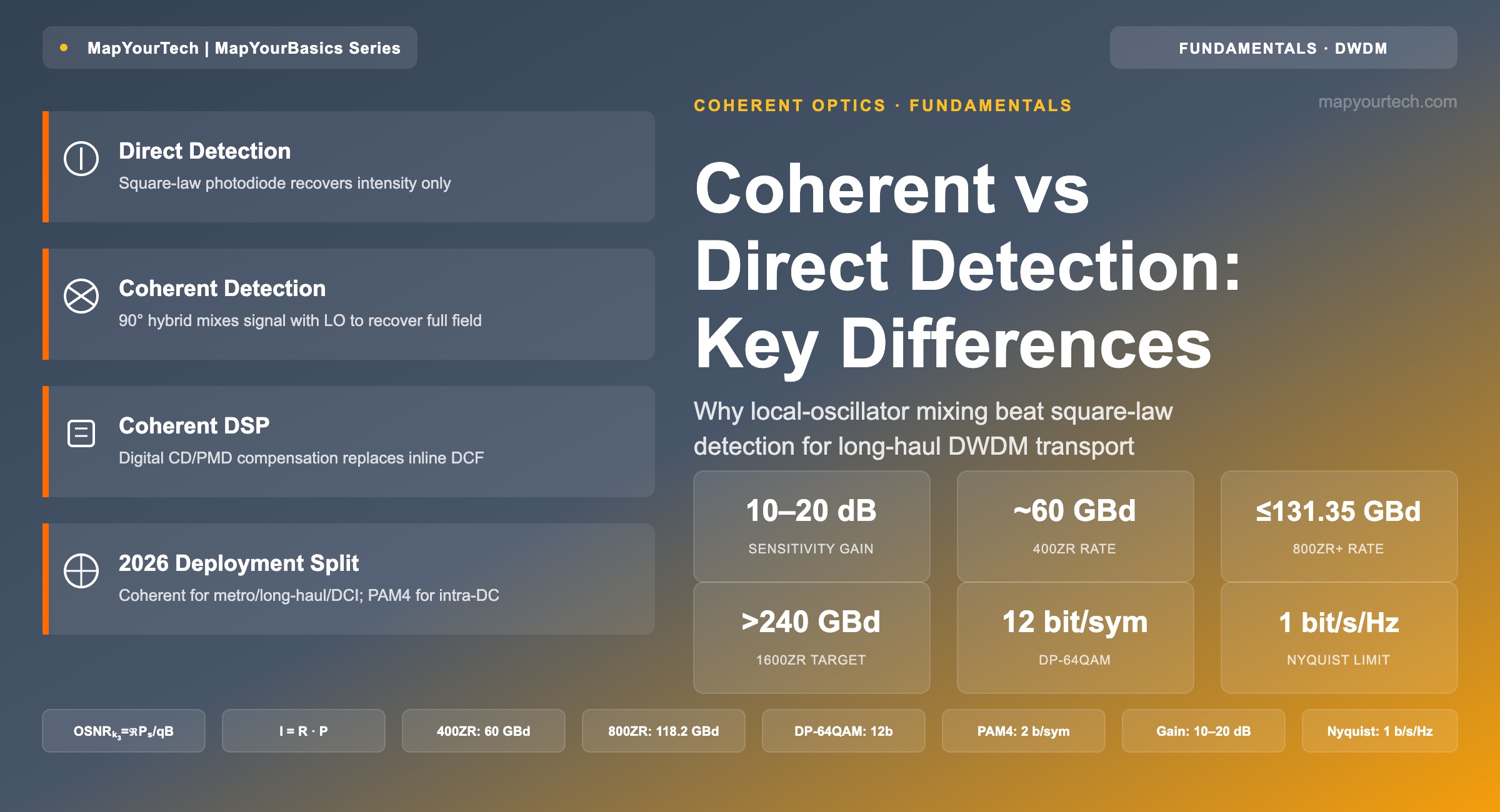
Comparative studies of shot-noise-limited coherent receivers against thermal-noise-limited direct-detection receivers commonly report a 10–20 dB sensitivity improvement for coherent detection — a literature-reported range rather than a fixed number, since the exact gain depends on LO power, photodiode responsivity, and receiver bandwidth. That sensitivity margin converts directly into either longer unregenerated reach or lower required launch power for a given reach, which is the largest single reason coherent detection displaced direct detection for long-haul transport once the DSP hardware to exploit it became available.
DSP: Compensation Moves from Fiber to Silicon
Recovering the full optical field means every linear fiber impairment that used to require optical hardware can instead be corrected as a filtering operation in the digital domain. A coherent DSP chain typically runs, in order: chromatic dispersion (CD) compensation using a frequency-domain filter sized to the link's accumulated dispersion; a polarization-mode dispersion (PMD) and polarization-dependent-loss equalizer, usually a multiple-input multiple-output (MIMO) adaptive filter that also reverses the random polarization rotation the signal picked up in the fiber; carrier-frequency-offset and carrier-phase-recovery loops that strip out the frequency difference between the LO and signal lasers and the phase noise of both; and soft-decision forward error correction (FEC) decoding. Because CD and PMD compensation happen digitally, coherent long-haul systems eliminated the external dispersion-compensating fiber (DCF) modules that direct-detection systems needed roughly every few spans — a link-engineering simplification, not just a receiver-sensitivity one. Direct-detection PAM4 receivers run a far shorter chain: a linear equalizer (feed-forward and decision-feedback, FFE/DFE) to correct residual bandwidth limitations and modest dispersion, followed by FEC. There is no phase or polarization information for that equalizer to act on, so it cannot compensate CD or PMD beyond a few hundred ps/nm — which is why direct-detection PAM4 links begin to show dispersion-driven eye closure at roughly 10 km on standard single-mode fiber unless the wavelength sits near the fiber's zero-dispersion point.
Nonlinear Behavior Diverges Too
Fiber nonlinearity behaves differently once the receiver becomes coherent. Direct-detection on-off-keyed systems are dominated by amplitude and timing jitter from four-wave mixing (FWM) and cross-phase modulation (XPM), and dispersion-managed links — which deliberately alternate positive- and negative-dispersion fiber to limit temporal spreading — are an effective way to suppress that jitter. Coherent systems carry information in phase and polarization as well as amplitude, so phase-sensitive nonlinearities such as cross-polarization modulation become significant, and dispersion management stops being optimal: letting chromatic dispersion accumulate unmanaged actually decorrelates WDM channels faster, which reduces FWM and XPM efficiency, while the coherent DSP cleans up the resulting linear dispersion afterward. That is one reason uncompensated spans with digital dispersion compensation, rather than inline dispersion-managed links, became the default long-haul architecture once coherent detection took over.
Spectral Efficiency: More Bits per Hertz
Binary modulation formats are capped at 1 bit/s/Hz per polarization — the Nyquist limit for a single amplitude or phase decision per symbol. Multilevel formats break that ceiling: an M-ary format carries log₂(M) bits per symbol, so 16-QAM (M = 16) carries 4 bits/symbol and 64-QAM (M = 64) carries 6 bits/symbol, before the ×2 multiplier from dual-polarization multiplexing. Direct detection can adopt multilevel formats too — PAM4 carries 2 bits/symbol — but only in the amplitude dimension, since phase is unavailable to it. Coherent detection gets a second, independent dimension in phase and a third in polarization to pack bits into, which is why achievable spectral efficiency in coherent DWDM systems runs several times higher than direct detection at a comparable symbol rate. For the full Shannon-Hartley treatment of how symbol rate, SNR, and bits per symbol combine into channel capacity, see design your link, learn the Shannon limit.
| Parameter | Direct Detection (IM-DD) | Coherent Detection |
|---|---|---|
| Detected quantity | Optical power only (|E|²) | Full field: amplitude, phase, polarization |
| Local oscillator | Not used | Required, mixed via 90° hybrid |
| Typical modulation | OOK, PAM4 | DP-QPSK, DP-16QAM, DP-64QAM |
| Bits/symbol (incl. dual pol.) | 1 (OOK), 2 (PAM4) | 4 (QPSK) to 12 (64QAM) |
| Chromatic dispersion compensation | Optical (DCF) or limited electronic FFE | Full digital compensation in DSP |
| PMD / PDL tolerance | Minimal, largely uncompensated | Digital MIMO equalization |
| WDM channel selection | Optical filters (thin-film, WSS) | Electrical filtering via tunable LO |
| Receiver front end | Photodiode + TIA | 90° hybrid + 4 balanced PDs + 4 ADCs |
| Typical unamplified reach | ~10 km before CD-limited eye closure (std. SMF) | Not CD-reach-limited; amplified reach to thousands of km |
| Primary 2026 use case | Intra-data-center links (≤10 km) | Metro, long-haul, submarine, DCI >80 km |
4. From 40 Gbaud to 240 Gbaud: Coherent's Path to Becoming Standard
The DSP hardware needed to run the compensation chain above did not exist commercially until CMOS scaling caught up with it. The industry's first commercial coherent transport system, announced by Nortel in March 2008, paired DP-QPSK modulation with a real-time DSP application-specific integrated circuit (ASIC) to deliver 40 Gb/s per wavelength at roughly 10 GBaud per polarization — a vendor-reported historical milestone widely credited with starting the shift away from direct detection in long-haul transport. Every generation since has scaled baud rate and modulation order together: the OIF's 400ZR interoperability specification standardizes DP-16QAM at approximately 60 GBd; the 800ZR Implementation Agreement, released in October 2024, standardizes 118.2 GBd for Ethernet framing, while 800ZR+ under the Open ROADM MSA runs up to 131.35 GBd using probabilistic constellation shaping; and the OIF's 1600ZR project, still under definition as of 2026, targets a symbol rate beyond 240 GBd. Embedded, non-pluggable coherent line systems run ahead of the pluggable roadmap — one vendor has reported a 200 GBd design for an embedded coherent modem, a figure not constrained by a pluggable module's power envelope the way 800ZR and 1600ZR are. See 800G ZR/ZR+ coherent optics for the full transmit and receive signal path at 118 GBd.
View chart data as a table
| Interface | Symbol rate | Evidence class |
|---|---|---|
| 400ZR | ~60 GBd | Standard-specified (OIF) |
| 800ZR | 118.2 GBd | Standard-specified (OIF, Oct 2024) |
| 800ZR+ | ≤131.35 GBd | Standard-specified (Open ROADM MSA) |
| Embedded coherent modem | 200 GBd | Vendor claim (non-pluggable) |
| 1600ZR (target) | >240 GBd | In-development target (OIF) |
5. Where Direct Detection Still Wins in 2026
Coherent detection carries essentially all metro, regional, long-haul, and submarine DWDM traffic in 2026, and it has taken over data-center-interconnect (DCI) links from roughly 80 km upward through the 400ZR, 800ZR, and OpenZR+ family of pluggable interfaces. The OIF's ZR standards specifically target that market because they fit a coherent DSP and optics into the same QSFP-DD or OSFP form factor and power envelope as a direct-detection module, removing the cost gap that used to confine coherent optics to dedicated transponder chassis. The full technology-selection picture — including where the reach boundary sits and how to size it for a specific deployment — is covered in coherent vs. direct-detect transceivers: application boundaries and technology selection.
Direct detection still wins inside the data center. For reaches under roughly 10 km, PAM4 IM-DD modules — 400GBASE-DR4 and -FR4, and their 800G and forthcoming 1.6T successors — cost less, consume less power, and need no local-oscillator laser, 90° hybrid, or coherent DSP ASIC. Component count and power draw both scale directly with system complexity, and a leaf-spine fabric with tens of thousands of links makes every watt and every dollar per port matter more than a sensitivity margin the link does not need. See PAM-4 IM/DD systems for short-reach data center interconnects for the complete engineering reference on that architecture, and QSFP-DD optical transceivers for the module family that carries most of it.
That crossover point is not fixed. As 1.6T and 3.2T coherent DSPs bring per-bit power down while PAM4 lane counts and equalizer complexity climb at similar speed, several optical vendors expect coherent detection to become cost-competitive at shorter DCI reaches over the next few years — the ongoing progression toward higher-order modulation and tighter spectral-efficiency per wavelength described in C+L band DWDM systems and carried operationally through IP-over-DWDM architectures is part of that trend. Pure intra-data-center links measured in tens or hundreds of meters, however, remain direct detection's ground for the foreseeable future — the physical distance is simply too short for coherent detection's reach and dispersion advantages to pay for its extra component count.
6. Summary
Direct detection recovers optical power only; coherent detection recovers the full field — amplitude, phase, and polarization — by mixing the signal with a local-oscillator laser ahead of detection. That extra information is what lets a coherent DSP compensate chromatic dispersion and PMD digitally, removes the external dispersion-compensation hardware direct-detection long-haul links used to need, and opens phase and polarization as extra dimensions for packing bits into a symbol. The resulting sensitivity margin — commonly reported in the 10 to 20 dB range against thermal-noise-limited direct detection — and the multi-bit-per-symbol modulation formats it enables are why coherent optics became the standard for every DWDM link longer than a data-center campus. Direct detection keeps its place at the shortest reaches, where lower component count and power draw outweigh a sensitivity advantage the link does not need.
Takeaway: Every advantage coherent detection has — sensitivity, dispersion tolerance, spectral efficiency — traces back to one design choice: mixing the signal with a local oscillator before the photodiode ever sees it. Everything downstream, from the 90° hybrid to the DSP's FEC decoder, exists to extract and use the phase information that choice recovers.
Related Articles on MapYourTech