DCI Architectures: Metro, Regional, and Long-Haul Tiers
How OSNR budgets and fiber propagation delay set the reach boundary for each data center interconnect tier — and which pluggable coherent option fits inside it.
1. Introduction
Hyperscalers spreading AI training clusters across multiple campuses are shipping coherent pluggables into router ports by the hundred thousand. Cignal AI's 2026 forecast puts combined 800ZR and 800ZR+ shipments above 200,000 units this year, a market-research figure that reflects how central data center interconnect (DCI) has become to AI infrastructure economics — this is a vendor-analyst forecast, not a measured shipment count, and actual volumes will confirm or revise it through the year.
DCI is the optical transport layer that links data center sites: two buildings on the same campus, two availability zones in the same metro region, or two continents on opposite ends of a submarine cable. Vendors and operators group these links into three tiers — metro, regional, and long-haul — and the boundaries between them are not marketing labels. They fall out of two physical constraints: how much optical signal-to-noise ratio (OSNR) a coherent receiver needs to close a link of a given length, and how much propagation delay an application can tolerate before its consistency model breaks.
This article works through both constraints, maps them to the pluggable coherent options available in 2026, and walks a worked OSNR calculation for a representative regional link.
2. What Defines a DCI Tier
Metro DCI exists because of a single application requirement: synchronous replication across availability zones (AZs) within a region. When a write has to be acknowledged by two or more AZs before the application considers it durable, the round-trip latency at the application layer typically has to stay within a few milliseconds. That budget gets consumed by switching delay, serialization delay, smartNIC processing, buffering, and application read/write time before the optical fiber even enters the picture — leaving the fiber segment a budget of only a few hundred microseconds one way. That constraint, not an arbitrary distance rule, is what has kept metro AZ separations under roughly 100 km industry-wide.
Regional DCI relaxes that constraint. Once an application accepts asynchronous replication or an active-active model with eventual consistency, the fiber segment can extend to 100–500 km without breaking the application's correctness guarantees. This is the domain where amplified, multi-span DWDM links with reconfigurable optical add-drop multiplexers (ROADMs) become standard, because a single unamplified span can no longer close the link budget.
Long-haul DCI covers everything beyond regional reach — disaster-recovery pairs, backbone links between metro rings, and increasingly, direct AI-cluster interconnects that hyperscalers are willing to run over hundreds to low thousands of kilometers because the alternative, building new compute in every metro, costs more than the extra fiber and amplification.
| Tier | Typical Distance | Amplification & Line System | Typical Pluggable / Module Class | One-Way Delay* | Typical OSNR Target** |
|---|---|---|---|---|---|
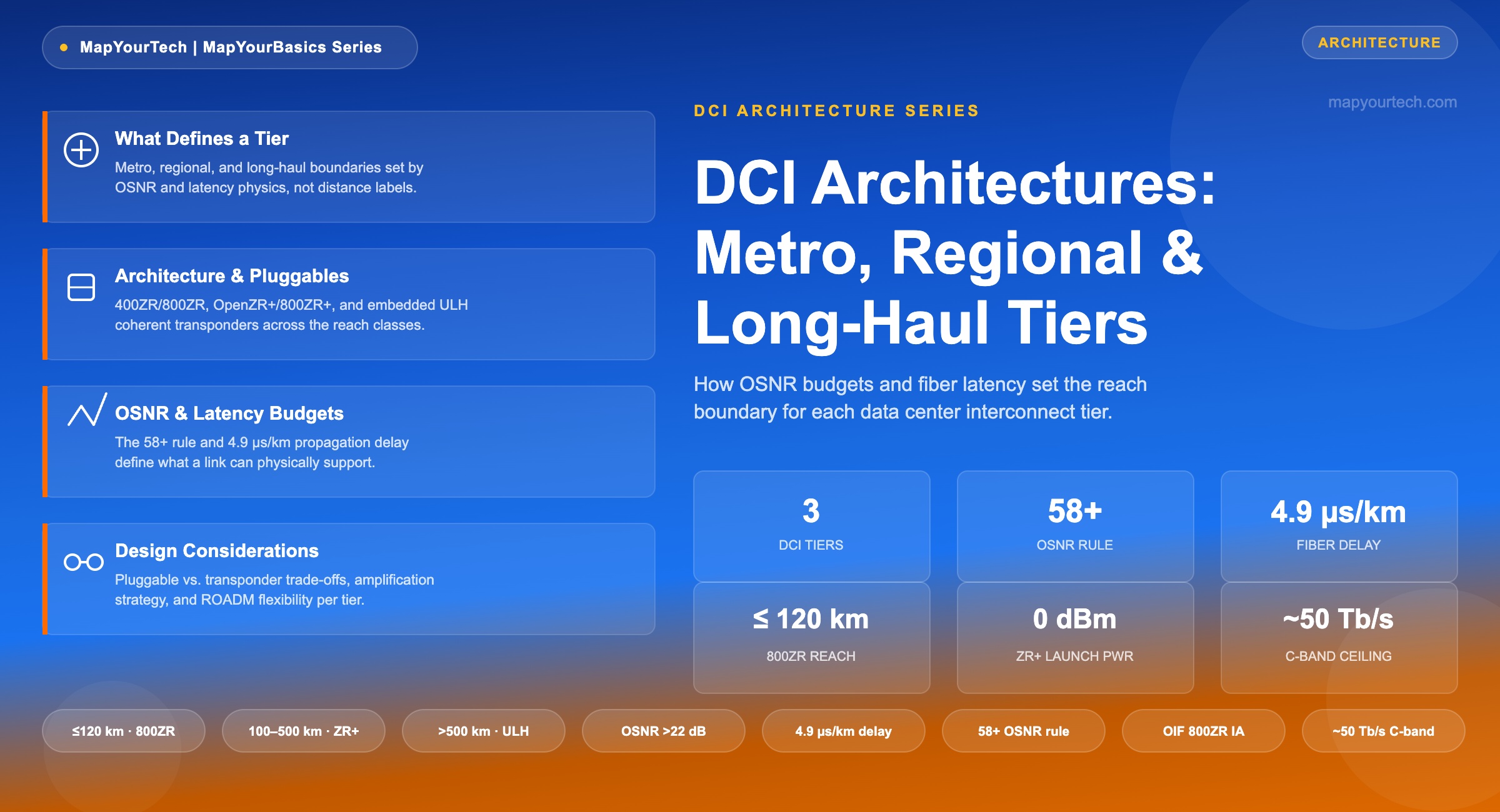
| Metro | ≤ 120 km | Unamplified or single EDFA span | 400ZR / 800ZR (OIF IA) | 0.2–0.6 ms | > 22 dB |
| Regional | 100–500 km | 2–5 EDFA spans + CDC ROADM | OpenZR+ / 800ZR+ | 0.5–2.5 ms | 18–20 dB |
| Long-haul | > 500 km, to ~1,700 km class | Multi-span EDFA + Raman, C+L band | Embedded ULH coherent / extended 800ZR+ | 2.5–8+ ms | 15–18 dB |
*Theoretical value from fiber propagation physics, computed at a group index of ~1.468 for standard G.652 fiber, one way. **Practitioner target ranges drawn from DWDM link-engineering practice — not a formal ITU-T figure; always confirm against the specific module's published OSNR sensitivity table.
Takeaway: The metro/regional/long-haul labels describe a latency budget and an OSNR budget, not a fixed kilometer count. A metro link engineered with extra amplification can stretch past 120 km, and a well-shaped regional link can beat the 500 km mark — what changes is whether the application on top can still tolerate the round trip.
3. Architecture and Pluggable Coherent Options
Every DCI link, regardless of tier, is built from the same building blocks: a coherent transmitter (pluggable or external transponder), a multiplexer that combines wavelengths onto the fiber, optical amplification to overcome span loss, a ROADM where the link needs add/drop flexibility, and a coherent receiver with digital signal processing (DSP) to undo chromatic dispersion, polarization effects, and nonlinear impairments. What differs across tiers is how many of those blocks are present and how much reach and OSNR margin each pluggable class was designed to deliver.
The OIF released the 400ZR Implementation Agreement first, establishing a fixed, interoperable specification for single-span, unamplified or lightly amplified DCI over roughly 80 km. The OIF followed with the 800ZR Implementation Agreement in October 2024, doubling capacity through a higher baud rate — around 118 Gbaud against 60 Gbaud for 400ZR — a 4-nanometer CMOS DSP, and 112G PAM4 electrical interfaces on the host side. Both specifications target the metro tier: a pluggable that plugs into a router or switch port and closes an 80–120 km link without a dedicated transport chassis.
OpenZR+ and 800ZR+ extend that same QSFP-DD or OSFP form factor into the regional tier. They add rate flexibility, a stronger forward error correction (FEC) code, probabilistic constellation shaping (PCS), and wavelength tunability across the ROADM-based amplified networks that ZR alone cannot serve. Coherent Corp's public data sheet for its 800G ZR/ZR+ module states a transmit output power of −7 dBm in OIF 800ZR mode and 0 dBm in the higher-power, ROADM-based line-system mode — the extra 7 dB of launch power is a direct contributor to the additional OSNR margin that regional and long-haul spans need.
Beyond regional reach, two paths coexist in 2026: extended-reach 800ZR+ pluggables that vendors are qualifying to roughly 1,000–1,700 km on amplified C+L-band systems, and embedded ultra-long-haul (ULH) coherent transponders — the Gen120C-class 400G-ULH modules that Cignal AI and Nokia both describe as the choice for hyperscalers who plan to skip an 800G pluggable generation and go straight to 1.6T. Looking ahead, the OIF's 1600ZR and 1600ZR+ digital baseline was approved in the fourth quarter of 2025, with the Implementation Agreement targeted for the third quarter of 2026 — the next milestone this tier structure will need to absorb.
For a deeper look at the 800ZR/ZR+ specification set — baud rates, FEC overhead, and form-factor trade-offs — see 800G ZR/ZR+ Coherent Optics, and for how pluggables compare against embedded transponders on link distance and power, see Coherent vs Direct-Detect Transceivers.
4. OSNR and Latency: The Two Budgets That Set Reach
Every DCI tier boundary reduces to two calculations: does the receiver see enough OSNR to close the link at the required bit-error rate, and does the round-trip delay fit inside the application's consistency budget. Neither calculation is exotic, and both are worth working through by hand before trusting a path-computation tool.
OSNR(dB) ≈ 58 + Ptx − Lspan − NF − 10·log10 (N)
t = (ng / c) × L ≈ 4.9 µs/km
An operator needs to connect two data centers 300 km apart using 800ZR+ pluggables over three amplified 100 km spans and one CDC ROADM. Fiber attenuation is taken at 0.25 dB/km with a 2 dB connector/patch-panel allowance per span — a commonly used conservative planning figure — giving a per-span loss of 100 × 0.25 + 2 = 27 dB. The EDFA noise figure is 5 dB, and the pluggable runs in its 0 dBm high-power, ROADM-based mode, per the vendor-published output-power figure cited above.
Applying the OSNR formula: 58 + 0 − 27 − 5 − 10·log10(3) = 58 − 32 − 4.8 ≈ 21.2 dB delivered OSNR. Vendor-published sensitivity tables for DP-16QAM-class 800ZR+ operation at this reach typically call for roughly 18–21 dB required OSNR before FEC, so a 3 dB design margin on top of that pushes the target to 21–24 dB — leaving this design tight to marginal. The fix, in order of preference, is usually to shorten the worst span, drop the EDFA noise figure below 5 dB, or fall back to a lower-order flexible modulation mode that trades data rate for OSNR headroom.
Checking the latency side of the same link: 300 km × 4.9 µs/km ≈ 1.5 ms one-way, or about 3 ms round trip — well outside the sub-millisecond range synchronous replication needs, confirming this link belongs in the regional tier serving asynchronous or active-active workloads, not synchronous AZ pairing.
The theoretical ceiling behind all of this is the Shannon capacity limit, C = B·log2(1+SNR), which caps how much information a channel of a given bandwidth and signal-to-noise ratio can carry without error. For a single C-band fiber pair, that ceiling sits near 50 Tb/s using 16QAM-class modulation at practical OSNR margins; adding the L-band roughly doubles it. As of 2026, commercial 800G systems running 64–80 channels across C+L bands are delivering roughly 25–40 Tb/s per fiber pair — on the order of half the theoretical ceiling, which is the gap probabilistic constellation shaping and higher-baud DSP generations continue to close.
For a full derivation of the OSNR budget with additional worked examples across metro, long-haul, and submarine reach classes, see OSNR Fundamentals, and for the Shannon-limit context behind current C+L deployments, see Design Your Link, Learn the Shannon Limit.
5. Design Considerations Across the Three Tiers
Choosing a pluggable-based IP-over-DWDM (IPoDWDM) architecture over a dedicated transport chassis is the first fork every DCI design hits, and the answer changes by tier. Coherent Corp's public commentary places over 70% of coherent bandwidth deployed in 2024 in pluggable form, a share Cignal AI expects to keep growing as AI drives DCI demand — a vendor/analyst estimate worth treating as directional rather than exact.
For metro links, pluggables win clearly: lower cost per bit, lower power per port, and no separate transport shelf to rack, power, and manage. For regional and long-haul links the trade-off narrows. A pluggable's OSNR budget is fixed by its form factor's thermal and power envelope — a QSFP-DD module measures roughly 78 × 18 × 9 mm and has to fit a coherent DSP, laser, and modulator inside that volume, which limits how much launch power and how many amplification stages the design can assume. External embedded transponders carry more power budget and support tighter FEC and multi-span aggregation, which is why they remain the default choice past roughly 1,000 km, even as extended-reach 800ZR+ closes part of that gap.
Amplification and Band Strategy
Metro spans generally close on EDFA gain alone. Regional and long-haul designs add Raman amplification on the highest-loss spans to lift the effective span budget before the next EDFA site, and increasingly extend into the L-band to add capacity without new fiber. A C+L system does not simply double C-band capacity: L-band EDFAs carry a different gain profile and typically a higher noise figure than C-band units, so a mixed-band regional or long-haul design needs a separate OSNR budget calculation per band rather than one shared number.
ROADM Flexibility
Metro point-to-point links can run without a ROADM at all. Regional and long-haul networks depend on colorless, directionless, and contentionless (CDC) ROADMs so that any wavelength can add or drop at any port in any direction without a truck roll — each ROADM node in the path adds insertion loss (typically several dB), which has to be folded into the span-loss term of the OSNR budget above, not treated as a separate line item.
Engineering callout: Router and switch chassis were not originally designed to dissipate coherent-DSP-class heat in every port. An 800ZR+ pluggable in ROADM-based high-power mode draws meaningfully more thermal budget than a client-side transceiver, and dense line cards hosting multiple coherent pluggables need airflow and power-supply headroom verified against the chassis vendor's coherent-optics support matrix before a regional or long-haul IPoDWDM design is finalized — this is a system-integration constraint, not an optics-only one.
Beyond 2026, the industry's own roadmap shows where these tier boundaries move next. OIF ran its largest interoperability showcase to date at OFC 2026, with roughly 40 member companies demonstrating 400ZR, 800ZR, and multi-span coherent interoperability side by side, while the 1600ZR/ZR+ Implementation Agreement targeted for the third quarter of 2026 will bring the same tier logic — OSNR budget against reach, latency budget against application — to the next pluggable generation. The tiers will not disappear; the kilometer numbers attached to them will keep shifting as baud rate, FEC gain, and launch power improve.
For the architecture-level trade-offs between pluggable IPoDWDM and traditional transponder-based transport across a full network, see IP over DWDM: A Complete Architecture Walkthrough, and for the engineering reasons behind the 0 dBm high-power pluggable trend referenced above, see 0dBm Transceivers: Key Takeaways. For multi-vendor open line system practice underpinning regional and long-haul ROADM design, see Open Line Systems: Multi-Vendor Coherent Wavelengths, and for the C+L band planning details touched on above, see Basics of C+L Band DWDM Systems. Channel-grid and spectral-efficiency background is covered in ITU-T G.694.1 DWDM Channel Grid, mixed-rate line planning in Mixed Channel Rate Planning on DWDM Line Systems, spectral guard-band trade-offs in Guard Band Optimization and Design, and future C+L+S band expansion in Future Optical Bands for Fiber Communication.
6. Summary
The metro, regional, and long-haul DCI tiers are defined by two physical budgets working together: OSNR, which sets how far a coherent signal can travel through amplified spans before the receiver runs out of margin, and propagation delay, which sets how far an application's consistency model can stretch before synchronous replication becomes impossible. Metro DCI (≤ 120 km) runs on 400ZR/800ZR pluggables over unamplified or lightly amplified single spans and supports synchronous AZ replication. Regional DCI (100–500 km) runs on OpenZR+/800ZR+ over multi-span amplified, ROADM-based networks and supports asynchronous and active-active workloads. Long-haul DCI (beyond 500 km, into the 1,000–1,700+ km class) runs on embedded ULH coherent or extended-reach 800ZR+ over hybrid EDFA-Raman, C+L-band systems and serves disaster recovery and cross-region AI cluster interconnects.
Takeaway: Before naming a link "metro" or "long-haul," run both numbers — the 58+ OSNR estimate against the module's published sensitivity table, and the 4.9 µs/km propagation delay against the application's replication model. The tier label should follow from that math, not the other way around.
References
- ITU-T Recommendation G.694.1 — Spectral grids for WDM applications: DWDM frequency grid, ITU-T Study Group 15.
- OIF-800ZR-01.0 — 800ZR Coherent Interface Implementation Agreement, Optical Internetworking Forum.
- ITU-T Recommendation G.698.2 — Amplified multichannel DWDM applications with single-channel optical interfaces, ITU-T Study Group 15.
Sanjay Yadav, "Optical Network Communications: An Engineer's Perspective" — Bridge the Gap Between Theory and Practice in Optical Networking.
Related Articles on MapYourTech